Total lunar eclipse next week, not visible in US
June 11, 2011 By ALICIA CHANG , AP Science Writer

Total lunar eclipse next week, not visible in US (AP)

Enlarge

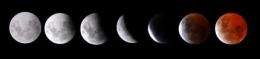
FILE In this March 4,2007 file photo showing a full moon is eclipsed by the earth's shadow in this seven pictures combination, from left, seen in Nairobi, Kenya. Mark your calendars. This year's first total eclipse of the moon will last unusually long, a rare celestial treat for a wide swath of the globe. Except if you're in the United States and Canada. But if you're in eastern Africa, central Asia, Middle East and western Australia, you should be able to view the entire lunar spectacle if the weather cooperates. Total lunar elipse will occur on June 15. (AP Photo/Akmal Rajput,File)

(AP) -- The year's first total eclipse of the moon will last an unusually long time, a rare celestial treat for a wide swath of the globe.

Except if you're in the United States and Canada. North America will be left out of Wednesday's lunar spectacle, which will be visible from start to finish from eastern Africa, central Asia, the Middle East and western Australia - weather permitting.

The period when Earth's shadow completely blocks the moon - known as totality - will last a whopping 1 hour and 40 minutes. The last time the moon was covered for this long was in July 2000, when it lasted 7 minutes longer than that.

The normally glows from reflected sunlight. A occurs when the moon glides through the long shadow cast by the Earth and is blocked from the sunlight that illuminates it.

As the moon plunges deeper into the Earth's shadow, the disk will appear to gradually change color, turning from silver to orange or red. This is because some indirect sunlight still reaches the moon after passing through the Earth's atmosphere, which scatters blue light. Only red light strikes the moon, giving it an eerie crimson hue.

It's difficult to predict the exact shade the moon will take, which will depend on how much dust and clouds are in the atmosphere during the eclipse.

Since the moon will pass close to the center of the Earth's shadow, the total eclipse phase will be longer than usual, said NASA eclipse expert Fred Espenak at the Goddard Space Flight Center in Maryland.

The entire eclipse will last a little over 5 1/2 hours. Observers in Europe will miss the first part of the show because it will occur before the moon rises. Eastern Asia and eastern Australia won't catch the final stages, which will happen after the moon sets. Portions of South America will be able see the moon entirely shrouded.

Unlike solar eclipses, are safe to watch with the naked eye.

Keith Gleason, who runs the Sommers-Bausch Observatory in Boulder, Colo., is disappointed that he will not have a ringside seat to the upcoming eclipse. The last total lunar eclipse visible from the U.S. occurred on Dec. 21, 2010, which coincided with winter solstice and was widely observed. Some 1,400 people showed up for a viewing party at the observatory.

"We had an absolutely glorious time," he said.

The next total lunar eclipse will fall on Dec. 10 with best viewing from Asia and Australia. The will be completely blotted out for 51 minutes. Only parts of the U.S. including Hawaii and the Pacific Northwest will catch a glimpse.

The rest of the continental U.S. will have to wait until April 15, 2014 to witness a total lunar eclipse.

More information: Eclipse information: http://eclipse.gsfc.nasa.gov/eclipse.html

©2011 The Associated Press. All rights reserved. This material may not be published, broadcast, rewritten or redistributed.

4.8 /5 (4 votes)  

Rank 4.8 /5 (4 votes)
Relevant PhysicsForums posts
  • revamping general concept and cosmological principle
    createdMay 25, 2012
  • Transiting Exoplanet Light Curve
    createdMay 25, 2012
  • Math behind Theoretical Physics
    createdMay 24, 2012
  • Do we know whats at the center of galaxies yet?
    createdMay 23, 2012
  • Structure of the Milky Way?
    createdMay 20, 2012
  • What would it take to terraform Pluto and Charon?
    createdMay 19, 2012
  • More from Physics Forums - General Astronomy

More news stories

Sophisticated simulations predict future warming

The chances of our planet being hit by a global warming of 3 degrees Celsius by 2050 is as likely as it being hit by an increase of 1.4 degrees, new research shows. Presented in the journal Nature Geoscience, the British study ...

Space & Earth / Earth Sciences

created May 22, 2012 | popularity 4.4 / 5 (9) | comments 51

Dragon arrives at space station in historic 1st (Update 2)

The privately bankrolled Dragon capsule made a historic arrival at the International Space Station on Friday, triumphantly captured by astronauts wielding a giant robot arm.

Space & Earth / Space Exploration

created May 25, 2012 | popularity 5 / 5 (10) | comments 19

Kyoto Protocol architect 'frustrated' by climate dialogue

UN climate talks are going nowhere, as politicians dither or bicker while the pace of warming dangerously speeds up, one of the architects of the Kyoto Protocol told AFP.

Space & Earth / Environment

created May 23, 2012 | popularity 3.7 / 5 (7) | comments 39

Aliens don't want to eat us, says former SETI director

Alien life probably isn’t interested in having us for dinner, enslaving us or laying eggs in our bellies, according to a recent statement by former SETI director Jill Tarter.

Space & Earth / Space Exploration

created May 25, 2012 | popularity 4.4 / 5 (13) | comments 37

What's the big deal about private space launches?

(AP) -- The first private spaceship is headed to the International Space Station. Some questions and answers about the cargo mission by Space Exploration Technologies, known as SpaceX:

Space & Earth / Space Exploration

created May 22, 2012 | popularity 5 / 5 (6) | comments 32


Nvidia trumpets Tegra 3 phone design wins for 2012

(Phys.org) -- Nvidia’s competitive war paint has a name, Tegra 3. On the heels of Nvidia announcements about lowering costs of its Tegra 3 processors and Nvidia-enabled tablets running Android Ice Cream ...

Browser wars flare in mobile space

The browser wars are heating up again, but this time the fight is for dominance of the mobile Internet.

Scientist: Evolution debate will soon be history

(AP) -- Richard Leakey predicts skepticism over evolution will soon be history. Not that the avowed atheist has any doubts himself.

Dell tablet leak: 10.1-inch display, two-battery choice

(Phys.org) -- Headline after headline talks about vendors’ tablets in the wings as likely number-one contenders for the iPad. Such claims have justifiably been taken with a grain of salt, considering ...

Keep food safety in mind this memorial day weekend

(HealthDay) -- Picnics, parades and cookouts are as much a part of Memorial Day weekend as tributes to the United States' war veterans.

Family history of Alzheimer's affects functional connectivity

(HealthDay) -- Cognitively normal individuals with a family history of late-onset Alzheimer's disease (AD) may display lower resting state functional connectivity in the default mode network (DMN) of the brain, ...