Space debris a growing problem
June 28, 2011 by Richard Ingham

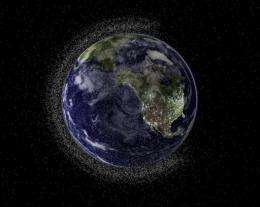
Illustration of swarms of space debris in Low Earth Orbit (LEO)

Enlarge

This handout illustration image created by Australia's Electro Optic Systems (EOS) aerospace company shows a view of the Earth from geostationary height depicting swarms of space debris in Low Earth Orbit (LEO). A scare triggered by orbital debris that on Tuesday came within a couple of hundred metres (yards) of the International Space Station (ISS) sheds light on an acutely worsening problem.

A scare triggered by orbital debris that on Tuesday came within a couple of hundred metres (yards) of the International Space Station (ISS) sheds light on an acutely worsening problem.

Millions of chunks of metal, plastic and glass are whirling round Earth, the garbage left from 4,600 launches in 54 years of space exploration.

The collision risk is low, but the junk travels at such high speed that even a tiny shard can cripple a satellite costing tens of millions of dollars.

Around 16,000 objects bigger than 10 centimetres (four inches) across are tracked by the US Space Surveillance Network, according to NASA's specialist newsletter.

There are around 500,000 pieces between one and 10 cms (half and four inches), while the total of particles smaller than one centimetre (half an inch) "probably exceeds tens of millions," NASA says elsewhere on its website.

The rubbish comes mainly from old satellites and upper stages of rockets whose residual fuel or other fluids explode while they turn in orbit. As the junk bumps and grinds, more debris results.

Another big source, though, is a Chinese , Fengyun-1C, which China destroyed in a test of an anti-satellite weapon in 2007.

Debris specialists and satellite operators were incensed. At a stroke, it helped increase the tally of large debris by more than a third.

In May 2009, a 10-cm (four-inch) chunk from Fengyun-1C passed within three kilometres (1.8 miles) of the US , prompting plans for evasive manoeuvres that proved to be unneeded.

Four known collisions have occurred between tracked objects, France's National Centre for Space Studies (CNES) says.

In 1991, a Russian navigation satellite, Cosmos 1991, collided with debris from a defunct Russian satellite, Cosmos 926, although this event only came to light in 2005.

In 1996, a fragment from an exploded Ariane rocket launched in 1986 damaged a French spy , Cerise.

In 2005, the upper stage of a US Thor launcher hit debris from a Chinese CZ-4 rocket.

And in 2009, a disused Russian military satellite, Cosmos 2251, smacked into a US Iridium communications satellite, generating a debris cloud in its own right.

In low Earth orbit, which is where the ISS is deployed, debris impacts at around 10 kilometres (six miles) per second (36,000 kph / 22,400 mph), says the CNES.

An aluminium pellet just one millimetre (0.04 of an inch) carries roughly the same kinetic energy as a cricket ball or baseball fired at 450 kph (280 mph).

In June 1983, the windscreen of the shuttle Challenger had to be replaced after it was chipped by a paint fleck just 0.3 mm (0.01 of an inch) across that impacted at four kms (2.5 miles) per second.

To cope with such threats, the ISS has some shielding but depends mainly on manoeuvering to get out of the way, an operation it has done several times.

Satellites, too, can take evasive action using onboard thrusters, but this is costly because it reduces the craft's operational life.

The ISS "is the most heavily shielded spacecraft ever flown," NASA says.

"Critical components, e.g. habitable compartments and high pressure tanks, will normally be able to withstand the impact of debris as large as one centimetre (half an inch) in diameter."

On the plus side, at low Earth orbit, debris is only a relatively short-term problem.

At orbits below 600 kms (375 miles), the material falls to Earth, where it usually burns up to nothing in the atmosphere, within several years.

Beyond 800 kms (500 miles), orbital decay is measured in decades, but beyond 1,000 kms (620 miles), the debris will trundle around the planet for a century or more.

The European Space Agency (ESA), Japan, Russia and the United States have issued guidelines for mitigating the debris problem, such as designing satellites and spacecraft so that they can be deliberately "de-orbited," using a fuel reserve, rather than let them drift in space.

Leading space agencies have also formed a panel to address the problem and the issue is also discussed in the UN's Committee on the Peaceful Uses of Outer Space (COPUOS).

(c) 2011 AFP

4.6 /5 (5 votes)  

Filter


Move the slider to adjust rank threshold, so that you can hide some of the comments.


Display comments: newest first

AceLepage
Jun 28, 2011

Rank: not rated yet
It would seem that any young space faring race would run into this problem, and thus have to work out a method of shielding spacecraft. A technology that will serve well as spacecraft venture further out into space.
GDM
Jun 28, 2011

Rank: 1 / 5 (2)
So start removing the debris...
http://www.star-t...121.html
hard2grep
Jun 28, 2011

Rank: not rated yet
Why don't they just considder iether painting with a darker color. I understand that thermal mass is a very small figure, but this could be a somewhat preventive measure. i would imagine that things would return quicker this way.
Rank 4.6 /5 (5 votes)
Relevant PhysicsForums posts
  • revamping general concept and cosmological principle
    createdMay 25, 2012
  • Transiting Exoplanet Light Curve
    createdMay 25, 2012
  • Math behind Theoretical Physics
    createdMay 24, 2012
  • Do we know whats at the center of galaxies yet?
    createdMay 23, 2012
  • Structure of the Milky Way?
    createdMay 20, 2012
  • What would it take to terraform Pluto and Charon?
    createdMay 19, 2012
  • More from Physics Forums - General Astronomy

More news stories

Sophisticated simulations predict future warming

The chances of our planet being hit by a global warming of 3 degrees Celsius by 2050 is as likely as it being hit by an increase of 1.4 degrees, new research shows. Presented in the journal Nature Geoscience, the British study ...

Space & Earth / Earth Sciences

created May 22, 2012 | popularity 4.4 / 5 (9) | comments 51

Kyoto Protocol architect 'frustrated' by climate dialogue

UN climate talks are going nowhere, as politicians dither or bicker while the pace of warming dangerously speeds up, one of the architects of the Kyoto Protocol told AFP.

Space & Earth / Environment

created May 23, 2012 | popularity 3.7 / 5 (7) | comments 39

Aliens don't want to eat us, says former SETI director

Alien life probably isn’t interested in having us for dinner, enslaving us or laying eggs in our bellies, according to a recent statement by former SETI director Jill Tarter.

Space & Earth / Space Exploration

created May 25, 2012 | popularity 4.4 / 5 (13) | comments 37

Dragon arrives at space station in historic 1st (Update 2)

The privately bankrolled Dragon capsule made a historic arrival at the International Space Station on Friday, triumphantly captured by astronauts wielding a giant robot arm.

Space & Earth / Space Exploration

created May 25, 2012 | popularity 5 / 5 (10) | comments 19

What's the big deal about private space launches?

(AP) -- The first private spaceship is headed to the International Space Station. Some questions and answers about the cargo mission by Space Exploration Technologies, known as SpaceX:

Space & Earth / Space Exploration

created May 22, 2012 | popularity 5 / 5 (6) | comments 32


Nvidia trumpets Tegra 3 phone design wins for 2012

(Phys.org) -- Nvidia’s competitive war paint has a name, Tegra 3. On the heels of Nvidia announcements about lowering costs of its Tegra 3 processors and Nvidia-enabled tablets running Android Ice Cream ...

Browser wars flare in mobile space

The browser wars are heating up again, but this time the fight is for dominance of the mobile Internet.

Scientist: Evolution debate will soon be history

(AP) -- Richard Leakey predicts skepticism over evolution will soon be history. Not that the avowed atheist has any doubts himself.

Dell tablet leak: 10.1-inch display, two-battery choice

(Phys.org) -- Headline after headline talks about vendors’ tablets in the wings as likely number-one contenders for the iPad. Such claims have justifiably been taken with a grain of salt, considering ...

Keep food safety in mind this memorial day weekend

(HealthDay) -- Picnics, parades and cookouts are as much a part of Memorial Day weekend as tributes to the United States' war veterans.

Social welfare cuts ultimately come with heavy price, researchers say

(Phys.org) -- Slashing government funding for Medicaid, food stamps and other programs that serve the poor – while politically popular with some lawmakers and many conservatives – may do more harm ...