Recycling water in space
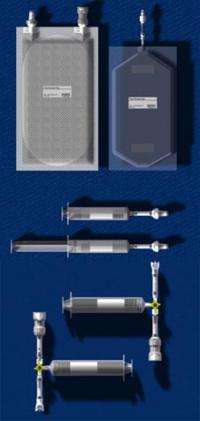
During the last space shuttle flight, astronauts will test a new method for recycling 'used' water. Water is essential for life, and having access to water beyond Earth will be a major obstacle for future space explorers.
Water - it's essential for life. When future space explorers venture beyond low Earth orbit, their only water supply will be on board their spacecraft. During the final space shuttle flight, NASA scientists plan to have astronauts test in microgravity a new method for recycling "used" water.
The idea is to make a fortified drink that provides hydration and nutrients from all sources available aboard a spacecraft, such as wastewater and even urine. The method set for testing uses a process known as forward osmosis.
"Forward osmosis is the natural diffusion of water through a semi-permeable membrane," explains Michael Flynn, research scientist at NASA's Ames Research Center. "The membrane acts as a barrier that allows small molecules, such as water, to pass through while blocking larger molecules like salts, sugars, starches, proteins, viruses, bacteria and parasites."
The forward osmosis method already is used for earthbound applications, allowing water of unknown purity to be changed into drinkable water in six to eight hours using a bag containing two chambers separated by a membrane. The commercial technology aids in diverse settings, from outdoor sports like hiking, to the military, to natural disasters where water purification is essential for survival.
The membrane alone can work for most water, but a two-stage system is necessary when recycling urine. It must first be filtered using an activated carbon bed, which removes urea and alcohol that would pass through the membrane alone.
Scientists from NASA's Kennedy Space Center in Florida plan to test a space-adapted version of the bag aboard space shuttle Atlantis during the STS-135 mission this summer. The group at Kennedy, led by NASA Project Manager Spencer Woodward, will include in the shuttle's cargo six forward osmosis bag kits for the astronauts to test. The bags' manufacturer, Hydration Technology Innovations of Albany, Ore., made a few adaptations to their commercial product for spaceflight.
"It's the same membrane, but the bag was remanufactured out of plastic that doesn't 'off gas' or burn," says Woodward, explaining that the fittings were also changed to a quick- release version already used in space to make it easier for the astronauts to work with in weightlessness.
The testing will come toward the end of the STS-135 mission, after undocking from the International Space Station. A shuttle astronaut will inject a prepared mixture of a lower concentration liquid containing dye into the outer chamber of the apparatus, which will represent the "dirty" water. He will then inject a higher concentrated "draw" solution into the bag's inner chamber, repeating the process for a total of six bags.
"Some of the unknowns are, if you get an air and a fluid mixture in space it can turn to foam instead of a liquid, so then what will that do as it sits on the membrane?" says Woodward. "Will it still be drawn across the membrane just like it is in 1g?"
The plan is to have the astronaut knead and manipulate three of the bags to assist in the transfer of the liquid through the membrane to see if it helps the process work better in the absence of gravity.
"The experiment that we're going to be looking at is the effect of mechanical mixing on the membrane, as far as if that's going to increase the flux rate. Half of them are going to get shaken and hand-kneaded for a couple minutes," explains Project Engineer Monica Soler, who works under the Engineering Service Contract with Team QinetiQ North America.
Soler says if the mixing helps, then the hope is that a long-term application would be in a spacesuit, which would induce the mechanical mixing as astronaut moves around during a spacewalk.
To conclude the experiment, after five hours, the crew member will use sample syringes to connect to the inner chambers of each bag and remove 60 milliliters of the sample from each of the six bags and stow them for landing. Once the samples are returned to Earth aboard Atlantis, Project Scientists Dr. Howard Levine and Dr. Michael Roberts from Kennedy's Space Life Sciences Lab will conduct post-flight analysis of the samples to see how well forward osmosis worked in microgravity.
Results could prove that the device can have several applications for NASA in addition to the spacesuits. It could serve as an emergency backup source for water aboard the International Space Station, provide hydration and nutrition during emergency return-to-Earth scenarios, as well as aid during future long-term space exploration.
Beyond water recycling, the results from the experiment also could shed light on several other aspects of life in space.
"Forward osmosis is the process that is responsible for the uptake of water from the human intestine into the blood. It is also the process that allows the root zones of plants to take up water from soil," explains Flynn. "In addition, many drug delivery capsules use forward osmosis." Learning how forward osmosis is affected by weightlessness might give scientists insight into the effects zero gravity has on space-grown plants and the digestive system function of humans in space -- all of which might help future space travelers adapt better on long-duration missions.
So in the end, the testing of this one simple device during the last days of the space shuttle's final voyage could provide key information for future exploration beyond our planet.
Source: Astrobio.net


