Pan-STARRS telescope spots new distant comet
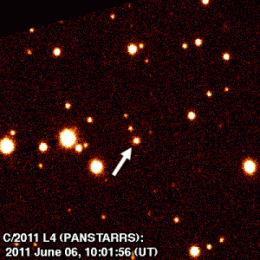
Image taken at the Pan-STARRS 1 Telescope on the night of June 5-6.
(PhysOrg.com) -- Astronomers at the University of Hawaii at Manoa have discovered a new comet that they expect will be visible to the naked eye in early 2013.
Originally found by the Pan-STARRS 1 telescope on Haleakala, Maui, on the night of June 5-6, it was confirmed to be a comet by UH Mānoa astronomer Richard Wainscoat and graduate student Marco Micheli the following night using the Canada-France-Hawaiʻi Telescope on Mauna Kea.
A preliminary orbit computed by the Minor Planet Center in Cambridge, Massachusetts, shows that the comet will come within about 30 million miles (50 million km) of the sun in early 2013, about the same distance as Mercury. The comet will pose no danger to Earth.
The comet has an orbit that is close to parabolic, meaning that this may be the first time it will ever come close to the sun, and that it may never return, said Wainscoat.
The comet is now about 700 million miles (1.2 billion km) from the sun, placing it beyond the orbit of Jupiter. It is currently too faint to be seen without a telescope with a sensitive electronic detector.
The comet is expected to be brightest in February or March 2013, when it makes its closest approach to the sun. At that time, the comet is expected to be visible low in the western sky after sunset, but the bright twilight sky may make it difficult to view.
Over the next few months, astronomers will continue to study the comet, which will allow better predictions of how bright it will eventually get. Wainscoat and UH Mānoa astronomer Henry Hsieh cautioned that predicting the brightness of comets is notoriously difficult, with numerous past comets failing to reach their expected brightness.
Making brightness predictions for new comets is difficult because astronomers do not know how much ice they contain. Because sublimation of ice (conversion from solid to gas) is the source of cometary activity and a major contributor to a comets overall eventual brightness, this means that more accurate brightness predictions will not be possible until the comet becomes more active as it approaches the sun and astronomers get a better idea of how icy it is.
The comet is named C/2011 L4 (PANSTARRS). Comets are usually named after their discoverers, but in this case, because a large team, including observers, computer scientists, and astronomers, was involved, the comet is named after the telescope.
C/2011 L4 (PANSTARRS) most likely originated in the Oort cloud, a cloud of cometlike objects located in the distant outer solar system. It was probably gravitationally disturbed by a distant passing star, sending it on a long journey toward the sun.
Comets like C/2011 L4 (PANSTARRS) offer astronomers a rare opportunity to look at pristine material left over from the early formation of the solar system.
The comet was found while searching the sky for potentially hazardous asteroidsones that may someday hit Earth. Software engineer Larry Denneau, with help from Wainscoat and astronomers Robert Jedicke, Mikael Granvik and Tommy Grav, designed software that searches each image taken by the Pan-STARRS 1 telescope for moving objects. Denneau, Hsieh and UH Mānoa astronomer Jan Kleyna also wrote other software that searches the moving objects for comets tell-tale fuzzy appearance. The comet was identified by this automated software.
The Pan-STARRS 1 telescope has a 1.8-meter-diameter mirror and the largest digital camera in the world (1.4 billion pixels). Each image is almost 3 gigabytes in size, and the camera takes an image approximately every 45 seconds. Each night, the telescope images more than 1,000 square degrees of the night sky.
Provided by University of Hawaii at Manoa
-
From lemons to lemonade: Reaction uses carbon dioxide to make carbon-based semiconductor,
32 comments
-
Thioridazine kills cancer stem cells in human while avoiding toxic side-effects of conventional cancer treatments,
3 comments
-
SpaceX private rocket blasts off for space station (Update),
42 comments
-
Climate scientists say they have solved riddle of rising sea,
31 comments
-
SpaceX capsule has 'new car' smell, astronauts say (Update),
2 comments
-
revamping general concept and cosmological principle
May 25, 2012
-
Transiting Exoplanet Light Curve
May 25, 2012
-
Math behind Theoretical Physics
May 24, 2012
-
Do we know whats at the center of galaxies yet?
May 23, 2012
-
Structure of the Milky Way?
May 20, 2012
-
What would it take to terraform Pluto and Charon?
May 19, 2012
- More from Physics Forums - General Astronomy
More news stories
Sophisticated simulations predict future warming
The chances of our planet being hit by a global warming of 3 degrees Celsius by 2050 is as likely as it being hit by an increase of 1.4 degrees, new research shows. Presented in the journal Nature Geoscience, the British study ...
Space & Earth / Earth Sciences
May 22, 2012 |
4.4 / 5 (9) |
51
Dragon arrives at space station in historic 1st (Update 2)
The privately bankrolled Dragon capsule made a historic arrival at the International Space Station on Friday, triumphantly captured by astronauts wielding a giant robot arm.
Space & Earth / Space Exploration
May 25, 2012 |
5 / 5 (10) |
19
Kyoto Protocol architect 'frustrated' by climate dialogue
UN climate talks are going nowhere, as politicians dither or bicker while the pace of warming dangerously speeds up, one of the architects of the Kyoto Protocol told AFP.
May 23, 2012 |
3.7 / 5 (7) |
39
Aliens don't want to eat us, says former SETI director
Alien life probably isnt interested in having us for dinner, enslaving us or laying eggs in our bellies, according to a recent statement by former SETI director Jill Tarter.
Space & Earth / Space Exploration
May 25, 2012 |
4.4 / 5 (13) |
37
What's the big deal about private space launches?
(AP) -- The first private spaceship is headed to the International Space Station. Some questions and answers about the cargo mission by Space Exploration Technologies, known as SpaceX:
Space & Earth / Space Exploration
May 22, 2012 |
5 / 5 (6) |
32
Nvidia trumpets Tegra 3 phone design wins for 2012
(Phys.org) -- Nvidias competitive war paint has a name, Tegra 3. On the heels of Nvidia announcements about lowering costs of its Tegra 3 processors and Nvidia-enabled tablets running Android Ice Cream ...
Browser wars flare in mobile space
The browser wars are heating up again, but this time the fight is for dominance of the mobile Internet.
Scientist: Evolution debate will soon be history
(AP) -- Richard Leakey predicts skepticism over evolution will soon be history. Not that the avowed atheist has any doubts himself.
Dell tablet leak: 10.1-inch display, two-battery choice
(Phys.org) -- Headline after headline talks about vendors tablets in the wings as likely number-one contenders for the iPad. Such claims have justifiably been taken with a grain of salt, considering ...
Keep food safety in mind this memorial day weekend
(HealthDay) -- Picnics, parades and cookouts are as much a part of Memorial Day weekend as tributes to the United States' war veterans.
Family history of Alzheimer's affects functional connectivity
(HealthDay) -- Cognitively normal individuals with a family history of late-onset Alzheimer's disease (AD) may display lower resting state functional connectivity in the default mode network (DMN) of the brain, ...
Jun 18, 2011
Rank: not rated yet
Wife: "what did you do at work today?"
Astronomer: "Stared at pan-starrs".
Forgive me, I never really grew up.