NM fire poised to become largest in state history
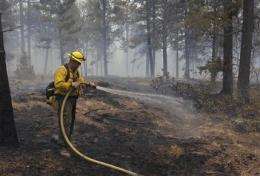
(AP) -- With firefighters bracing for another day of strong, erratic winds, a wildfire near the nation's premier nuclear weapons laboratory and a northern New Mexico community was poised Thursday to become the largest in state history.
But fire officials remained confident that the fire would not spread onto the Los Alamos National Laboratory or into the town of Los Alamos. Crews lit brush to create a 10-mile-long burned-out area between the fire and the facility that created the first atomic bomb.
"It's looking good right now," Los Alamos County Fire Chief Doug Tucker said.
The fire has chewed up tens of thousands of acres a day since it started Sunday, charring a total of nearly 145 square miles, or 92,735 acres.
Fire officials believe the blaze will soon surpass the Dry Lakes fire, which burned more than 94,000 acres of the Gila National Forest in 2003.
Crews have contained only 3 percent of the fire near Los Alamos. They were bracing for winds that could gust up to 40 mph Thursday afternoon.
"Every day we continue to see an active fire day, and with those winds it still brings the potential for spotting," fire information officer Sandra Lopez said.
"Those are the conditions these guys and gals that are out there on the fire lines fighting the fire are enduring," she said. "It's rugged, steep country. It's hot, and there are late-afternoon winds."
As firefighters hold the line along the lab's southern border, lab officials are trying to determine the extent of how experiments at the facility have been affected by a shutdown caused by the fast-moving fire.
Lab Director Charles McMillan said Wednesday teams will quickly figure out how things stand as soon as they're able to return.
The lab has been closed since Monday, when the city of Los Alamos and some of its surrounding areas - 12,000 people in all - were evacuated. There was no word on when it would reopen, but it was expected to remain idle at least through Friday.
Officials said the Los Alamos National Laboratory has some 10,000 experiments running at the same time that have been put on hold.
"We have a range of projects, some of them have shorter time deliverable, some of them are years to decades," said McMillan, who last month took over management of the lab that sits atop desert mesas.
The delayed projects include experiments run on two supercomputers, the Roadrunner and Cielo. The National Nuclear Security Administration's three national laboratories - Los Alamos, Sandia, and Lawrence Livermore - all share computing time on Cielo, which is among the world's fastest computers.
Also delayed are studies on how climate change affects ocean currents, and on extending the life of 1960s-era B61 nuclear bombs.
The lab also works on such topics as renewable energy and particle physics, solar flares, forensics on terrorist attacks, and studying the AIDS virus at the molecular level to help scientists develop strategies for developing vaccines.
On Monday, about an acre of lab property burned, raising concerns about possible contamination from material stored or buried on lab grounds. As a precaution, the government sent a plane equipped with radiation monitors over the lab. Samples analyzed so far from some of the lab's monitors show nothing abnormal in the smoke.
Lab authorities described the monitoring from the air as a precaution, and they, along with outside experts on nuclear engineering, expressed confidence that the blaze would not scatter radioactive material, as some in surrounding communities feared.
"The nuclear materials are secure," said Penn State University nuclear engineering professor Barry Scheetz, who has served on National Academy of Sciences nuclear review boards and has been to Los Alamos several times. "There's multiple redundancy in the protection of this material."
Anti-nuclear groups have sounded the alarm about thousands of 55-gallon drums containing low-grade nuclear waste - gloves, tools, even paper notes and other contaminated items - about two miles from the fire.
Lab officials said it was highly unlikely the blaze would reach the drums, and that the steel containers can in any case withstand flames and will be sprayed with fire-resistant foam if necessary.
Meanwhile, the economic impact of shutting down the town was already weighing on the minds of Los Alamos officials and business owners.
The lab's employees account for up to 90 percent of the town's commerce, said Kevin Holsapple, executive director of the Los Alamos Chamber of Commerce, as well as the local economic development group.
Holsapple did not have an estimate on what the impact would be from the latest fire.
Following a major wildfire in May 2000, the federal government paid out tens of millions to hundreds of businesses to compensate for financial and property loss. Congress approved the payments because the fire was started as a controlled burn on federal land, and got out of control.
"Lightning is not supposed to strike twice in one place," Holsapple said of the second town evacuation in a little over 11 years. "Their preparation in general is better that you would find because of people's experience with this kind of thing."
This time around, that federal government help isn't available.
Gov. Susana Martinez said the state is helping by delaying collection of sales taxes from business affected by the fire.
Other measures being offered to Los Alamos businesses by Holsapple's groups include making interest payments for business loans, as well as support to help business restart.
©2011 The Associated Press. All rights reserved. This material may not be published, broadcast, rewritten or redistributed.


