Messenger orbital data confirm theories, reveal surprises
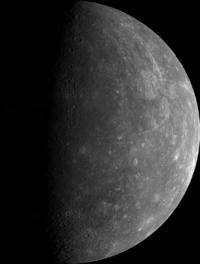
Mercury. Photo courtesy of NASA
On March 18, 2011, the MESSENGER spacecraft entered orbit around Mercury to become that planet's first orbiter. The spacecraft's instruments are making a complete reconnaissance of the planet's geochemistry, geophysics, geologic history, atmosphere, magnetosphere, and plasma environment. MESSENGER is providing a wealth of new information and some surprises. For instance, Mercury's surface composition differs from that expected for the innermost of the terrestrial planets, and Mercury's magnetic field has a north-south asymmetry that affects interaction of the planet's surface with charged particles from the solar wind.
Tens of thousands of images reveal major features on the planet in high resolution for the first time. Measurements of the chemical composition of the planet's surface are providing important clues to the origin of the planet and its geological history. Maps of the planet's topography and magnetic field are offering new evidence on Mercury's interior dynamical processes. And scientists now know that bursts of energetic particles in Mercury's magnetosphere are a continuing product of the interaction of Mercury's magnetic field with the solar wind.
"MESSENGER has passed a number of milestones just this week," offers MESSENGER principal investigator Sean Solomon of the Carnegie Institution. "We completed our first perihelion passage from orbit on Sunday, our first Mercury year in orbit on Monday, our first superior solar conjunction from orbit on Tuesday, and our first orbit-correction maneuver on Wednesday. Those milestones provide important context to the continuing feast of new observations that MESSENGER has been sending home on nearly a daily basis."
The Surface in Detail
Images obtained with MESSENGER's Mercury Dual Imaging System (MDIS) are being combined into maps for the first global look at the planet under optimal viewing conditions. New images of areas near Mercury's north pole orbital show that region hosts one of the largest expanses of volcanic plains deposits on the planet, with thicknesses of up to several kilometers. The broad expanses of plains confirm that volcanism shaped much of Mercury's crust and continued through much of Mercury's history, despite an overall contractional stress state that tended to inhibit the extrusion of volcanic material onto the surface.
Among the fascinating features seen in flyby images of Mercury were bright, patchy deposits on some crater floors, but they remained a curiosity. New targeted MDIS observations reveal these patchy deposits to be clusters of rimless, irregular pits with horizontal dimension from hundreds of meters to several kilometers. These pits are often surrounded by diffuse halos of higher-reflectance material, and they are found associated with central peaks, peak rings, and rims of craters.
"The etched appearance of these landforms is unlike anything we've seen before on Mercury or the Moon," says Brett Denevi, a staff scientist at the Johns Hopkins University Applied Physics Laboratory (APL) in Laurel, Md., and a member of the MESSENGER imaging team. "We are still debating their origin, but they appear to have a relatively young age and may suggest a more abundant than expected volatile component in Mercury's crust."
The Surface Composition
The X-Ray Spectrometer (XRS) has made several important discoveries since orbit insertion. The magnesium/silicon, aluminum/silicon, and calcium/silicon ratios averaged over large areas of the planet's surface show that, unlike the surface of the Moon, Mercury's surface is not dominated by feldspar-rich rocks. XRS observations have also revealed substantial amounts of sulfur at Mercury's surface, lending support to suggestions from ground-based observations that sulfide minerals are present. This discovery suggests that Mercury's original building blocks may have been less oxidized than those that formed the other terrestrial planets and could be key to understanding the nature of volcanism on Mercury.
MESSENGER's Gamma-Ray and Neutron Spectrometer detected the decay of radioactive isotopes of potassium and thorium, and researchers have determined the bulk abundances of these elements. "The abundance of potassium rules out some prior theories for Mercury's composition and origin," says Larry Nittler, a staff scientist at the Carnegie Institution. "Moreover, the inferred ratio of potassium to thorium is similar to that of other terrestrial planets, suggesting that Mercury is not highly depleted in volatiles, contrary to some prior ideas about its origin."
Mercury's Topography and Magnetic Field
MESSENGER's Mercury Laser Altimeter has been mapping the topography of Mercury's northern hemisphere in detail. The north polar region, for instance, is a broad area of low elevations. The overall topographic height range seen to date exceeds 9 kilometers (5.5 miles).
Previous Earth-based radar images showed that around Mercury's north and south poles are deposits thought to consist of water ice and perhaps other ices preserved on cold, permanently shadowed floors of high-latitude impact craters. MESSENGER's altimeter is measuring the floor depths of craters near the north pole. The depths of craters with polar deposits support the idea that these areas are in permanent shadow.
The geometry of Mercury's internal magnetic field can potentially allow the rejection of some theories for how the field is generated. The spacecraft found that Mercury's magnetic equator is well north of the planet's geographic equator. The best-fitting internal dipole magnetic field is located about 0.2 Mercury radii, or 480 km (298 miles), northward of the planet's center. The dynamo mechanism responsible for generating the planet's magnetic field therefore has a strong north-south asymmetry.
As a result of this north-south asymmetry, the geometry of magnetic field lines is different in Mercury's north and south polar regions. In particular, the magnetic "polar cap" where field lines are open to the interplanetary medium is much larger near the south pole. This geometry implies that the south polar region is much more exposed than the north to charged particles heated and accelerated by the solar wind. The impact of those charged particles onto Mercury's surface contributes both to the generation of the planet's tenuous atmosphere and to the "space weathering" of surface materials, both of which should have a north-south asymmetry.
Energetic Particles at Mercury
One of the major discoveries made by Mariner 10 flybys of Mercury in 1974 were bursts of energetic particles in Mercury's Earth-like magnetosphere. Four bursts of particles were observed on the first flyby, so it was puzzling that no such events were detected by MESSENGER during any of its three flybys.
With MESSENGER now in near-polar orbit about Mercury, energetic events are being seen almost like clockwork, remarked MESSENGER Project Scientist Ralph McNutt, of APL. "While varying in strength and distribution, bursts of energetic electronswith energies from 10 kiloelectron volts (keV) to more than 200 keVhave been seen in most orbits since orbit insertion," McNutt said. "The Energetic Particle Spectrometer has shown these events to be electrons rather than energetic ions, and to occur at moderate latitudes. The latitudinal location is entirely consistent with the events seen by Mariner 10."
With Mercury's smaller magnetosphere and with the lack of a substantial atmosphere, the generation and distribution of energetic electrons differ from those at Earth. One candidate mechanism for their generation is the formation of a "double layer," a plasma structure with large electric fields along the local magnetic field. Another is induction brought about by rapid changes in the magnetic field, a process that follows the principle used in generators on Earth to produce electric power. The mechanisms at work will be the studied over the coming months.
"We are assembling a global overview of the nature and workings of Mercury for the first time," remarked Solomon, "and many of our earlier ideas are being cast aside as new observations lead to new insights. Our primary mission has another three Mercury years to run, and we can expect more surprises as our Solar System's innermost planet reveals its long-held secrets."
Provided by Carnegie Institution
-
From lemons to lemonade: Reaction uses carbon dioxide to make carbon-based semiconductor,
32 comments
-
Thioridazine kills cancer stem cells in human while avoiding toxic side-effects of conventional cancer treatments,
3 comments
-
SpaceX private rocket blasts off for space station (Update),
42 comments
-
Climate scientists say they have solved riddle of rising sea,
31 comments
-
SpaceX capsule has 'new car' smell, astronauts say (Update),
2 comments
-
revamping general concept and cosmological principle
May 25, 2012
-
Transiting Exoplanet Light Curve
May 25, 2012
-
Math behind Theoretical Physics
May 24, 2012
-
Do we know whats at the center of galaxies yet?
May 23, 2012
-
Structure of the Milky Way?
May 20, 2012
-
What would it take to terraform Pluto and Charon?
May 19, 2012
- More from Physics Forums - General Astronomy
More news stories
SpaceX capsule has 'new car' smell, astronauts say (Update)
SpaceX's Dragon cargo vessel smells like a new car, said astronauts at the International Space Station after opening the hatches Saturday following the spacecraft's landmark mission to the orbiting lab.
Space & Earth / Space Exploration
23 hours ago |
4.5 / 5 (21) |
2
Australia hails surprise super-telescope decision
Australia has hailed a surprise decision giving it a role in a radio telescope project aimed at revolutionising astronomy, vowing to draw on its decades of experience in space science.
23 hours ago |
5 / 5 (4) |
3
Astronomers seize last chance in lifetime for Venus Transit
Astronomers are gearing for one the rarest events in the Solar System: an alignment of Earth, Venus and the Sun that will not be seen for another 105 years.
23 hours ago |
5 / 5 (3) |
2
Astronauts enter world's 1st private supply ship
(AP) -- Space station astronauts floated into the Dragon on Saturday, a day after its heralded arrival as the world's first commercial supply ship.
Space & Earth / Space Exploration
23 hours ago |
5 / 5 (6) |
0
Sophisticated simulations predict future warming
The chances of our planet being hit by a global warming of 3 degrees Celsius by 2050 is as likely as it being hit by an increase of 1.4 degrees, new research shows. Presented in the journal Nature Geoscience, the British study ...
Space & Earth / Earth Sciences
May 22, 2012 |
4.4 / 5 (9) |
51
Nvidia trumpets Tegra 3 phone design wins for 2012
(Phys.org) -- Nvidias competitive war paint has a name, Tegra 3. On the heels of Nvidia announcements about lowering costs of its Tegra 3 processors and Nvidia-enabled tablets running Android Ice Cream ...
Browser wars flare in mobile space
The browser wars are heating up again, but this time the fight is for dominance of the mobile Internet.
Scientist: Evolution debate will soon be history
(AP) -- Richard Leakey predicts skepticism over evolution will soon be history. Not that the avowed atheist has any doubts himself.
Dell tablet leak: 10.1-inch display, two-battery choice
(Phys.org) -- Headline after headline talks about vendors tablets in the wings as likely number-one contenders for the iPad. Such claims have justifiably been taken with a grain of salt, considering ...
SpotterRF debuts Radar Backpack Kit (w/ Video)
(Phys.org) -- SpotterRF has announced a special radar backpack kit designed to enhance situational awareness for soldiers on the ground. The company says its special radar is designed for warfighters as part ...
Thousands of shellfish found dead in Peru
Thousands of crustaceans were found dead off the coast of Lima following the mystery mass death of dolphins and pelicans, the Peruvian Navy said Friday.
Jun 16, 2011
Rank: 5 / 5 (2)
Jun 16, 2011
Rank: 2.5 / 5 (4)
Highly doubtful.
Jun 16, 2011
Rank: not rated yet
I dont understand this: when i squeeze an orange, juice eeks out via any flaw in its skin. The article authors seem surprised when Mercury does the same, under contractual forces .
Jun 16, 2011
Rank: 4.6 / 5 (5)
Mercury is also near the bottom of a very large gravity well. Moving equipment and ore to and from Mercury could be very expensive indeed.
Jun 16, 2011
Rank: not rated yet
Well already thorium has been measured. I would have expected that it should be able to detect uranium as well. I assuming that potassium is considered a more volatile element than thorium, suggesting that the surface of Mercury has not boiled off into space.
Now for my question: How much power does the solar wind magnetic field variations induce in the planet itself?
Magnetotellurics should be able to tell us how deep the core, or conducting levels are in the planet. But perhaps we need probes fixed on the surface for this.
Jun 17, 2011
Rank: 1 / 5 (1)
So that means that sending a rover/lander to Mercury is out of the question? Darn.
Jun 17, 2011
Rank: not rated yet
When you squeeze an orange, the pressure that you apply is asymmetric allowing juices to escape where the skin ruptures under deformation.
However, in the case of Mercury, as the planet contracted slightly as it cooled, the rigid (cold) crust was squeezed laterally and equally in all directions. Any erupting magma, as it forced its way to the surface, would have to overcome this lateral squeezing force in order to open up cracks in the crust through which it could flow to the surface.
That's my interpretation, but then again I have a degree in biochemistry and physiology and not one in planetary geophysics! Maybe someone more qualified could comment on this.
Jun 17, 2011
Rank: not rated yet
It also has lots of solar energy available. Solar powered VASIMR or thermal tug could help keep the costs down.
Jun 17, 2011
Rank: 4 / 5 (2)
Gravity on Mercury is less than 0.4g. Solar gravity can be dismissed altogether by comparison at that distance from the sun.
But we have another gravity well to worry about: There is the matter of bringing this stuff down to the Earth's surface.
To make extraterrestrial mining economically viable we're talking about A LOT bigger masses than could be dumped via a heat-shielded cannister with parachutes attached ... or you'd need gazillions of those delivered to orbit first - which would make costs skyrocket (pun intended).
The alternative is just letting the ore fall to earth which would result in massive impact craters or huge splashdowns (the latter incurring additional costs for recovery of the submerged goods)
Conclusion: Drilling deeper into the Earth's crust is probably a LOT cheaper than taking a roundtrip to Mercury (or the Asteroid belt or even the Moon) for mining purposes.
Jun 17, 2011
Rank: 4 / 5 (3)
If we are able to mine another planet then we would not bring the materials down to the Earth's surface unless they were rare or really needed. We would have a permantent base on the Moon and in Earth and probably Moon orbit.
Jun 17, 2011
Rank: 5 / 5 (1)
Russia sent a rover to Venus, so I wouldn't say it's impossible.
Jun 17, 2011
Rank: 5 / 5 (1)
Try this analogy. Place the orange in a microwave until the juices boil and they will try to spit out through holes in the skin. That's the Earth. Stuff the orange inside several layers of rubber. like empty balloons. and do the same thing. That's Mercury.
Jun 17, 2011
Rank: not rated yet
The effect is caused by Mercury's relatively small radius and relatively high density. It results in gravity tending to keep mercury held together more firmly than Earth is. So it's like placing an elastic cover around the orange, making it harder for the juices to get out.
Jun 17, 2011
Rank: 1 / 5 (1)
Yeah, you're absolutely right. The temperatures on Venus are hellish, even compared to Mercury.
Jun 17, 2011
Rank: 5 / 5 (4)
I think you're referring to the Russian Venera series probes, of which 10 made successful landings on the surface of Venus: http://en.wikiped...i/Venera
Btw, all probes in the Venera series were landers, not rovers.
Jun 17, 2011
Rank: 1 / 5 (1)
NASA has come up with the concept of sending a rover or solar powered plane to Venus, though. It's something they've actually considered.
http://www.youtub...63vzBvkg
Jun 17, 2011
Rank: 5 / 5 (1)
Yep, that's what I was talking about. Either way, a craft of any sort would last much longer on Mercury, methinks.
Jun 18, 2011
Rank: 1 / 5 (1)
Jun 18, 2011
Rank: not rated yet
Rovers on the surface of Venus isn't going to happen anytime soon. There are short videos from Russian landers showing the atmosphere is so dense that it was blowing rocks at low speeds across the ground.
As for transuranics on Mercury via solar radiation, it is the wrong kind to do that. The solar wind is mostly EM, electrons and protons. Production of transuranics requires neutrons.
Jun 18, 2011
Rank: not rated yet
Jun 19, 2011
Rank: 5 / 5 (2)
It might be more pertinent than you'd think. You'd find your costs skyrocket both in terms of extra fuel needed to slow down transports headed to Mercury, and extra fuel needed to move all the extra mass of transport ore away from the sun.
Not to mention that Mercury has a magnetic field that, although weak compared to Earth's, still effectively deflects solar wind.
Jun 19, 2011
Rank: 3 / 5 (2)
I still think it would be awesome to send a lander or rover there, despite the difficulties in doing so. NASA HAD proposed an exploration rover mission for Venus. But they had to cut it out of the budget. And yes, yyz we all know about the Venera landers.
http://www.mental...ages.htm
I think that aroc91 just got mixed up when he said "rover", instead of "lander".
Jun 19, 2011
Rank: 5 / 5 (1)
Jun 19, 2011
Rank: 5 / 5 (4)
http://en.wikiped...e_probes