Honey helps heal horses' wounds, researchers find
June 29, 2011

Honey helps heal horses' wounds, researchers find

Enlarge

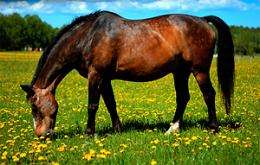
A manuka honey gel applied to horse's leg wounds led to 27 percent faster healing times.

(PhysOrg.com) -- A simple application of honey to horses' leg wounds results in smaller wound sizes and faster healing time, University of Sydney researchers have found.

Honey has been used to treat in humans since , but this study, using manuka honey from New Zealand, is the first time in the world a clinical trial has been conducted in horses.

"Wounds in horses, particularly leg wounds, have long healing periods. But we found applying a manuka honey gel throughout healing led to 27 percent faster healing times," said lead researcher Dr. Andrea Bischofberger.

"Wounds in horses which received no treatment took an average of 64 days to heal, while those treated with manuka honey gel took 47 days to heal," said Dr. Bischofberger, who will present her findings this Friday 1 July at a conference.

"In our pilot study we used pure honey, but in our second study we used a water-based manuka honey gel of 66 percent honey. When applied for 12 days we found these wounds healed just as well as those treated with pure honey."

Using a manuka honey gel means expensive bandages can be avoided, Dr Bischofberger explained. "With its faster wound healing times and its bandage-free application, the manuka honey gel solution is an extremely versatile and affordable topical wound product."

In a third study Dr. Bischofberger and colleagues investigated how manuka honey actually worked to speed up wound healing. While it seems to have an anti-bacterial effect and immune-modifying effect on the key initial healing phase, the inflammatory stage, the honey's exact healing mechanism is still unclear.

"What we do know is treating wounds with manuka honey leads to healthier tissue regrowth," Dr. Bischofberger said.

"Wounds treated with manuka also showed improved new blood vessel and skin surface growth compared to control wounds," Dr Bischofberger added.

Dr. Bischofberger is a Swiss veterinarian currently with the Research and Clinical Training Unit (REaCT) at the University Veterinary Teaching Hospital in Camden (UVTHC), a part of the University of Sydney.

REaCT Director, Professor Andrew Dart, is a surgical specialist and expert on the complications associated with lower leg wound healing in , and is supervising Dr. Bischofberger's research.

" in horses' limbs, particularly lower limbs, is usually a long and complicated process compared to wounds on the body," he said.

"The results of these studies have led to significant national and international interest both from the animal and human fields. There is potential for the manuka gel to be used across species with similar beneficial effects."

Provided by University of Sydney


Rank 4 /5 (3 votes)
Relevant PhysicsForums posts

More news stories

Scientist: Evolution debate will soon be history

(AP) -- Richard Leakey predicts skepticism over evolution will soon be history. Not that the avowed atheist has any doubts himself.

Biology / Evolution

created 16 hours ago | popularity 3.3 / 5 (17) | comments 48

More plant species responding to global warming than previously thought

(Phys.org) -- Far more wild plant species may be responding to global warming than previous large-scale estimates have suggested.

Biology / Ecology

created May 22, 2012 | popularity 4.6 / 5 (14) | comments 18 | with audio podcast

Thousands of shellfish found dead in Peru

Thousands of crustaceans were found dead off the coast of Lima following the mystery mass death of dolphins and pelicans, the Peruvian Navy said Friday.

Biology / Ecology

created May 26, 2012 | popularity 4.8 / 5 (4) | comments 7

For monogamous sparrows, it doesn't pay to stray (but they do it anyway)

It's quite common for a female song sparrow to stray from her breeding partner and mate with the male next door, but a new study shows that sleeping around can be costly.

Biology / Plants & Animals

created May 22, 2012 | popularity 5 / 5 (2) | comments 7 | with audio podcast

Study uncovers secret to speedy burrowing by razor clams

(Phys.org) -- If you look at a razor burrowing clam sitting in a bucket, you’d never guess that it could burrow itself down into the soil, much less do it with any speed. Razor clams look like fat straws, ...

Biology / Plants & Animals

created May 25, 2012 | popularity 1 / 5 (1) | comments 3 | with audio podcast report


Nvidia trumpets Tegra 3 phone design wins for 2012

(Phys.org) -- Nvidia’s competitive war paint has a name, Tegra 3. On the heels of Nvidia announcements about lowering costs of its Tegra 3 processors and Nvidia-enabled tablets running Android Ice Cream ...

Browser wars flare in mobile space

The browser wars are heating up again, but this time the fight is for dominance of the mobile Internet.

Dell tablet leak: 10.1-inch display, two-battery choice

(Phys.org) -- Headline after headline talks about vendors’ tablets in the wings as likely number-one contenders for the iPad. Such claims have justifiably been taken with a grain of salt, considering ...

Keep food safety in mind this memorial day weekend

(HealthDay) -- Picnics, parades and cookouts are as much a part of Memorial Day weekend as tributes to the United States' war veterans.

Social welfare cuts ultimately come with heavy price, researchers say

(Phys.org) -- Slashing government funding for Medicaid, food stamps and other programs that serve the poor – while politically popular with some lawmakers and many conservatives – may do more harm ...

Is a classical electrodynamics law incompatible with special relativity?

(Phys.org) -- The laws of classical electromagnetism that were developed in the 19th century are the same laws that scientists use today. They include Maxwell’s four equations along with the Lorentz la ...