Duo of big telescopes probes the depths of binary star formation
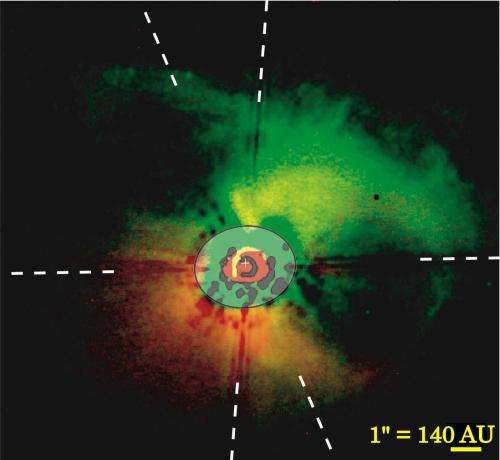
Figure 1: A composite image toward Taurus FS A binary system. The green color shows the intensity of visible light, based on optical data from the Hubble Space Telescope. The red color displays near-infrared data from the Subaru Telescope. The ellipse marks an artifact from data processing of the central bright star. The dashed lines denote the directions of the support of the secondary mirror of the telescope. The field of view is 16.5" x 17.5". North is up, and east is to the left.
A team of researchers from four Japanese universities (Kobe, Saitama, Osaka, and Tokyo) has been able to delineate the intricate structure of the circumbinary disk that surrounds a young binary star system from the observation with the Subaru Telescope and the Hubble Space Telescope. By using different wavelengths to examine the system's internal structure, they succeeded in demonstrating a distinct color difference between its northern and southern portions. The researchers are now prepared to apply their approach of combining optical and near-infrared observations to other regions of binary formation.
Previous observations have demonstrated that protoplanetary disks, composed of a ring of dense gas surrounding a star like our Sun, not only accompany many infant stars but also are sites that generate planetary systems such as the one to which our Earth belongs. Therefore, these disks provide important information about the formation of stars and planets.
Past observations have focused on the protoplanetary disks of single stars. However, stellar research reveals that the majority of stars are members of binary or multiple star systems rather than ones composed of a single star. The research team addressed the issue of limited research on binary systems by pointing the Subaru Telescope toward the FS star system in the constellation Taurus. The separation between the primary (A) and companion (B) stars is 20 arc seconds (2800 AU; astronomical unit, the distance between the Sun and the Earth) and the FS A star itself is also a binary system with only 0.2 arc seconds (30 AU) of separation between its stars. The research team succeeded in detecting a circumbinary disk by using the Subaru Telescope's near-infrared camera CIAO (Coronagraphic Imager with Adaptive Optics), which blocks out the bright light of the central star. The disk's size of 630 AU is equivalent to the aphelion (the furthest point from the Sun in its orbit) of Sedona, one of the trans-Neptunian objects.
The team then compared its near-infrared image with the optical image taken by the Advanced Camera System (ACS) aboard the Hubble Space Telescope (HST). The area north of the FS A binary is brighter in the visible light (optical), while that south of the binary stands out in the near-infrared. In other words, the north is blue, and the south is red. The protoplanetary disk reflects the visible or the infrared light from the central star, but it does not emit light by itself. The highly distinct color contrast between the northern and southern portions of FS A's protoplanetary disk is a very unique characteristic of the system.
The question becomes why the color is different in these regions around the binary. Part of the answer relates to the degree of the polarization dispersed from the surface of the disk. Regardless of whether the light is visible or near-infrared, it displays the properties of a wave as well as a particle, and its reflection shows polarization. The degree and the direction of the polarization provide information about the object that reflects the light. This is why measurement of the polarization is important for understanding the structure of the protoplanetary disk. The observation with the Hubble Space Telescope included information on polarization, and figure 2 shows the distribution of the polarized light. The majority of the disk shows a typical concentric pattern around the central star. Other protoplanetary disks show similar patterns.
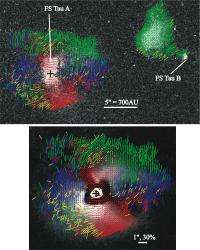
Figure 2: The polarization distribution in visible light, overlaid on the visible image (top) and near-infrared image (bottom). The color-coding refers to the offset from the expected centro-symmetric pattern around FS A star and FS B star. The blue and red colors show the circular pattern around FS A while the green encircles FS B. The area toward the southeast of FS A is bright in the near infrared, and the offset, denoted by the yellow color, is larger. The fields of view are 19" x 31" (top) and 14" x 17" (bottom), respectively. North is up and east is to the left.
In addition to its circular pattern, the outer region to the north reflects the light from the FS B star, which is much further away from the FS A system. The research team interpreted this feature as an effect of abundant interstellar material in front of the FS A circumbinary disk and the influence of the FS B. However, the polarization data show that the inner region to the north is part of the protobinary disk surrounding the FS A binary. The mystery of color difference remains.In sum, the research team established that there is a distinct color difference between the areas to the north and south of the circumbinary disk of the FS A star. They want to continue observations of protoplanetary disks so that they can identify their common characteristics and chronicle their evolution. Their ultimate goal is to understand the planetary formation process in circumstellar/circumbinary disks.
More information: "High-Resolution Optical and Near-Infrared Images of the FS Tauri Circumbinary Disk", Tomonori Hioki, Yoichi Itoh, Yumiko Oasa, Misato Fukagawa, Masahiko Hayashi. June 2011 issue of the Publications of the Astronomical Society of Japan.
Provided by Subaru Telescope
-
From lemons to lemonade: Reaction uses carbon dioxide to make carbon-based semiconductor,
32 comments
-
Thioridazine kills cancer stem cells in human while avoiding toxic side-effects of conventional cancer treatments,
3 comments
-
SpaceX private rocket blasts off for space station (Update),
42 comments
-
Climate scientists say they have solved riddle of rising sea,
31 comments
-
SpaceX capsule has 'new car' smell, astronauts say (Update),
2 comments
-
revamping general concept and cosmological principle
May 25, 2012
-
Transiting Exoplanet Light Curve
May 25, 2012
-
Math behind Theoretical Physics
May 24, 2012
-
Do we know whats at the center of galaxies yet?
May 23, 2012
-
Structure of the Milky Way?
May 20, 2012
-
What would it take to terraform Pluto and Charon?
May 19, 2012
- More from Physics Forums - General Astronomy
More news stories
Sophisticated simulations predict future warming
The chances of our planet being hit by a global warming of 3 degrees Celsius by 2050 is as likely as it being hit by an increase of 1.4 degrees, new research shows. Presented in the journal Nature Geoscience, the British study ...
Space & Earth / Earth Sciences
May 22, 2012 |
4.4 / 5 (9) |
51
Dragon arrives at space station in historic 1st (Update 2)
The privately bankrolled Dragon capsule made a historic arrival at the International Space Station on Friday, triumphantly captured by astronauts wielding a giant robot arm.
Space & Earth / Space Exploration
May 25, 2012 |
5 / 5 (10) |
19
Kyoto Protocol architect 'frustrated' by climate dialogue
UN climate talks are going nowhere, as politicians dither or bicker while the pace of warming dangerously speeds up, one of the architects of the Kyoto Protocol told AFP.
May 23, 2012 |
3.7 / 5 (7) |
39
Aliens don't want to eat us, says former SETI director
Alien life probably isnt interested in having us for dinner, enslaving us or laying eggs in our bellies, according to a recent statement by former SETI director Jill Tarter.
Space & Earth / Space Exploration
May 25, 2012 |
4.4 / 5 (13) |
37
What's the big deal about private space launches?
(AP) -- The first private spaceship is headed to the International Space Station. Some questions and answers about the cargo mission by Space Exploration Technologies, known as SpaceX:
Space & Earth / Space Exploration
May 22, 2012 |
5 / 5 (6) |
32
Nvidia trumpets Tegra 3 phone design wins for 2012
(Phys.org) -- Nvidias competitive war paint has a name, Tegra 3. On the heels of Nvidia announcements about lowering costs of its Tegra 3 processors and Nvidia-enabled tablets running Android Ice Cream ...
Browser wars flare in mobile space
The browser wars are heating up again, but this time the fight is for dominance of the mobile Internet.
Scientist: Evolution debate will soon be history
(AP) -- Richard Leakey predicts skepticism over evolution will soon be history. Not that the avowed atheist has any doubts himself.
Dell tablet leak: 10.1-inch display, two-battery choice
(Phys.org) -- Headline after headline talks about vendors tablets in the wings as likely number-one contenders for the iPad. Such claims have justifiably been taken with a grain of salt, considering ...
Keep food safety in mind this memorial day weekend
(HealthDay) -- Picnics, parades and cookouts are as much a part of Memorial Day weekend as tributes to the United States' war veterans.
Family history of Alzheimer's affects functional connectivity
(HealthDay) -- Cognitively normal individuals with a family history of late-onset Alzheimer's disease (AD) may display lower resting state functional connectivity in the default mode network (DMN) of the brain, ...

Jun 21, 2011
Rank: 1 / 5 (4)
1. "On the cosmic nuclear cycle and the similarity of nuclei
and stars", Journal of Fusion Energy 25, 107-114 (2006):
http://xxx.lanl.g.../0511051
With kind regards,
Oliver K. Manuel
Jun 22, 2011
Rank: 1 / 5 (4)
A simple reference but a precious access to deeper understanding of this Subaru news and previous sources works.