Butterfly data to help guide restoration work
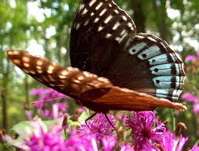
(PhysOrg.com) -- “Butterflies are Free,” so the old song and movie title says, but thanks to researchers at UALR’s Department of Biology in the College of Science and Mathematics, they also are being tracked.
Dr. William Baltosser, professor of biology, and a team of volunteers collected and tagged a community of Diana fritillaries – black, orange, and blue butterflies – in the shaded edge of woodland habitats at Terre Noire Natural Area June 10 to 13. Areas surveyed changed gradually from prairie to open woodlands to forests and back again, exactly the kind of habitat Dianas prefer.
The project to tag the butterflies and monitor their movements is a collaboration between UALR and the Arkansas Natural Heritage Commission, the Nature Conservancy, the Arkansas Game and Fish Commission, and the U.S. Forest Service.
By tagging the delicate creatures, scientists and naturalists can learn which nectar-producing plants are favored by the butterflies to help with habitat restoration projects. Tagging also allows researchers to document butterfly movements between tracts of land.
“During the survey, at least one male moved approximately 1,000 meters from its initial capture location on Friday morning to a different area where it was recaptured early Sunday afternoon,” Baltosser said. “Species movement is important because it demonstrates habitat connectivity and indicates probable gene flow.”
Later in the season, Baltosser will also monitor egg laying habitats and overwintering caterpillars. All of the data will be compared to long-term and on-going studies of Diana and great spangled fritillaries from other sites managed primarily by the U.S. Forest Service and the Arkansas Game and Fish Commission.
To accomplish the initial tagging operation, volunteers with nets split into teams and scoured the area for butterflies. “They wandered in and out of the prairies and woodlands looking for flashes of orange, black, and blue,” Baltosser said. “They were looking for both male and female Dianas, as well as great spangled fritillaries, a related species.”
And how does one tag a butterfly? Very delicately. Once captured, individual butterflies are gently placed in glassine envelopes and carried to the tagging station. The specimen then is placed into a homemade paper envelope, which is folded and clipped closed. Three holes expose the underside of the butterfly’s lower, left wing.
A piece of cellophane tape is used to remove some of the wing scales, which are shed naturally. A dot of super glue is dabbed onto the cleaned space. A numbered paper circle, cut with a hole punch, is then placed with tweezers on the glue.
Once tagged, the butterfly is placed back into the glassine envelope and released at the place it was captured. Volunteers also recorded locations on GPS and made notes regarding what the butterfly was doing and, if nectaring, the plant species from which it was feeding.
The Diana fritillary requires a fire-maintained ecosystem with high native plant diversity. They generally live in pine-oak woodland/savanna and deciduous/mixed forests where large quantities of violets can be found in the understory. Violets are its larval food plant. Adults feed at the margins of these habitats on the nectar of flower species such as purple coneflower, butterfly weed, horsemint, and wild bergamot.
Recent restoration work at Terre Noire Natural Area increased prairie openings by clearing brushy undergrowth from woodlands and forests, allowing more sunlight to reach the ground. These activities improved habitat quality and increased native plant diversity.
Provided by University of Arkansas at Little Rock


