Another asteroid to give Earth a close shave June 27, 2011
Jun 24, 2011 By Nancy Atkinson, Universe Today
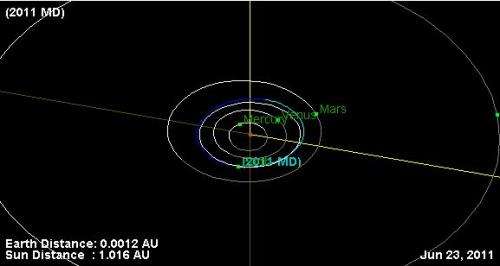
2011 MD's orbital parameters. Credit: JPL Small-Body Database Browser

(PhysOrg.com) -- A newly discovered house-sized asteroid will miss the Earth by less than 17,700 km (11,000 miles) on Monday June 27, 2011. That’s about 23 times closer than the Moon. The size and location of the asteroid, named 2011 MD, should allow observers in certain locations to take a look at the space rock, even with small telescopes. It’s closest approach will be at 13:26 UTC on June 27.

According to Skymania, 2011 MD was found just yesterday, June 22, by LINEAR, a pair of robotic telescopes in New Mexico that scan the skies for Near Asteroids.

As of now, asteroid 2011 MD is estimated to be between 9 to 45 meters (10 to 50 yards) wide. Dr. Emily Baldwin, of Astronomy Now magazine, said there is no danger of the asteroid hitting Earth, and even if it did enter the atmosphere, an this size would “mostly burn up in a brilliant fireball, possibly scattering a few meteorites.”

To find out updated information on 2011 MD’s ephemeris, physical parameters and more, including an orbit diagram and close-approach data, see this page on JPL’s Solar System Dynamics website.

Explore further: Dark, massive asteroid to fly by Earth on May 31

Related Stories

Small asteroid to pass within Earth-Moon system Tuesday

Oct 11, 2010

(PhysOrg.com) -- A small asteroid will fly past Earth early Tuesday within the Earth-moon system. The asteroid, 2010 TD54, will have its closest approach to Earth's surface at an altitude of about 45,000 kilometers ...

Asteroid to Make Rare Close Flyby of Earth

Jan 24, 2008

Scientists are monitoring the orbit of asteroid 2007 TU24. The asteroid, believed to be between 150 meters (500 feet) and 610 meters (2,000 feet) in size, is expected to fly past Earth on Jan. 29, with its ...

Huge asteroid hurtles toward Earth

Jun 29, 2006

An asteroid that's about one-half-mile wide is hurtling toward Earth, expected to narrowly miss the planet early Monday.

New horseshoe orbit Earth-companion asteroid discovered

Apr 06, 2011

(PhysOrg.com) -- Apostolos Christou and David Asher from the Armagh Observatory in Northern Ireland announced the discovery of an asteroid near Earth called Asteroid 2010 SO16 and their findings were published ...

Recommended for you

Dark, massive asteroid to fly by Earth on May 31

16 hours ago

It's 1.7 miles long. Its surface is covered in a sticky black substance similar to the gunk at the bottom of a barbecue. If it impacted Earth it would probably result in global extinction. Good thing it is ...

Research team explains 'Lazarus' comets

19 hours ago

Astronomers from the University of Antioquia have discovered a graveyard of comets. These once-dormant comets, dubbed by astronomers as "The Lazarus comets," are now rejuvenated.

NASA ships sensors for seafaring satellite to France

20 hours ago

(Phys.org) —Three NASA-built instruments that are integral components of the next in a series of U.S./European ocean altimetry satellites have arrived in France for integration with their spacecraft in ...

Trip into space with DiCaprio costs $1.55m

20 hours ago

Leonardo DiCaprio is going to get closer to stars of a different kind as he heads into space aboard the Virgin Galactic, and a well-heeled bidder at the Cannes Film Festival has paid 1.2 million euros (1.5 million) to be ...

User comments : 11

Adjust slider to filter visible comments by rank

Display comments: newest first

Donutz
5 / 5 (3) Jun 24, 2011
eek!
gunslingor1
1 / 5 (8) Jun 24, 2011
That's not really news, a house sized meteor is small. These hit the earth everyday, what do you think shooting stars are? I guess it's news that they can detect them and happened to have been looking in the right place at the right time. I guess its a great tool for meteorite hunters.
thomaswk
4.6 / 5 (13) Jun 24, 2011
Umm... gunslingor1: A meteor 150 feet wide would hit with the same force as a 20 megaton nuclear explosion, and would create a hole in the Earth almost one mile in diameter. Read up on Meteor Crater in Arizona. Meteors of this size absolutely do NOT hit the Earth every day. Do you know what causes "shooting stars"? Rocks roughly the size of a pencil eraser -- travelling about 20 times faster than a bullet.
Ferris
not rated yet Jun 24, 2011
haha burn
Telekinetic
3 / 5 (4) Jun 25, 2011
We should be more concerned about gunslingor.
Azpod
5 / 5 (3) Jun 25, 2011
Umm... gunslingor1: A meteor 150 feet wide would hit with the same force as a 20 megaton nuclear explosion, and would create a hole in the Earth almost one mile in diameter. Read up on Meteor Crater in Arizona. Meteors of this size absolutely do NOT hit the Earth every day. Do you know what causes "shooting stars"? Rocks roughly the size of a pencil eraser -- travelling about 20 times faster than a bullet.

That may be true for house-sized meteorites that hit the ground going that fast. A house-sized meteor, however, would expend its energy high up in the atmosphere where it would most likely break up catastrophically in a large fireball that would be amazing to see, but would be mostly harmless. Surviving fragments from the fireball might hit the ground, but they'd be slowed by atmospheric friction to the point where they would do little if any damage when they land.
Sinister1811
3.4 / 5 (10) Jun 25, 2011
Close shave, huh?

They should call this asteroid Gillette.
dachi
not rated yet Jun 25, 2011
Earth Distance:0.00012AU ?
Shootist
1 / 5 (3) Jun 25, 2011
@azpod

facts

30 meter crater, 2 meter bolide.

http://forgetomor...in-peru/

see page 25

4 meter wide bolides strike the Earth ~every 15 years.

6 meter wide bolides strike ~every 35 years.
Shootist
1 / 5 (3) Jun 25, 2011
Durn edit feature is dark ages.

Page 25 of http://www.lpi.us...-954.pdf

Humpty
1 / 5 (1) Jun 27, 2011
Start using them for target practice.....

Nuke 01 : Rock 00.

More news stories

Galaxies fed by funnels of fuel

(Phys.org) —Computer simulations of galaxies growing over billions of years have revealed a likely scenario for how they feed: a cosmic version of swirly straws.

Source of life running out: water scientists

The majority of people on Earth people will face severe water shortages within a generation or two if pollution and waste continues unabated, scientists warned at a conference in Bonn Friday.

Dark, massive asteroid to fly by Earth on May 31

It's 1.7 miles long. Its surface is covered in a sticky black substance similar to the gunk at the bottom of a barbecue. If it impacted Earth it would probably result in global extinction. Good thing it is ...