Tree rings tell a 1,100-year history of El Nino
May 6, 2011

Tree rings tell a 1,100-year history of El Niņo

Enlarge

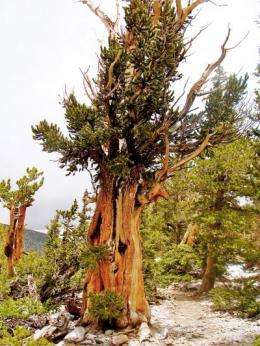
Bristlecone trees, such as this over a thousand-year-old tree in the Great Basin National Park, contributed to the tree-ring record on El Niņo. Credit: Image courtesy International Pacific Research Center

El Niño and its partner La Niña, the warm and cold phases in the eastern half of the tropical Pacific, play havoc with climate worldwide. Predicting El Niño events more than several months ahead is now routine, but predicting how it will change in a warming world has been hampered by the short instrumental record. An international team of climate scientists has now shown that annually resolved tree-ring records from North America, particularly from the US Southwest, give a continuous representation of the intensity of El Niño events over the past 1100 years and can be used to improve El Niño prediction in climate models. The study, spearheaded by Jinbao Li, International Pacific Research Center, University of Hawai'i at Manoa, is published in the May 6 issue of Nature Climate Change.

Tree rings in the US Southwest, the team found, agree well with the 150-year instrumental sea surface temperature records in the tropical Pacific. During El Niño, the unusually warm surface temperatures in the eastern Pacific lead to changes in the atmospheric circulation, causing unusually wetter winters in the US Southwest, and thus wider ; unusually cold eastern Pacific temperatures during La Niña lead to drought and narrower rings. The tree-ring records, furthermore, match well existing reconstructions of the El Niño-Southern Oscillation and correlate highly, for instance, with δ18O isotope concentrations of both living corals and corals that lived hundreds of years ago around Palmyra in the central Pacific.

"Our work revealed that the towering trees on the mountain slopes of the US Southwest and the colorful corals in the tropical Pacific both listen to the music of El Niño, which shows its signature in their yearly growth rings," explains Li. "The coral records, however, are brief, whereas the tree-ring records from North America supply us with a continuous El Niño record reaching back 1100 years."
Tree rings tell a 1,100-year history of El Niņo
Enlarge

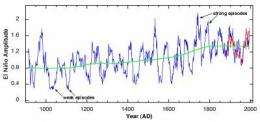
This graph shows El Niņo amplitude derived from North American tree rings (blue) and instrumental measurements (red). The green curve represents the long-term trend in El Nino strength. (Individual El Niņo events occur typically at intervals of 2-7 years.) Periods of strong El Niņo activity are indicated by amplitudes above 1.0. Superimposed on a general rising trend, cycles of strong activity occurred about every 50-90 years. Credit: International Pacific Research Center

The tree rings reveal that the intensity of El Niño has been highly variable, with decades of strong El Niño events and decades of little activity. The weakest El Niño activity happened during the Medieval Climate Anomaly in the 11th century, whereas the strongest activity has been since the 18th century.

These different periods of El Niño activity are related to long-term changes in Pacific climate. Cores taken from lake sediments in the Galapagos Islands, northern Yucatan, and the Pacific Northwest reveal that the eastern–central tropical Pacific climate swings between warm and cool phases, each lasting from 50 to 90 years. During warm phases, El Niño and La Niña events were more intense than usual. During cool phases, they deviated little from the long-term average as, for instance, during the Medieval Climate Anomaly when the eastern tropical Pacific was cool.

Tree rings tell a 1,100-year history of El Niņo
Enlarge

Porites corals, such as these from Ofu Island, contributed to the Pacific coral isotope record of El Niņo. Credit: Peter Craig, National Park Service.

"Since El Niño causes climate extremes around the world, it is important to know how it will change with global warming," says co-author Shang-Ping Xie. "Current models diverge in their projections of its future behavior, with some showing an increase in amplitude, some no change, and some even a decrease. Our tree-ring data offer key observational benchmarks for evaluating and perfecting models and their predictions of the El Niño-Southern Oscillation under global warming."

More information: Jinbao Li, Shang-Ping Xie, Edward R. Cook, Gang Huang, Rosanne D'Arrigo, Fei Liu, Jian Ma, and Xiao-Tong Zheng, 2011: Interdecadal modulation of El Niño amplitude during the past millennium. Nature Climate Change.

Provided by University of Hawaii at Manoa

4.7 /5 (3 votes)  

Filter


Move the slider to adjust rank threshold, so that you can hide some of the comments.


Display comments: newest first

farmerpat42
May 07, 2011

Rank: not rated yet
I'm glad that climate scientists are doing work on natural cycles of weather. It will be very interesting to see what impact is discovered across the globe from these findings.
rwinners
May 08, 2011

Rank: not rated yet
El and La are both cycles of part of the earth's climate. These cycles don't produce 'havoc'. Perhaps the earth's climate does produce what we humans consider 'havoc' to ourselves... but otherwise, all is quite normal.
Rank 4.7 /5 (3 votes)
Relevant PhysicsForums posts

More news stories

SpaceX capsule has 'new car' smell, astronauts say (Update)

SpaceX's Dragon cargo vessel smells like a new car, said astronauts at the International Space Station after opening the hatches Saturday following the spacecraft's landmark mission to the orbiting lab.

Space & Earth / Space Exploration

created 22 hours ago | popularity 4.5 / 5 (20) | comments 2

Australia hails surprise super-telescope decision

Australia has hailed a surprise decision giving it a role in a radio telescope project aimed at revolutionising astronomy, vowing to draw on its decades of experience in space science.

Space & Earth / Astronomy

created 22 hours ago | popularity 5 / 5 (4) | comments 2

Astronomers seize last chance in lifetime for Venus Transit

Astronomers are gearing for one the rarest events in the Solar System: an alignment of Earth, Venus and the Sun that will not be seen for another 105 years.

Space & Earth / Astronomy

created 22 hours ago | popularity 5 / 5 (3) | comments 2

Astronauts enter world's 1st private supply ship

(AP) -- Space station astronauts floated into the Dragon on Saturday, a day after its heralded arrival as the world's first commercial supply ship.

Space & Earth / Space Exploration

created 22 hours ago | popularity 5 / 5 (6) | comments 0

Sophisticated simulations predict future warming

The chances of our planet being hit by a global warming of 3 degrees Celsius by 2050 is as likely as it being hit by an increase of 1.4 degrees, new research shows. Presented in the journal Nature Geoscience, the British study ...

Space & Earth / Earth Sciences

created May 22, 2012 | popularity 4.4 / 5 (9) | comments 51


Browser wars flare in mobile space

The browser wars are heating up again, but this time the fight is for dominance of the mobile Internet.

Nvidia trumpets Tegra 3 phone design wins for 2012

(Phys.org) -- Nvidia’s competitive war paint has a name, Tegra 3. On the heels of Nvidia announcements about lowering costs of its Tegra 3 processors and Nvidia-enabled tablets running Android Ice Cream ...

Scientist: Evolution debate will soon be history

(AP) -- Richard Leakey predicts skepticism over evolution will soon be history. Not that the avowed atheist has any doubts himself.

Dell tablet leak: 10.1-inch display, two-battery choice

(Phys.org) -- Headline after headline talks about vendors’ tablets in the wings as likely number-one contenders for the iPad. Such claims have justifiably been taken with a grain of salt, considering ...

SpotterRF debuts Radar Backpack Kit (w/ Video)

(Phys.org) -- SpotterRF has announced a special radar backpack kit designed to enhance situational awareness for soldiers on the ground. The company says its special radar is designed for warfighters as part ...

Thousands of shellfish found dead in Peru

Thousands of crustaceans were found dead off the coast of Lima following the mystery mass death of dolphins and pelicans, the Peruvian Navy said Friday.