Waves and the perception power of seals
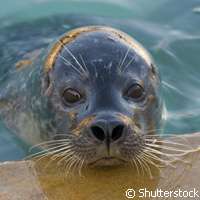
If you ever thought that murky waters would stop seals in their (hunting) tracks, think again. Harbour seals (Phoca vitulina) extend their vibration-sensitive whiskers to find food when their vision is obstructed. But can these mammals differentiate objects that pass them? Scientists from the University of Rostock in Germany shed new light on the ability of harbour seals to distinguish between the wakes (the trails of water disturbance) generated by objects that differ in both size and shape. The findings of the study are presented in the Journal of Experimental Biology.
The Rostock scientists had already identified the seals' ability to perceive and follow fish wakes, around half a minute after the prey passes. In this latest study, they found that harbour seals use only their whiskers to make distinctions in wakes produced by different objects.
The researchers evaluated a harbour seal called Henry. They tested the seal's ability to distinguish between the wakes of differently sized paddles. Blindfolding Henry's eyes and covering his ears, the investigators swept a paddle through a big box in the seal's enclosure. After an interval of just three seconds, Henry was allowed to enter the area, where he was tested.
Already trained to press a target outside the enclosure when he recognised the wake of a standard paddle, Henry was also trained to press a different target when he recognised the wake of a bigger or smaller paddle. Henry, according to the researchers, could differentiate between paddles that had a tiny difference between them, as little as 2.8 centimetres in width. Following this, they tested which aspects of the wake Henry detected.
'We randomised the speeds of the paddles so that the maximum flow velocity wasn't a distinguishing cue for the widest paddles, but the structure of the wake had to be recognised by the seal and he could do that too, but with slightly less accuracy,' says Professor Wolf Hanke of the University of Rostock.
Henry was also tested on his ability to distinguish between the wakes of triangular, cylindrical, flat and undulating paddles. His responses were spot on when he distinguished between cylindrical and flat, flat and undulating, and cylindrical and undulating paddles.
Henry didn't pass muster when it came to distinguishing between the triangular paddle from the cylindrical or undulating shapes, though.
Using digital particle image velocimetry to measure Henry's successful attempts at distinguishing between the wakes of passing objects that vary in size and shapes, Professor Hanke says it is not easy to determine which 'part of the wake serves the animal most and which aided only a little'.
The Rostock researcher plans to test the seal's responses to single vortices in order to identify the wake components that could give a fish's size and shape away. The seal's hunting efficiency would be hugely boosted if it could differentiate between various differently sized fish, particularly thin ones which force them to waste a lot of energy in order to reach their target.
More information: Wieskotten, S., et al. (2011) Hydrodynamic discrimination of wakes caused by objects of different size or shape in a harbor seal (Phoca vitulina). J Exp Biol 214: 1922-1930. DOI:10.1242/jeb.053926
Provided by CORDIS
-
From lemons to lemonade: Reaction uses carbon dioxide to make carbon-based semiconductor,
32 comments
-
Thioridazine kills cancer stem cells in human while avoiding toxic side-effects of conventional cancer treatments,
3 comments
-
SpaceX private rocket blasts off for space station (Update),
42 comments
-
Climate scientists say they have solved riddle of rising sea,
31 comments
-
Research team claims to have found evidence Lake Cheko is impact crater for Tunguska Event,
18 comments
-
What would stain as translucent on light-coloured fabric?
12 hours ago
-
How do I identify different bacteria on culture plates?
22 hours ago
-
Why Do Dogs do Strange things...
May 25, 2012
-
What does exophillic and endophillic mean in terms of mosquito and their control?
May 24, 2012
-
Semen stains glows under black lights (uv light)?
May 23, 2012
-
Question on Human Chromosome 2
May 23, 2012
- More from Physics Forums - Biology
More news stories
Scientist: Evolution debate will soon be history
(AP) -- Richard Leakey predicts skepticism over evolution will soon be history. Not that the avowed atheist has any doubts himself.
11 hours ago |
3.5 / 5 (11) |
26
Thousands of shellfish found dead in Peru
Thousands of crustaceans were found dead off the coast of Lima following the mystery mass death of dolphins and pelicans, the Peruvian Navy said Friday.
21 hours ago |
4.8 / 5 (4) |
6
More plant species responding to global warming than previously thought
(Phys.org) -- Far more wild plant species may be responding to global warming than previous large-scale estimates have suggested.
May 22, 2012 |
4.6 / 5 (14) |
18
|
Totally rad: Scientists create rewritable digital data storage in DNA
(Phys.org) -- Scientists from Stanford's Department of Bioengineering have devised a method for repeatedly encoding, storing and erasing digital data within the DNA of living cells.
May 21, 2012 |
4.9 / 5 (17) |
11
|
For monogamous sparrows, it doesn't pay to stray (but they do it anyway)
It's quite common for a female song sparrow to stray from her breeding partner and mate with the male next door, but a new study shows that sleeping around can be costly.
May 22, 2012 |
5 / 5 (1) |
7
|
Browser wars flare in mobile space
The browser wars are heating up again, but this time the fight is for dominance of the mobile Internet.
Dell tablet leak: 10.1-inch display, two-battery choice
(Phys.org) -- Headline after headline talks about vendors tablets in the wings as likely number-one contenders for the iPad. Such claims have justifiably been taken with a grain of salt, considering ...
SpotterRF debuts Radar Backpack Kit (w/ Video)
(Phys.org) -- SpotterRF has announced a special radar backpack kit designed to enhance situational awareness for soldiers on the ground. The company says its special radar is designed for warfighters as part ...
SpaceX capsule has 'new car' smell, astronauts say (Update)
SpaceX's Dragon cargo vessel smells like a new car, said astronauts at the International Space Station after opening the hatches Saturday following the spacecraft's landmark mission to the orbiting lab.
Australia hails surprise super-telescope decision
Australia has hailed a surprise decision giving it a role in a radio telescope project aimed at revolutionising astronomy, vowing to draw on its decades of experience in space science.
Astronomers seize last chance in lifetime for Venus Transit
Astronomers are gearing for one the rarest events in the Solar System: an alignment of Earth, Venus and the Sun that will not be seen for another 105 years.