Nature's best magnifying glass views eary spiral galaxy
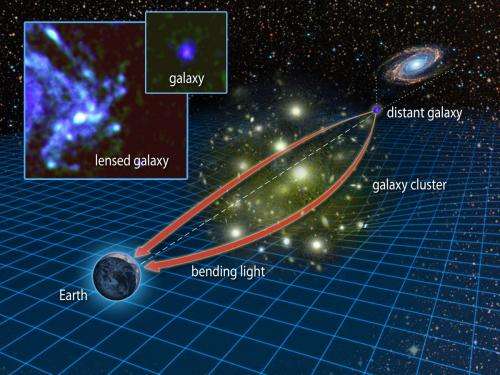
(PhysOrg.com) -- Astronomers in Hawaii have plucked unprecedented details from the life of an early galaxy using an unusually lucid gravitational lens coupled with the powerful 10-meter Keck II Telescope on Mauna Kea.
Gravitational lenses are Nature’s largest telescopes, created by colossally massive clusters of thousands of galaxies that bend and magnify the light of more distant objects behind them in a way similar to a glass lens. But gravitational lenses are far from perfect. Though they make very distant galaxies from the early universe visible to telescopes, they also put the images through a cosmic blender. As a result, the smeared and distorted images don’t offer much in the way of direct information about what the earliest galaxies looked like.
But that is not the case for an elegant little spiral galaxy called Sp1149, located 9.3 billion light-years away. The galaxy’s image has come through a gravitational lens magnified 22 times and fairly intact, as seen in a Hubble Space Telescope image. The image was first observed in detail by the University of Hawaii’s Tiantian Yuan and was initially taken by Harald Ebeling, also of Hawaii, and published by Graham P. Smith and colleagues in 2009. The giant cluster of galaxies that created the lens is located in the vast expanse of space between Sp1149 and Earth, and appears beside Sp1149 in the Hubble image.
The secret to Sp1149’s successful magnification is that it is in a special position behind the cluster which allows its light to be bent equally in all directions, explained astronomer Lisa Kewley of the University of Hawaii at Manoa.
“We’re lucky that it’s not being terribly distorted,” said Kewley. “Something so far away that’s not lensed would look like a blurred dot.”
The fact that you can distinguish the galactic core and spiral arms of Sp1149, plus the fact that we are seeing the galaxy as it was when the universe was only a third of its current age, makes it a great specimen for testing different models of how galaxies are born and then grow up to be places like our own Milky Way.
To that end, Yuan, Kewley and their colleagues aimed the Keck II Telescope at Sp1149. With the help of Laser Guide Star Adaptive Optics (which cancels out much of the optical distortions caused by Earth’s atmosphere) and the OSIRIS instrument (which filters out the noise created by hydroxyl molecules in Earth’s atmosphere) the researchers were able to get an unprecedented look at the distributions of elements in Sp1149. Oxygen, in particular, is very revealing because the element accumulates more in the older stellar neighborhoods – the parts of galaxies where stars have lived and died more. In the case of Sp1149, the oxygen distribution spoke volumes.
“The oxygen in the spiral galaxy was much more concentrated at the center,” said Kewley. “They had a lot of star formation at the center.”
This sharp oxygen gradient, from core to outer disk, suggests that stars in the cores of galaxies form first and create the oldest stellar neighborhoods in Sp1149, followed later by the disk and arms. That supports what’s called the inside-out model of galactic evolution, she said.
“This is an idea that has been out there,” explained Kewley. “Some models predict the opposite. “It’s been an open question for a long time.” What has been needed was something other than a local galaxy to study to see how the oxygen gradients looked much earlier in a galaxy’s history. Without that, astronomers would have nothing but middle aged galaxies to judge from. They would be like a biologist studying the lives of frogs without ever having seen a tadpole.
“This is the first time anyone has done such a detailed and precise oxygen gradient that wasn’t on a local galaxy,” said Kewley. Yuan, Kewley and their colleagues published their discovery in the journal May 1 issue of Astrophysical Journal Letters (available online at arxiv.org/abs/1103.3277)
Now that the team has found one galactic tadpole, they are hunting for more, said Kewley. They also are hoping to study some galaxies that are midway between the ages of our local galaxies and Sp1149. With these samples from different ages, Kewley and her colleagues hope to piece together a much clearer life history of galaxies like our own.
Provided by W. M. Keck Observatory


