Cell phones may be contributing to the honeybee population decline
May 18, 2011 by Deborah Braconnier report

bee

Enlarge

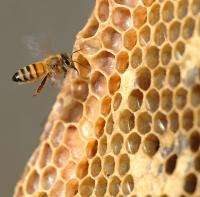
A honey bee robs a comb. Photo by Lynn Ketchum

(PhysOrg.com) -- In a new study published in Apidologie, Lausanne researcher and bee specialist Daniel Favre shares his findings of cell phones electromagnetic fields and their effects on the honeybee population. Research is being done worldwide to try and explain the phenomenon known as Colony Collapse Disorder (CCD), where workers bees disappear from a colony and cause a decline in honeybees, and Favre's research puts another idea out there.

In his experiment, Favre placed two cell phones inside a bee hive and set up equipment to record the sounds of the when the phones were off, in stand-by mode, and active in a phone call. After the phones had been on for about 20 - 40 minutes, the bees began to make a high pitched squeaking sound known as “piping.” This sound is usually a single made by the bees to announce swarming or that the hive is in danger. However, even after the phone signals running for 20 hours and the “piping” sound continuing, the bees did not swarm. Within only two minutes of the cell phones being turned off, the bees calmed down to their original state.

Favre is calling for the international scientific community to continue looking into the connection between cell phones and and the decline in the population.

While this experiment does show that phones in a close proximity to beehives can disrupt the normal bee behavior, scientists argue that cell phones are not normally found in beehives and believe that other causes, such as pesticides, the varroa mite, viruses, genetically modified crops, and unusually cold winters.

British bee expert Norman Carreck does not hold much weight in the study as having a link to CCD as he says you can knock or hit a beehive and receive the same result this experiment shows and many cases of CCD in the United States have taken place in remote areas where cell phone signals would not be an issue.

More information: Mobile phone-induced honeybee worker piping, Apidologie, DOI: 10.1007/s13592-011-0016-x , Paper online.

Abstract
The worldwide maintenance of the honeybee has major ecological, economic, and political implications. In the present study, electromagnetic waves originating from mobile phones were tested for potential effects on honeybee behavior. Mobile phone handsets were placed in the close vicinity of honeybees. The sound made by the bees was recorded and analyzed. The audiograms and spectrograms revealed that active mobile phone handsets have a dramatic impact on the behavior of the bees, namely by inducing the worker piping signal. In natural conditions, worker piping either announces the swarming process of the bee colony or is a signal of a disturbed bee colony.

© 2010 PhysOrg.com

4.5 /5 (8 votes)  

Filter


Move the slider to adjust rank threshold, so that you can hide some of the comments.


Display comments: newest first

jtdrexel
May 18, 2011

Rank: 5 / 5 (4)
"...scientists argue that cell phones are not normally found in beehives..."

That's a very good argument!
SteveL
May 18, 2011

Rank: not rated yet
The idea that cell phones, more specifically their signals, or electrical/electronic signals in general are a possible source of CCD has been suggested for a few years now. Not exactly a new idea. Putting a cell phone inside a bee hive is an interesting experiment, but as it's not realistically representative of normal use or signal strength I'm not sure how this information is expected to be useful.

It would be interesting to know if bees living in large areas of "organic" farming experience the same CCD rates as around non-organic farming.
Moebius
May 18, 2011

Rank: not rated yet
Cell phone signals are lower power RF. The current thinking is that insects should not be affected by RF at ALL. If putting a cell phone in a hive really affects them as described it is totally relevant because it shows they ARE affected by RF.
b2theory
May 18, 2011

Rank: 3 / 5 (2)
Cell phone signals are lower power RF. The current thinking is that insects should not be affected by RF at ALL. If putting a cell phone in a hive really affects them as described it is totally relevant because it shows they ARE affected by RF.


Putting a cell phone into a hive doesn't isolate the RF. In close proximity, cell phones can do quite a few different things. They heat up. The conductors in the switching regulators may vibrate due to magnetostriction. The speakers may have a non-zero noise floor. As the components heat up they may out-gas.

This is actually an extremely dumb experiment. If you wanted to control for RF you would spend a couple hundred bucks and rent a horn antenna and an RF amp to perform power and frequency sweeps.
hesit8or
May 18, 2011

Rank: not rated yet
I looked into this a few years ago my conclusion was that it was the Square wave that was being used in the digital signal that was causing the problem even if the Square waves were used to repersent an analogue wave this problem still occurred but if an Analog Wave was used with no digital Square wave @same freq no change was noticed i have also noticed this with fish that i keep they become a lot more irritated it seems when a strong digital signal is present
MediocreSmoke
May 19, 2011

Rank: not rated yet
Does anybody ever proofread these articles or even look at what their STT program is writing?
Sean_W
May 19, 2011

Rank: not rated yet
"and Favre's research puts another idea out there."

Hey that's great. But let me put an idea out there. CCD is caused by bees becoming despondent at the state of scientific literature. They think that there are very few papers written lately that were not authored by drunken hippies with little concept of correlation vs causality or basing a conclusion on evidence.

The bees are so disgusted by science journals that they have been going off in suicide pacts and stinging each other.
Rank 4.5 /5 (8 votes)
Relevant PhysicsForums posts

More news stories

Scientist: Evolution debate will soon be history

(AP) -- Richard Leakey predicts skepticism over evolution will soon be history. Not that the avowed atheist has any doubts himself.

Biology / Evolution

created 13 hours ago | popularity 3.5 / 5 (11) | comments 30

Thousands of shellfish found dead in Peru

Thousands of crustaceans were found dead off the coast of Lima following the mystery mass death of dolphins and pelicans, the Peruvian Navy said Friday.

Biology / Ecology

created 23 hours ago | popularity 4.8 / 5 (4) | comments 7

More plant species responding to global warming than previously thought

(Phys.org) -- Far more wild plant species may be responding to global warming than previous large-scale estimates have suggested.

Biology / Ecology

created May 22, 2012 | popularity 4.6 / 5 (14) | comments 18 | with audio podcast

For monogamous sparrows, it doesn't pay to stray (but they do it anyway)

It's quite common for a female song sparrow to stray from her breeding partner and mate with the male next door, but a new study shows that sleeping around can be costly.

Biology / Plants & Animals

created May 22, 2012 | popularity 5 / 5 (1) | comments 7 | with audio podcast

Study uncovers secret to speedy burrowing by razor clams

(Phys.org) -- If you look at a razor burrowing clam sitting in a bucket, you’d never guess that it could burrow itself down into the soil, much less do it with any speed. Razor clams look like fat straws, ...

Biology / Plants & Animals

created May 25, 2012 | popularity 1 / 5 (1) | comments 3 | with audio podcast report


Nvidia trumpets Tegra 3 phone design wins for 2012

(Phys.org) -- Nvidia’s competitive war paint has a name, Tegra 3. On the heels of Nvidia announcements about lowering costs of its Tegra 3 processors and Nvidia-enabled tablets running Android Ice Cream ...

Browser wars flare in mobile space

The browser wars are heating up again, but this time the fight is for dominance of the mobile Internet.

Dell tablet leak: 10.1-inch display, two-battery choice

(Phys.org) -- Headline after headline talks about vendors’ tablets in the wings as likely number-one contenders for the iPad. Such claims have justifiably been taken with a grain of salt, considering ...

SpotterRF debuts Radar Backpack Kit (w/ Video)

(Phys.org) -- SpotterRF has announced a special radar backpack kit designed to enhance situational awareness for soldiers on the ground. The company says its special radar is designed for warfighters as part ...

SpaceX capsule has 'new car' smell, astronauts say (Update)

SpaceX's Dragon cargo vessel smells like a new car, said astronauts at the International Space Station after opening the hatches Saturday following the spacecraft's landmark mission to the orbiting lab.

Australia hails surprise super-telescope decision

Australia has hailed a surprise decision giving it a role in a radio telescope project aimed at revolutionising astronomy, vowing to draw on its decades of experience in space science.