Bees 'read sky' to find home
May 18, 2011

Bees 'read sky' to find home

Enlarge

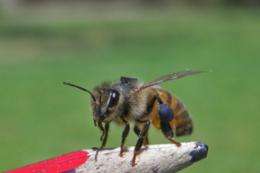
This honeybee pollen forager is being released 3km from her hive. The RFID chip on her back enables researchers to measure the bees' exact flight times and homing success. Credit: Mario Pahl.

(PhysOrg.com) -- Bees remember landmarks and read information from the sky to find their way home from an amazing 11 kilometres away and over several days’ travel, a new study from The Australian National University shows.

Vision scientists have found more reasons for the honeybee’s incredible knack of navigating cross-country – these creatures often rely on the position of the sun, the polarisation of light in the , the panorama view of the horizon and landmarks including towers, mountains or lakes.

Led by Professor ShaoWu Zhang from the ARC Centre of Excellence in Vision Science and ANU, the research team released bees in Canberra, where the landmarks include Black Mountain, Mount Ainslie, Red Hill and Lake Burley Griffin.

“We found that from four kilometres onwards, honeybees coming from the eastern direction return to their hives sooner than bees from the north, west and south,” said Professor Zhang. “Also, when we released these bees from seven kilometres and above, only those from the east can successfully find their way back.

“This is because bees released from the east can see Black Mountain in the opposite direction. It also helps if they are released in the early afternoon, when the sun is situated in the west, too. When they fly towards Black Mountain, familiar local features can guide them back to the hive.”

In the study, the team caught foragers as they returned to their hives and displaced them in a black box. The bees were then released in novel spots at various distances up to 13 kilometres in the north, east, south and west.

“In their forage trips, one way that honeybees use to find their way home is by storing distance and directional information when they venture out,” said Professor Zhang. “In other words, they try to go back the way they came.

“Catching them as soon as they reach their hives and placing them in a black box sets their pre-calculated information back to zero, so the bees are deprived of any directional information in relation to the hive. By doing this, we can confirm that they are relying solely on knowledge that they have gathered about the landscape to travel home.”

The team also used new technology to track the bee’s journey. They placed Radio Frequency Identification (RFID) tags on each bee and left a receiver at the hive entrance. The system recorded the exact arrival time of the individually targeted bees, including the late arrivals, ensuring accurate results without having a researcher keep watch for hours on end.

released from longer distances did not reach their hives until two to three days later,” he says. “What took us by surprise was the bee’s ability to retain their knowledge of the landscape and directions for several days.

“It’s fascinating that the honeybee has a brain the size of a small seed, but it still can keep so much information, and has so many creative ways to survive.”

More information: The research was carried out in collaboration with the ‘BEE group’ at Würzburg University, Germany, led by Professor Jürgen Tautz. The study Large Scale Homing in Honeybees by Mario Pahl, et al., was published last week in PloS ONE. It is available at http://bit.ly/in4XIr

Provided by Australian National University

Filter


Move the slider to adjust rank threshold, so that you can hide some of the comments.


Display comments: newest first

epsi00
May 18, 2011

Rank: not rated yet
If bees with a "brain the size of a small seed" can achieve so much why are we surprised to find out that animals with a much bigger and complex brain can do things only humans were thought capable of. Why are we so biased against animals?
Rank 5 /5 (1 vote)
Tags

Relevant PhysicsForums posts

More news stories

Scientist: Evolution debate will soon be history

(AP) -- Richard Leakey predicts skepticism over evolution will soon be history. Not that the avowed atheist has any doubts himself.

Biology / Evolution

created 13 hours ago | popularity 3.5 / 5 (11) | comments 30

Thousands of shellfish found dead in Peru

Thousands of crustaceans were found dead off the coast of Lima following the mystery mass death of dolphins and pelicans, the Peruvian Navy said Friday.

Biology / Ecology

created 23 hours ago | popularity 4.8 / 5 (4) | comments 7

More plant species responding to global warming than previously thought

(Phys.org) -- Far more wild plant species may be responding to global warming than previous large-scale estimates have suggested.

Biology / Ecology

created May 22, 2012 | popularity 4.6 / 5 (14) | comments 18 | with audio podcast

For monogamous sparrows, it doesn't pay to stray (but they do it anyway)

It's quite common for a female song sparrow to stray from her breeding partner and mate with the male next door, but a new study shows that sleeping around can be costly.

Biology / Plants & Animals

created May 22, 2012 | popularity 5 / 5 (1) | comments 7 | with audio podcast

Study uncovers secret to speedy burrowing by razor clams

(Phys.org) -- If you look at a razor burrowing clam sitting in a bucket, you’d never guess that it could burrow itself down into the soil, much less do it with any speed. Razor clams look like fat straws, ...

Biology / Plants & Animals

created May 25, 2012 | popularity 1 / 5 (1) | comments 3 | with audio podcast report


Nvidia trumpets Tegra 3 phone design wins for 2012

(Phys.org) -- Nvidia’s competitive war paint has a name, Tegra 3. On the heels of Nvidia announcements about lowering costs of its Tegra 3 processors and Nvidia-enabled tablets running Android Ice Cream ...

Browser wars flare in mobile space

The browser wars are heating up again, but this time the fight is for dominance of the mobile Internet.

Dell tablet leak: 10.1-inch display, two-battery choice

(Phys.org) -- Headline after headline talks about vendors’ tablets in the wings as likely number-one contenders for the iPad. Such claims have justifiably been taken with a grain of salt, considering ...

SpotterRF debuts Radar Backpack Kit (w/ Video)

(Phys.org) -- SpotterRF has announced a special radar backpack kit designed to enhance situational awareness for soldiers on the ground. The company says its special radar is designed for warfighters as part ...

SpaceX capsule has 'new car' smell, astronauts say (Update)

SpaceX's Dragon cargo vessel smells like a new car, said astronauts at the International Space Station after opening the hatches Saturday following the spacecraft's landmark mission to the orbiting lab.

Australia hails surprise super-telescope decision

Australia has hailed a surprise decision giving it a role in a radio telescope project aimed at revolutionising astronomy, vowing to draw on its decades of experience in space science.