Astronauts to try spacewalk 'hokey pokey': NASA
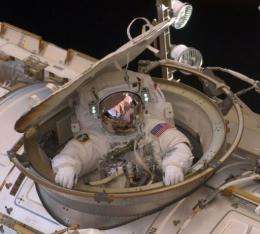
US astronauts on Tuesday will try out a new set of exercises to prepare them for the change in pressure they encounter on their spacewalk outside the International Space Station, NASA said.
Known in part as the "slow motion hokey pokey," the exercises are designed to prevent decompression sickness known as the bends, the type scuba divers can face if they rise to the surface too quickly, the US space agency said.
To prevent the bends, astronauts typically get their spacesuits on early and take a series of steps, such as breathing pure oxygen through a mask, in order to get rid of nitrogen in the bloodstream.
Otherwise they could form gas bubbles in their bodies as they stroll in space, causing pain in the joints, or in rare cases, paralysis or death.
On the eve of the past 70 spacewalks, astronauts have camped out overnight in an airlock where the pressure is 10.2 pounds per square inch, in between that of the space station (around 14 psi) and the spacesuits (about 4 psi).
The new combination of breathing and low-effort exercises, known officially as ILE, or in-suit light exercise prebreathe protocol, aims to skip the campout but still gradually purge nitrogen from the bloodstream.
On a perceived exertion scale of six to 20 -- where six is "sitting there not doing anything, we are asking crew members to target seven," said lead spacewalk officer Allison Bollinger.
"This is equivalent to walking a mile in about 70 minutes, so this is very light exercise," she explained.
Bollinger showed reporters a video of astronauts in their spacesuits, kicking one leg from the knee down, followed by a long pause, then the other leg kicking, then another long pause, then a brief flailing of the arms.
"This is what we call the slow motion hokey-pokey," she said.
After that they are scheduled to do a "50-minute resting pre-breathe," though they will break up that resting session into two separate parts for extra tests this time around.
It's a far cry from past days when astronauts would strap on an oxygen mask and pedal furiously on a stationary bicycle before stepping out on a spacewalk.
"The effort all along has been to save time and go out earlier, and to help conserve oxygen," explained Kylie Clem, a spokeswoman for mission control in Houston.
But like anyone who tries to squeeze in some exercise before work, the effort has already fallen short of one of its main goals.
"The one drawback to this protocol though is it does take longer in the morning to get out the door than it does with the campout protocol," said Bollinger. "About 30 minutes later."
Still, the new regimen is part of the longer-term goal of helping conserve the amount of oxygen needed at the International Space Station, which will be important once the shuttle program ends later this year and Russia's spacecraft are the only vehicles equipped to tote oxygen to the orbiting lab.
"It is estimated that we are going to use less oxygen during this protocol so post shuttle retirement this will be a big deal for the station," said Bollinger.
A pre-spacewalk campout uses up 25 pounds of oxygen per astronaut, whereas the ILE uses about 18-20 pounds each, said NASA spokesman Kelly Humphries.
It's not that astronauts are in danger of running out of oxygen at the station. NASA is simply seeking ways to trim the long-term overall costs of resupplying the ISS, said Humphries.
"Any time you can save oxygen, that is one of the things you don't have to resupply," he said.
The spacewalk -- the third of four scheduled spacewalks during the Endeavour shuttle's mission to the International Space Station -- begins Wednesday at 1:46 am Eastern time in the United States, or 0546 GMT.
The two American astronauts who will step out on the walk are STS-134 mission specialists Drew Feustel and Mike Fincke.
Objectives of the walkabout include completing an external wireless antenna system and making some fixes to the Russian side of the space station.
If the new pre-walk exercises are judged a success, they might be used again for the fourth and final spacewalk of the mission.
(c) 2011 AFP


