Solar activity heats up
April 15, 2011 Dr. Tony Phillips

Solar activity heats up

Enlarge

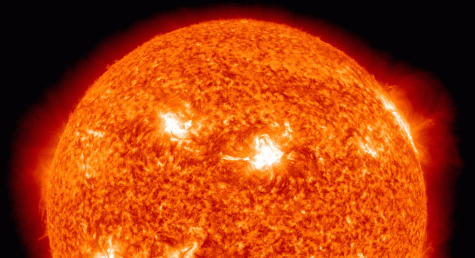
NASA's Solar Dynamics Observatory recorded this X1.5-class solar flare on March 9, 2011.

(PhysOrg.com) -- If you've ever stood in front of a hot stove, watching a pot of water and waiting impatiently for it to boil, you know what it feels like to be a solar physicist.

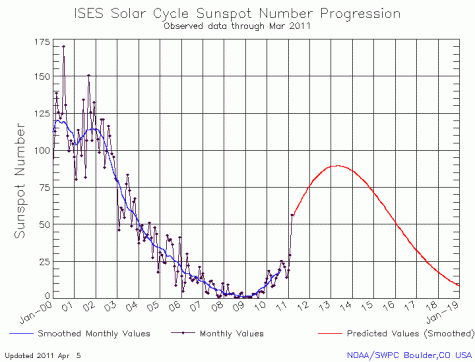
Back in 2008, the solar cycle plunged into the deepest minimum in nearly a century. Sunspots all but vanished, subsided, and the was eerily quiet.

"Ever since, we've been waiting for solar activity to pick up," says Richard Fisher, head of the Heliophysics Division at NASA Headquarters in Washington DC. "It's been three long years."

Quiet spells on the sun are nothing new. They come along every 11 years or so—it's a natural part of the solar cycle. This particular solar minimum, however, was lasting longer than usual, prompting some researchers to wonder if it would ever end.

News flash: The pot is starting to boil. "Finally," says Fisher, "we are beginning to see some action."

As 2011 unfolds, sunspots have returned and they are crackling with activity. On February 15th and again on March 9th, Earth orbiting satellites detected a pair of "X-class" solar flares--the most powerful kind of x-ray flare. The last such eruption occurred back in December 2006.
Solar activity heats up
Enlarge

After years of lying low, sunspot counts are on the rise again.

Another eruption on March 7th hurled a billion-ton cloud of plasma away from the sun at five million mph (2200 km/s). The rapidly expanding cloud wasn't aimed directly at Earth, but it did deliver a glancing blow to our planet's magnetic field. The off-center impact on March 10th was enough to send Northern Lights spilling over the Canadian border into US states such as Wisconsin, Minnesota, and Michigan.

"That was the fastest coronal mass ejection in almost six years," says Angelos Vourlidas of the Naval Research Lab in Washington DC. "It reminds me of a similar series of events back in Nov. 1997 that kicked off Solar Cycle 23, the solar cycle before this one."

"To me," says Vourlidas, "this marks the beginning of Solar Cycle 24."

The slow build-up to this moment is more than just "the watched pot failing to boil," says Ron Turner, a space weather analyst at Analytic Services, Inc. "It really has been historically slow."

There have been 24 numbered solar cycles since researchers started keeping track of them in the mid-18th century. In an article just accepted for publication by the Space Weather Journal, Turner shows that, in all that time, only four cycles have started more slowly than this one. "Three of them were in the Dalton Minimum, a period of depressed solar activity in the early 19th century. The fourth was Cycle #1 itself, around 1755, also a relatively low solar cycle," he says.

In his study, Turner used sunspots as the key metric of . Folding in the recent spate of sunspots does not substantially alter his conclusion: " 24 is a slow starter," he says.

Better late than never.

See the ScienceCast of this story:

This video is not supported by your browser at this time.


Provided by Science@NASA

Filter


Move the slider to adjust rank threshold, so that you can hide some of the comments.


Display comments: newest first

CapitalismPrevails
Apr 15, 2011

Rank: not rated yet
Next year will have solar storm of 1859 all over again.
omatumr
Apr 15, 2011

Rank: 1 / 5 (5)
Thanks, Tony, for this interesting and well-written report on the Sun.

Nothing that astronomers study could be of more importance to the public than quantitative information on Earth's heat source - the Sun.
beelize54
Apr 15, 2011

Rank: 3 / 5 (4)
It seems, the global warming period is returning again. It would be unpleasant.
Calenur
Apr 16, 2011

Rank: 4 / 5 (4)
Will you PLEASE do something about these ads? This is getting infuriating.

Tachyon8491
Apr 16, 2011

Rank: 5 / 5 (1)
I have reported this arrogant, self-serving commercial sewage several times to Physorg's management - WHEN ARE YOU GOING TO GET RID OF THIS INVASIVE BASTARD!!!
deepsand
Apr 17, 2011

Rank: 3.7 / 5 (6)
Nothing that astronomers study could be of more importance to the public than quantitative information on Earth's heat source - the Sun.

Is this an acknowledgment that the Sun, by virtue of its having been in a protracted MINIMUM, cannot be the cause of global warming?
omatumr
Apr 17, 2011

Rank: 1 / 5 (7)
Nothing that astronomers study could be of more importance to the public than quantitative information on Earth's heat source - the Sun.

Is this an acknowledgment that the Sun, by virtue of its having been in a protracted MINIMUM, cannot be the cause of global warming?


No. The Sun's influence on Earth's climate is explained here:

http://arxiv.org/pdf/0905.0704

The photosphere that we observe:

a.) Is a glowing cloud of waste products (H and He) from the Suns central neutron star:

http://arxiv.org/...2.1499v1

b.) That will eventually expand "to the orbit of Mercury or Venusor even the Earth!

According to NASAs Dr. Sten Odenwald:

www.astronomycafe...958.html

deepsand
Apr 17, 2011

Rank: 4.2 / 5 (5)
Nothing that astronomers study could be of more importance to the public than quantitative information on Earth's heat source - the Sun.

Is this an acknowledgment that the Sun, by virtue of its having been in a protracted MINIMUM, cannot be the cause of global warming?

No. The Sun's influence on Earth's climate is explained here:

Nice evasion.

But, since the far distant future is of no practical import to the here and now, perhaps you'd care to address the question in the current context.
omatumr
Apr 17, 2011

Rank: 1 / 5 (6)
Typo's Corrected:

1. Earth's ever-changing climate is controlled by the Sun:

http://arxiv.org/pdf/0905.0704

2. The photosphere is a glowing cloud of waste products (H and He) from the Sun's central neutron star:

http://arxiv.org/...2.1499v1

3. According to NASA's Dr. Sten Odenwald, the photosphere will eventually expand into a red giant star that extends out all the way "to the orbit of Mercury or Venus or even the Earth!"

www.astronomycafe...958.html
deepsand
Apr 18, 2011

Rank: 5 / 5 (5)
Typo's Corrected:

1. Earth's ever-changing climate is controlled by the Sun:


Still evades the question re. the current situation.
deepsand
Apr 18, 2011

Rank: 5 / 5 (3)
@ geokstr

Cat got your tongue?

Ethelred
Apr 18, 2011

Rank: 5 / 5 (3)
Calenur
ill you PLEASE do something about these ads?
YOU can DO something. And I note that you don't. Not yet anyway.

Give the post a one and then click on REPORT ABUSE click then on yes. And you can do even more. Click on the Spammer's handle to go to its profile then activity to see the other posts. Then open each of the threads and REPORT ABUSE on each of the spammer's posts.

I seem to be one of the few doing this but I am not the only one.

Join the Few, The Proud, The Anti-Spam Corp.

Ethelred
Ethelred
Apr 18, 2011

Rank: 5 / 5 (5)
b.) That will eventually expand "to the orbit of Mercury or Venusor even the Earth!
Based on a theory that YOU don't believe. So why pretend that you do?

The expansion of suns shows that they DO NOT HAVE neutron stars in them. Or iron or whatever other nonsense you are using this week. Neutron star CANNOT expand as the all matter on them would become degenerate.

Still evades the question re. the current situation.
He evades most hard questions. Follow up questions or repeated questions that he doesn't like result in him giving you ones.

Ethelred
deepsand
Apr 18, 2011

Rank: 5 / 5 (3)
Still evades the question re. the current situation.
He evades most hard questions. Follow up questions or repeated questions that he doesn't like result in him giving you ones.

Ethelred

Of that I am well aware.

I address him simply to keep him aware of the fact that he does speak with impunity, that his inability and/or unwillingness to engage in rational discourse does not go unnoticed.

His "1s" signal that I've succeeded in getting his attention. :D
Rank 5 /5 (8 votes)
Relevant PhysicsForums posts
  • revamping general concept and cosmological principle
    createdMay 25, 2012
  • Transiting Exoplanet Light Curve
    createdMay 25, 2012
  • Math behind Theoretical Physics
    createdMay 24, 2012
  • Do we know whats at the center of galaxies yet?
    createdMay 23, 2012
  • Structure of the Milky Way?
    createdMay 20, 2012
  • What would it take to terraform Pluto and Charon?
    createdMay 19, 2012
  • More from Physics Forums - General Astronomy

More news stories

SpaceX capsule has 'new car' smell, astronauts say (Update)

SpaceX's Dragon cargo vessel smells like a new car, said astronauts at the International Space Station after opening the hatches Saturday following the spacecraft's landmark mission to the orbiting lab.

Space & Earth / Space Exploration

created 21 hours ago | popularity 4.5 / 5 (20) | comments 1

Australia hails surprise super-telescope decision

Australia has hailed a surprise decision giving it a role in a radio telescope project aimed at revolutionising astronomy, vowing to draw on its decades of experience in space science.

Space & Earth / Astronomy

created 21 hours ago | popularity 5 / 5 (4) | comments 2

Dragon arrives at space station in historic 1st (Update 2)

The privately bankrolled Dragon capsule made a historic arrival at the International Space Station on Friday, triumphantly captured by astronauts wielding a giant robot arm.

Space & Earth / Space Exploration

created May 25, 2012 | popularity 5 / 5 (10) | comments 19

Astronomers seize last chance in lifetime for Venus Transit

Astronomers are gearing for one the rarest events in the Solar System: an alignment of Earth, Venus and the Sun that will not be seen for another 105 years.

Space & Earth / Astronomy

created 21 hours ago | popularity 5 / 5 (3) | comments 2

Organic carbon from Mars, but not biological

(Phys.org) -- Molecules containing large chains of carbon and hydrogen--the building blocks of all life on Earth--have been the targets of missions to Mars from Viking to the present day. While these molecules ...

Space & Earth / Space Exploration

created May 24, 2012 | popularity 4.4 / 5 (5) | comments 2 | with audio podcast


Nvidia trumpets Tegra 3 phone design wins for 2012

(Phys.org) -- Nvidia’s competitive war paint has a name, Tegra 3. On the heels of Nvidia announcements about lowering costs of its Tegra 3 processors and Nvidia-enabled tablets running Android Ice Cream ...

Browser wars flare in mobile space

The browser wars are heating up again, but this time the fight is for dominance of the mobile Internet.

Dell tablet leak: 10.1-inch display, two-battery choice

(Phys.org) -- Headline after headline talks about vendors’ tablets in the wings as likely number-one contenders for the iPad. Such claims have justifiably been taken with a grain of salt, considering ...

Scientist: Evolution debate will soon be history

(AP) -- Richard Leakey predicts skepticism over evolution will soon be history. Not that the avowed atheist has any doubts himself.

Of mice and mental models: Neuroscientific implications of risk-optimized behavior in the mouse

(Medical Xpress) -- Regardless of an organism’s biological complexity, every encephalized animal continuously makes under-informed behavioral choices that can have serious consequences. Despite its ubiquity, ...

SpotterRF debuts Radar Backpack Kit (w/ Video)

(Phys.org) -- SpotterRF has announced a special radar backpack kit designed to enhance situational awareness for soldiers on the ground. The company says its special radar is designed for warfighters as part ...