Scientists discover mechanism that could feed solar explosions
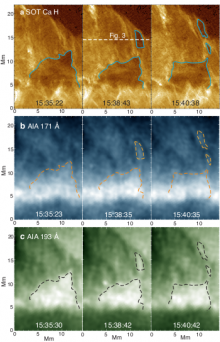
(a) Top row: SOT Ca H-line images showing the dark prominence bubble developing a sharp protrusion that develops into the large plume. The plume is fully separated from the bubble by 15:38:43 UT. The outlines of the bubble and plume are traced in these images. (b) Middle row: SDO/AIA 17.1 nm images of the bubble and plume development. The yellow dashed lines are taken from the Hinode/SOT tracings in the top row. They show that the bubble and plume brightness in this spectral line correspond exactly to the dark bubble and plume outlines in the SOT images. (c) Bottom row: SDO/AIA 19.3 nm images of the bubble and plume development. The black dashed lines are the outlines taken from the top row. Again, the brightness of the bubble and plume in this spectal line are apparent.
(PhysOrg.com) -- Coronal Mass Ejections (CMEs) are violent solar explosions that can propel up to 10 billion tons of the Suns atmosphere at a million miles an hour out through the corona and into space. These fast, powerful ejections can take as little as 18 hours to reach Earth and give rise to geomagnetic storms, which can disrupt radio transmissions, induce large currents in power lines and oil pipelines, seriously disrupt spacecraft and be extremely hazardous to astronauts. New instruments on advanced spacecraft have provided fresh insight into these cataclysmic phenomena, and illuminated a path toward predicting space weather.
In a paper published today in the journal Nature, researchers from the Solar and Astrophysics Laboratory (LMSAL) of the Lockheed Martin Advanced Technology Center (ATC), along with colleagues at the Harvard-Smithsonian Center for Astrophysics, Kyoto University, and the High Altitude Observatory of the National Center for Atmospheric Research (which is sponsored by the National Science Foundation) have discovered a turbulent convective flow system in solar "quiescent" prominences suspended in the coronathe Suns outer atmosphere that point to a mechanism by which hot coronal plasma (and presumably magnetic flux) are injected upwards into the coronal cavity system. Coronal cavities are large magnetic flux ropes suspended in the corona, typically in the polar regions of the Sun. These flux ropes all eventually erupt in the form of CMEs that can impact the interplanetary and terrestrial space environments.
This video is not supported by your browser at this time.
The images have been rotated to show the solar limb horizontal. Notice the large bubble that rises through the prominence until it collapses and then reforms in the same location to collapse again. During the second collapse, the boundary shows clear classic Rayleigh-Taylor symmetric plume/spike formation. Also note the bright emission structure in the 171 channel that rises just below the dark front and then breaks through the front during the cavity collapse. This is the hot core of the emerging structure that causes the large dark bubble visible in the 304 channel.
How these large flux ropes erupt is a poorly understood fundamental process in the science of space weather. Our discovery points to a way in which intermittent bubbles in solar prominences can inject new mass and magnetic flux into the flux ropes, thus slowly building up their magnetic buoyancy over time. These bubbles, which can be as wide as several Earth diameters, are analogous to the blobs of material in a Lava Lamp that are heated by a light from below, become buoyant, and rise to the top to deposit their energy, then drop back down again. By this mechanism coronal cavity flux ropes could grow slowly until they are able to exceed the tethering forces of overlying magnetic fields and thus erupt as CMEs, said Dr. Thomas Berger, lead author of the Nature paper, and solar physicist at the Lockheed Martin Solar and Astrophysics Lab at the ATC. If we can show in further research that the prominence bubbles are indeed magnetic flux emergence events taking place below prominences, we can verify that weve found a new mechanism for transferring magnetic flux from the convection zone into the corona, and perhaps establish a predictive tool for the eruption of CMEs based on the rate of observed flux injection.
The researchers used observations from the Atmospheric Imaging Assembly (AIA) on NASAs recently launched Solar Dynamics Observatory (SDO) and NASAs Focal Plane Package for the Solar Optical Telescope (SOT) on the Japanese Hinode satellite. Both instruments were designed and built at the ATC.
This video is not supported by your browser at this time.
The images have been rotated to show the solar limb horizontal. The pixel scale of the images is 0.108 arcseconds per pixel. The full field-of-view (FOV) is 130 x 89 arcseconds (95 x 65 Mm) with the rotated SOT FOV contained within. The time span of the movie is from 15:02 UT to 17:44 UT with a 34-minute gap due to an eclipse by the Earth from 16:06 to 16:40 UT. The average cadence (time between frames) in the movie is 14 sec. Note the dark semi-circular bubble and plume formation in the lower right region of the prominence. The plume is visible from approximately 15:34 to 15:44 UT (6,000 sec).
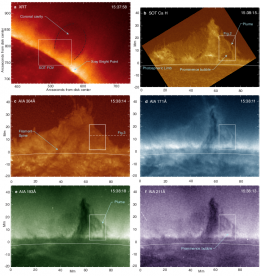
It was the high spatial and temporal resolution of SOT, combined with the broad temperature coverage of AIA that unlocked the mystery. SOT movies from 2006--2009 reveal dark "bubbles" forming below 10,000 K prominence material. These bubbles go unstable and form turbulent upflow plumes that rise into the prominence and the 1,000,000 K "coronal cavity" above the prominence. SOT images alone couldn't identify the source of the bubbles buoyancy¬was it magnetic field concentration or thermal energy that led to the buoyancy relative to the heavy prominence above? In August 2010, using a simultaneous prominence observation by SOT and the newly launched AIA instrument suite, Berger and his team discovered that the bubbles were heated to temperatures of at least 250,000 K and more likely 1,000,000 K before rising into the prominence. This is 25-100 times hotter than the overlying prominence and implies that in addition to any magnetic buoyancy in the system, there is significant thermal buoyancy as well.(a) Hinode X-Ray Telescope (XRT) image of the region surrounding the prominence. The coronal cavity above the prominence is denoted by the dashed black lines. XRT images coronal plasma in the 1--3 MK temperature range. Note the much larger field-of-view of XRT compared to the following images. The axes are labelled in arcseconds from solar disk center. (b) Hinode Solar Optical Telescope (SOT) image of the quiescent prominence below the coronal cavity. The image is taken in the spectral line of ionized Calcium at 396.8 nm in the visible spectrum (the "H-line"). This spectral line images plasma in the 7,000--10,000 K temperature range. The white box shows the field-of-view of Figure 2 below. The dark prominence bubble and a large plume from the bubble are pointed out in the image. Note that the image has been rotated relative to (a) to place the solar limb approximately horizontal. (c) Solar Dynamics Observatory (SDO) Atmospheric Imaging Assembly (AIA) image of the same prominence as in (b). The image is taken in the spectral line of ionized Helium at 30.4 nm. This spectral line images plasma in the 50,000--80,000 K temperature range. The white dashed line defines a line along which emission is measured in Figure 3. (d) SDO/AIA image of the prominence in the spectral line of ionized iron at 17.1 nm showing the prominence plasma at a temperature of approximately 700,000 K. Note that the prominence bubble and plume are bright in this spectral line. (e) SDO/AIA image of the prominence in the spectral line of ionized iron at 19.3 nm showing the prominence plasma at a temperature of approximately 1,250,000 K. Note that the prominence bubble and plume are bright in this spectral line. (f) SDO/AIA image of the prominence in the spectral line of ionized iron at 21.1 nm showing the prominence plasma at a temperature of approximately 1,700,000 K. Note that the prominence bubble and plume are bright in this spectral line. Axes in panels (b)--(f) are labelled in Megameters (1,000,000 meters). The UT times of the images are shown in the upper right corners.
This discovery is significant because it revises the common view that the magnetic field in the corona dominates the gas pressure and allows only simple, laminar, flows along magnetic field lines. Here we establish that the prominence bubbles and resultant plumes are a form of the Rayleigh-Taylor instability, a buoyant turbulent flow system that, combined with the cool downflowing plasma in quiescent prominences, represents a form of convection, or overturning motion in the prominence/corona system the first confirmed discovery of convection in the solar outer atmosphere, added Berger. It is apparent that our understanding of basic forces at work in the corona must be revised to include turbulent motions that can deform the magnetic field lines and produce novel flow and mixing systems.The Solar and Astrophysics Laboratory at the ATC conducts basic research into understanding and predicting space weather and the behavior of our Sun including its impacts on Earth and climate. It has a 47-year-long heritage of spaceborne solar instruments including the Soft X-ray Telescope on the Japanese Yohkoh satellite, the Michelson Doppler Imager on the ESA/NASA Solar and Heliospheric Observatory, the solar telescope on NASAs Transition Region and Coronal Explorer, the Focal Plane Package on the Japanese Hinode satellite, the Solar X-ray Imagers on GOES-N, -O and P, the Extreme Ultraviolet Imager instruments on NASAs twin STEREO spacecraft, and the Helioseismic and Magnetic Imager and the Atmospheric Imaging Assembly on NASAs Solar Dynamics Observatory. The ATC is currently building both the science instrument and spacecraft for NASAs Interface Region Imaging Spectrometer (IRIS), a Small Explorer Mission scheduled for launch in late 2012.
The ATC is the research and development organization of Lockheed Martin Space Systems Company (LMSSC).
Provided by Lockheed Martin Corporation
-
From lemons to lemonade: Reaction uses carbon dioxide to make carbon-based semiconductor,
32 comments
-
Thioridazine kills cancer stem cells in human while avoiding toxic side-effects of conventional cancer treatments,
3 comments
-
SpaceX private rocket blasts off for space station (Update),
42 comments
-
Climate scientists say they have solved riddle of rising sea,
31 comments
-
Research team claims to have found evidence Lake Cheko is impact crater for Tunguska Event,
18 comments
-
revamping general concept and cosmological principle
May 25, 2012
-
Transiting Exoplanet Light Curve
May 25, 2012
-
Math behind Theoretical Physics
May 24, 2012
-
Do we know whats at the center of galaxies yet?
May 23, 2012
-
Structure of the Milky Way?
May 20, 2012
-
What would it take to terraform Pluto and Charon?
May 19, 2012
- More from Physics Forums - General Astronomy
More news stories
SpaceX capsule has 'new car' smell, astronauts say (Update)
SpaceX's Dragon cargo vessel smells like a new car, said astronauts at the International Space Station after opening the hatches Saturday following the spacecraft's landmark mission to the orbiting lab.
Space & Earth / Space Exploration
21 hours ago |
4.5 / 5 (20) |
1
Australia hails surprise super-telescope decision
Australia has hailed a surprise decision giving it a role in a radio telescope project aimed at revolutionising astronomy, vowing to draw on its decades of experience in space science.
21 hours ago |
5 / 5 (4) |
2
Dragon arrives at space station in historic 1st (Update 2)
The privately bankrolled Dragon capsule made a historic arrival at the International Space Station on Friday, triumphantly captured by astronauts wielding a giant robot arm.
Space & Earth / Space Exploration
May 25, 2012 |
5 / 5 (10) |
19
Astronomers seize last chance in lifetime for Venus Transit
Astronomers are gearing for one the rarest events in the Solar System: an alignment of Earth, Venus and the Sun that will not be seen for another 105 years.
21 hours ago |
5 / 5 (3) |
2
Organic carbon from Mars, but not biological
(Phys.org) -- Molecules containing large chains of carbon and hydrogen--the building blocks of all life on Earth--have been the targets of missions to Mars from Viking to the present day. While these molecules ...
Space & Earth / Space Exploration
May 24, 2012 |
4.4 / 5 (5) |
2
|
Nvidia trumpets Tegra 3 phone design wins for 2012
(Phys.org) -- Nvidias competitive war paint has a name, Tegra 3. On the heels of Nvidia announcements about lowering costs of its Tegra 3 processors and Nvidia-enabled tablets running Android Ice Cream ...
Browser wars flare in mobile space
The browser wars are heating up again, but this time the fight is for dominance of the mobile Internet.
Dell tablet leak: 10.1-inch display, two-battery choice
(Phys.org) -- Headline after headline talks about vendors tablets in the wings as likely number-one contenders for the iPad. Such claims have justifiably been taken with a grain of salt, considering ...
Scientist: Evolution debate will soon be history
(AP) -- Richard Leakey predicts skepticism over evolution will soon be history. Not that the avowed atheist has any doubts himself.
Of mice and mental models: Neuroscientific implications of risk-optimized behavior in the mouse
(Medical Xpress) -- Regardless of an organism’s biological complexity, every encephalized animal continuously makes under-informed behavioral choices that can have serious consequences. Despite its ubiquity, ...
SpotterRF debuts Radar Backpack Kit (w/ Video)
(Phys.org) -- SpotterRF has announced a special radar backpack kit designed to enhance situational awareness for soldiers on the ground. The company says its special radar is designed for warfighters as part ...