New pairs of compounds may help tree nuts fight fungal foe
April 29, 2011 By Marcia Wood

New Pairs of Compounds May Help Tree Nuts Fight Fungal Foe

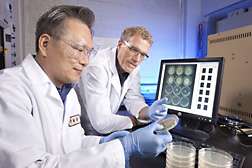
ARS research leader Bruce C. Campbell (right) and molecular biologist Jong H. Kim have teamed up with colleagues in Russia to explore new strategies for destroying fungi that attack tree nuts, grains, and other crops.

(PhysOrg.com) -- Some crunchy, good-for-you tree nuts like almonds and pistachios are vulnerable to attack by a troublesome mold known as Aspergillus flavus. The mold produces cancer-causing natural compounds called aflatoxins.

U.S. Department of Agriculture (USDA) scientists in Albany, Calif., are fighting back. They have teamed up with colleagues halfway around the globe—in Moscow—to explore new strategies for destroying A. flavus.

The researchers' anti-Aspergillus tactics might help quell other troublesome fungi as well. That's why this collaboration with the All-Russian Research Institute of Phytopathology in Moscow encompasses not only A. flavus but also several other key fungal foes. Targeted microbes include, for instance, Fusarium culmorum and Bipolaris sorokiana, both of which can cause root rots and other problems, and Alternaria alternata, which causes leaf spot disease of some crops.

Research leader Bruce C. Campbell, who heads the USDA Agricultural Research Service (ARS) Plant Mycotoxin Research Unit at Albany, developed the international collaboration to quicken discovery of that could work in concert with commercial fungicides. Ideally, the natural compound would make the target fungi more vulnerable to the fungicide.

Studies at Albany, started in 2004 by Campbell and ARS research molecular biologist Jong H. Kim, provide strong evidence to support this concept. By reducing the amount of fungicide commonly used today, the strategy may prove to be less costly and more environmentally friendly than conventional approaches, according to Campbell.

At the Moscow institute, scientists are rigorously testing the concept in studies coordinated by Vitaly Dzhavakhiya and Larisa Shcherbakova. In one study, the team paired thymol, a natural compound from thyme, with Folicur (tebuconazole), a commercial fungicide. The researchers determined that adding a very small amount of thymol to Folicur was about twice as effective in reducing growth of A. alternata than applying either thymol alone or the fungicide alone.

More information: Some of the research findings have been published in Applied Microbiology and Biotechnology, Biochemical and Biophysical Research Communications, FEMS Microbiology Letters, Fungal Biology, Letters in Applied Microbiology, Mycopathologia, and World Mycotoxin Journal.

Provided by USDA Agricultural Research Service


Rank not rated yet
Relevant PhysicsForums posts

More news stories

Scientist: Evolution debate will soon be history

(AP) -- Richard Leakey predicts skepticism over evolution will soon be history. Not that the avowed atheist has any doubts himself.

Biology / Evolution

created 10 hours ago | popularity 3.5 / 5 (11) | comments 23

Thousands of shellfish found dead in Peru

Thousands of crustaceans were found dead off the coast of Lima following the mystery mass death of dolphins and pelicans, the Peruvian Navy said Friday.

Biology / Ecology

created 20 hours ago | popularity 4.8 / 5 (4) | comments 6

More plant species responding to global warming than previously thought

(Phys.org) -- Far more wild plant species may be responding to global warming than previous large-scale estimates have suggested.

Biology / Ecology

created May 22, 2012 | popularity 4.6 / 5 (14) | comments 18 | with audio podcast

Totally rad: Scientists create rewritable digital data storage in DNA

(Phys.org) -- Scientists from Stanford's Department of Bioengineering have devised a method for repeatedly encoding, storing and erasing digital data within the DNA of living cells.

Biology / Biotechnology

created May 21, 2012 | popularity 4.9 / 5 (17) | comments 11 | with audio podcast

For monogamous sparrows, it doesn't pay to stray (but they do it anyway)

It's quite common for a female song sparrow to stray from her breeding partner and mate with the male next door, but a new study shows that sleeping around can be costly.

Biology / Plants & Animals

created May 22, 2012 | popularity 5 / 5 (1) | comments 7 | with audio podcast


Dell tablet leak: 10.1-inch display, two-battery choice

(Phys.org) -- Headline after headline talks about vendors’ tablets in the wings as likely number-one contenders for the iPad. Such claims have justifiably been taken with a grain of salt, considering ...

SpotterRF debuts Radar Backpack Kit (w/ Video)

(Phys.org) -- SpotterRF has announced a special radar backpack kit designed to enhance situational awareness for soldiers on the ground. The company says its special radar is designed for warfighters as part ...

SpaceX capsule has 'new car' smell, astronauts say (Update)

SpaceX's Dragon cargo vessel smells like a new car, said astronauts at the International Space Station after opening the hatches Saturday following the spacecraft's landmark mission to the orbiting lab.

Astronomers seize last chance in lifetime for Venus Transit

Astronomers are gearing for one the rarest events in the Solar System: an alignment of Earth, Venus and the Sun that will not be seen for another 105 years.

Australia hails surprise super-telescope decision

Australia has hailed a surprise decision giving it a role in a radio telescope project aimed at revolutionising astronomy, vowing to draw on its decades of experience in space science.

Keep food safety in mind this memorial day weekend

(HealthDay) -- Picnics, parades and cookouts are as much a part of Memorial Day weekend as tributes to the United States' war veterans.