Next-generation US space racers outline plans
April 28, 2011 by Kerry Sheridan
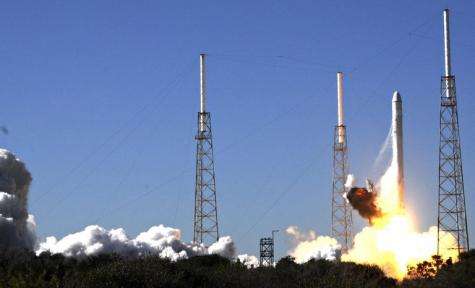
SpaceX's Falcon 9 rocket lifts off in 2010 to launch the Dragon space capsule into orbit. A handful of companies competing to make the spaceship to replace the iconic US shuttle said Thursday they are racing to shrink what will be a long gap in flying Americans into space aboard US craft.
A handful of companies competing to make the spaceship to replace the iconic US shuttle said Thursday they are racing to shrink what will be a long gap in flying Americans into space aboard US craft.
Boeing, SpaceX and Sierra Nevada Corporation were among the big winners of the latest round of US government funding, totaling 269.3 million dollars, through a NASA program to boost private companies' efforts.
It will likely be 2015 before a US vehicle is ready to take humans into space again, a timeline that has been widely touted by NASA as a reason for American optimism as the 30-year-old shuttle program comes to an end later this year.
But according to Mark Sirangelo, program manager at the Colorado-based Sierra Nevada Corp., his team could eke out a crew flight one year earlier with its Dream Chaser, modeled on a NASA design for a space station rescue vehicle.
"Our vehicle has been in testing for 12 years," said Sirangelo, adding that atmospheric tests would begin in 2012 and the first orbital tests would follow in 2014.
"By that time we would be crewed and ready in 2014," he said.
Sierra Nevada won the largest amount of NASA seed money, $20 million, in the first round in 2010, and the second largest sum in the latest round of NASA contracts issued earlier this month at $80 million.
SpaceX won $75 million in new seed money this year, after it became the first company to successfully send its own space capsule, the gumdrop-shaped Dragon, into orbit and back in December 2010.
The California-based company sent newly hired ex-NASA astronaut Garrett Reisman to speak to reporters alongside competitor companies at Kennedy Space Center one day before Endeavour takes off on the second-to-last shuttle flight.
"We are taking it to the next level," said Reisman, who smiled broadly after showing a slick animated video punctuated by electric guitar and pounding drumbeats, illustrating the company's progress in spaceflight.
"The Falcon 9 rocket and the Dragon capsule were designed from day one to carry people," he said. "It is under contract and we have built this in cooperation with NASA."
SpaceX is planning a cargo launch for the Dragon later this year, to "take it to the space station, dock it and unload it," he said.
As to when the Dragon might carry astronauts, Reisman said it depends on funding.
"We still believe we could have people in the Dragon three years from now, however we would need additional support from NASA," he said.
Boeing won the biggest contract in this round with $92.3 million, and program manager John Elbon said the money would be used to advance its CST-100 spacecraft through the design review process with an eye to "full crew transport ability by 2015."
"We are really focused on keeping it simple," said Elbon.
"Having a simple system makes it safe and reliable and helps keep operational costs low."
Blue Origin of Kent, Washington, got $22 million in funding, but its New Shepard vehicle is only being tested for sub-orbital flight "before we commit to orbital development," said company representative Rob Meyerson.
Sirangelo said the NASA contract system sets competition in motion by paying companies only after they reach certain milestones.
"It self adjusts -- those companies that are successful will continue to advance and those that do not will not get paid."
The US space shuttle program is set to end later this year after the Atlantis launch in June. Then, Russian space capsules will be the sole method for bringing astronauts to the International Space Station and back.
"The machine is not the most important," said Ed Mango, program manager for NASA's Commercial Crew Program.
"It is the people and the intelligence behind the machine that makes the machine fly."
(c) 2011 AFP
-
From lemons to lemonade: Reaction uses carbon dioxide to make carbon-based semiconductor,
32 comments
-
Thioridazine kills cancer stem cells in human while avoiding toxic side-effects of conventional cancer treatments,
3 comments
-
SpaceX private rocket blasts off for space station (Update),
42 comments
-
Climate scientists say they have solved riddle of rising sea,
30 comments
-
Research team claims to have found evidence Lake Cheko is impact crater for Tunguska Event,
18 comments
-
revamping general concept and cosmological principle
May 25, 2012
-
Transiting Exoplanet Light Curve
May 25, 2012
-
Math behind Theoretical Physics
May 24, 2012
-
Do we know whats at the center of galaxies yet?
May 23, 2012
-
Structure of the Milky Way?
May 20, 2012
-
What would it take to terraform Pluto and Charon?
May 19, 2012
- More from Physics Forums - General Astronomy
More news stories
SpaceX capsule has 'new car' smell, astronauts say (Update)
SpaceX's Dragon cargo vessel smells like a new car, said astronauts at the International Space Station after opening the hatches Saturday following the spacecraft's landmark mission to the orbiting lab.
Space & Earth / Space Exploration
18 hours ago |
4.5 / 5 (20) |
0
Astronomers seize last chance in lifetime for Venus Transit
Astronomers are gearing for one the rarest events in the Solar System: an alignment of Earth, Venus and the Sun that will not be seen for another 105 years.
18 hours ago |
5 / 5 (3) |
2
Australia hails surprise super-telescope decision
Australia has hailed a surprise decision giving it a role in a radio telescope project aimed at revolutionising astronomy, vowing to draw on its decades of experience in space science.
18 hours ago |
5 / 5 (4) |
1
Astronauts enter world's 1st private supply ship
(AP) -- Space station astronauts floated into the Dragon on Saturday, a day after its heralded arrival as the world's first commercial supply ship.
Space & Earth / Space Exploration
18 hours ago |
5 / 5 (5) |
0
Sophisticated simulations predict future warming
The chances of our planet being hit by a global warming of 3 degrees Celsius by 2050 is as likely as it being hit by an increase of 1.4 degrees, new research shows. Presented in the journal Nature Geoscience, the British study ...
Space & Earth / Earth Sciences
May 22, 2012 |
4.4 / 5 (9) |
51
Scientist: Evolution debate will soon be history
(AP) -- Richard Leakey predicts skepticism over evolution will soon be history. Not that the avowed atheist has any doubts himself.
Dell tablet leak: 10.1-inch display, two-battery choice
(Phys.org) -- Headline after headline talks about vendors tablets in the wings as likely number-one contenders for the iPad. Such claims have justifiably been taken with a grain of salt, considering ...
SpotterRF debuts Radar Backpack Kit (w/ Video)
(Phys.org) -- SpotterRF has announced a special radar backpack kit designed to enhance situational awareness for soldiers on the ground. The company says its special radar is designed for warfighters as part ...
Thousands of shellfish found dead in Peru
Thousands of crustaceans were found dead off the coast of Lima following the mystery mass death of dolphins and pelicans, the Peruvian Navy said Friday.
Keep food safety in mind this memorial day weekend
(HealthDay) -- Picnics, parades and cookouts are as much a part of Memorial Day weekend as tributes to the United States' war veterans.
Family history of Alzheimer's affects functional connectivity
(HealthDay) -- Cognitively normal individuals with a family history of late-onset Alzheimer's disease (AD) may display lower resting state functional connectivity in the default mode network (DMN) of the brain, ...
Apr 28, 2011
Rank: 5 / 5 (3)
Apr 28, 2011
Rank: 1.7 / 5 (6)
Apr 29, 2011
Rank: not rated yet