Solving the mystery of the vanishing bees
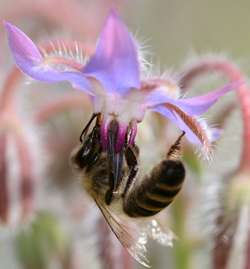
(PhysOrg.com) -- As scientists continue to be baffled over the recent decline in bee populations around the world, a new model developed by Dr Andrew Barron at Macquarie University in collaboration with David Khoury and Dr Mary Myerscough at the University of Sydney, might hold some of the answers to predicting bee populations at risk.
Since 2006 the rate of honeybee colony failure has increased significantly with a report released by the UN Environment Programme last month concluding that the disastrous decline in honeybees over the last few years is unlikely to stop without a better understanding of the reasons behind the decline.
Dr Barron says while an enormous amount is know about honeybee sociobiology, comparatively little is know about the social responses of bees to population stresses on a colony.
In this latest study Dr Barron has discovered links between rapid population decline and chronically high forager death rates, suggesting that by examining forager numbers in a colony this new model could help predict colonies under threat.
This research also looks into one of the most mysterious aspects of colony collapse disorder (CCD), the disappearance of bees from colonies leaving abandoned brood and food stores. On this Dr Barron says: Our model suggests that the response of bees in a stressed colony is to get outside and forage, but this just increases the stress on individual bees and makes the problem worse.
The model also suggests strategies to rescue failing colonies. Treatment strategies to restore failing colonies need to focus on supporting bees in the hive, and encouraging them to raise brood to boost the colony population. Were currently testing some ideas how to do this. said Barron.
According to the UNEP head Achim Steiner: "The way humanity manages or mismanages its nature-based assets, including pollinators, will in part define our collective future in the 21st century. The fact is that of the 100 crop species that provide 90 per cent of the world's food, over 70 are pollinated by bees.
This research aids better understanding of the multiple threats facing bees around the world which unless addressed could lead to serious long-term consequences for food supplies. By identifying colonies at risk, this research can help scientist better understand the process of catastrophic colony failure, and how best to intervene to restore failing colonies.
Provided by Macquarie University
-
From lemons to lemonade: Reaction uses carbon dioxide to make carbon-based semiconductor,
32 comments
-
Thioridazine kills cancer stem cells in human while avoiding toxic side-effects of conventional cancer treatments,
3 comments
-
SpaceX private rocket blasts off for space station (Update),
42 comments
-
Climate scientists say they have solved riddle of rising sea,
30 comments
-
Research team claims to have found evidence Lake Cheko is impact crater for Tunguska Event,
18 comments
-
What would stain as translucent on light-coloured fabric?
9 hours ago
-
How do I identify different bacteria on culture plates?
19 hours ago
-
Why Do Dogs do Strange things...
May 25, 2012
-
What does exophillic and endophillic mean in terms of mosquito and their control?
May 24, 2012
-
Semen stains glows under black lights (uv light)?
May 23, 2012
-
Question on Human Chromosome 2
May 23, 2012
- More from Physics Forums - Biology
More news stories
Scientist: Evolution debate will soon be history
(AP) -- Richard Leakey predicts skepticism over evolution will soon be history. Not that the avowed atheist has any doubts himself.
8 hours ago |
3.4 / 5 (8) |
21
Thousands of shellfish found dead in Peru
Thousands of crustaceans were found dead off the coast of Lima following the mystery mass death of dolphins and pelicans, the Peruvian Navy said Friday.
18 hours ago |
4.8 / 5 (4) |
6
More plant species responding to global warming than previously thought
(Phys.org) -- Far more wild plant species may be responding to global warming than previous large-scale estimates have suggested.
May 22, 2012 |
4.6 / 5 (14) |
18
|
Totally rad: Scientists create rewritable digital data storage in DNA
(Phys.org) -- Scientists from Stanford's Department of Bioengineering have devised a method for repeatedly encoding, storing and erasing digital data within the DNA of living cells.
May 21, 2012 |
4.9 / 5 (17) |
11
|
For monogamous sparrows, it doesn't pay to stray (but they do it anyway)
It's quite common for a female song sparrow to stray from her breeding partner and mate with the male next door, but a new study shows that sleeping around can be costly.
May 22, 2012 |
5 / 5 (1) |
7
|
Dell tablet leak: 10.1-inch display, two-battery choice
(Phys.org) -- Headline after headline talks about vendors tablets in the wings as likely number-one contenders for the iPad. Such claims have justifiably been taken with a grain of salt, considering ...
SpotterRF debuts Radar Backpack Kit (w/ Video)
(Phys.org) -- SpotterRF has announced a special radar backpack kit designed to enhance situational awareness for soldiers on the ground. The company says its special radar is designed for warfighters as part ...
SpaceX capsule has 'new car' smell, astronauts say (Update)
SpaceX's Dragon cargo vessel smells like a new car, said astronauts at the International Space Station after opening the hatches Saturday following the spacecraft's landmark mission to the orbiting lab.
Astronomers seize last chance in lifetime for Venus Transit
Astronomers are gearing for one the rarest events in the Solar System: an alignment of Earth, Venus and the Sun that will not be seen for another 105 years.
Keep food safety in mind this memorial day weekend
(HealthDay) -- Picnics, parades and cookouts are as much a part of Memorial Day weekend as tributes to the United States' war veterans.
Australia hails surprise super-telescope decision
Australia has hailed a surprise decision giving it a role in a radio telescope project aimed at revolutionising astronomy, vowing to draw on its decades of experience in space science.
Apr 19, 2011
Rank: 5 / 5 (1)
Apr 19, 2011
Rank: 1.5 / 5 (2)
No.
Shouldn't we let honeybees adapt to these new conditions?
Apr 19, 2011
Rank: 5 / 5 (2)
It's impossible to really make an intelligent decision either way without an actual cause you can point to IMO. So I think the answer is more research...this would be one of those environmental studies I actually want a lot of government money thrown at... :P