New horseshoe orbit Earth-companion asteroid discovered
April 6, 2011 by Deborah Braconnier
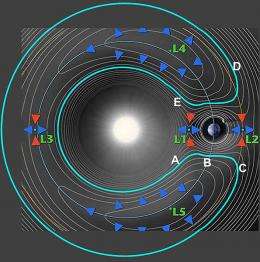
Horseshoe orbit. Image: NASA
(PhysOrg.com) -- Apostolos Christou and David Asher from the Armagh Observatory in Northern Ireland announced the discovery of an asteroid near Earth called Asteroid 2010 SO16 and their findings were published on arXiv.org. While finding near-Earth asteroids is not unusual, there is something quite rare about this particular asteroid in that it orbits the sun in what is referred to as a horseshoe orbit.
A horseshoe orbit gets its name because when viewed from Earths point of view, the asteroid appears to travel in a shape of a horseshoe. However, from the perspective of the asteroid, it is in a continual orbit around the sun.
To better understand this horseshoe orbit it must be understood that objects closer to the sun will orbit at a faster rate than objects of a further distance.
Imagine this asteroid is on an orbit around the Sun just slightly closer than that of Earth. Given the fact the asteroid is closer it is traveling at a slightly faster rate than Earth. Eventually the asteroid will approach Earth and what happens next is what gives the appearance of a horseshoe.
Given that the Earth is larger its gravity will work to pull the asteroid away from the Sun, eventually pulling the asteroid into an orbit which is a greater distance from the sun than Earth. The asteroids new orbital track will then be slower than that of Earth, making it appear to fall behind and look as though it is going in the opposite direction.
As both the Earth and the asteroid continue to orbit, eventually the Earth will catch up to the asteroid and the process will reverse, with the Earths gravity pulling the asteroid back into the smaller orbit.
The belief of astronomers has been that horseshoe orbits are not stable. However, Christou and Asher have run simulations and they show that SO16 remains in this horseshoe orbit for anywhere from 120,000 to over a million years.
Currently SO16 is traveling at one of its closest approach points and will hold a place in the evening sky for several decades to come.
More information: A long-lived horseshoe companion to the Earth, arXiv:1104.0036v1 [astro-ph.EP] http://arxiv.org/abs/1104.0036
via Technology Review
© 2010 PhysOrg.com
-
From lemons to lemonade: Reaction uses carbon dioxide to make carbon-based semiconductor,
32 comments
-
Thioridazine kills cancer stem cells in human while avoiding toxic side-effects of conventional cancer treatments,
3 comments
-
SpaceX private rocket blasts off for space station (Update),
42 comments
-
Climate scientists say they have solved riddle of rising sea,
30 comments
-
Research team claims to have found evidence Lake Cheko is impact crater for Tunguska Event,
18 comments
-
revamping general concept and cosmological principle
May 25, 2012
-
Transiting Exoplanet Light Curve
May 25, 2012
-
Math behind Theoretical Physics
May 24, 2012
-
Do we know whats at the center of galaxies yet?
May 23, 2012
-
Structure of the Milky Way?
May 20, 2012
-
What would it take to terraform Pluto and Charon?
May 19, 2012
- More from Physics Forums - General Astronomy
More news stories
SpaceX capsule has 'new car' smell, astronauts say (Update)
SpaceX's Dragon cargo vessel smells like a new car, said astronauts at the International Space Station after opening the hatches Saturday following the spacecraft's landmark mission to the orbiting lab.
Space & Earth / Space Exploration
20 hours ago |
4.5 / 5 (20) |
0
Astronomers seize last chance in lifetime for Venus Transit
Astronomers are gearing for one the rarest events in the Solar System: an alignment of Earth, Venus and the Sun that will not be seen for another 105 years.
20 hours ago |
5 / 5 (3) |
2
Australia hails surprise super-telescope decision
Australia has hailed a surprise decision giving it a role in a radio telescope project aimed at revolutionising astronomy, vowing to draw on its decades of experience in space science.
20 hours ago |
5 / 5 (4) |
1
Astronauts enter world's 1st private supply ship
(AP) -- Space station astronauts floated into the Dragon on Saturday, a day after its heralded arrival as the world's first commercial supply ship.
Space & Earth / Space Exploration
20 hours ago |
5 / 5 (6) |
0
Sophisticated simulations predict future warming
The chances of our planet being hit by a global warming of 3 degrees Celsius by 2050 is as likely as it being hit by an increase of 1.4 degrees, new research shows. Presented in the journal Nature Geoscience, the British study ...
Space & Earth / Earth Sciences
May 22, 2012 |
4.4 / 5 (9) |
51
Scientist: Evolution debate will soon be history
(AP) -- Richard Leakey predicts skepticism over evolution will soon be history. Not that the avowed atheist has any doubts himself.
Dell tablet leak: 10.1-inch display, two-battery choice
(Phys.org) -- Headline after headline talks about vendors tablets in the wings as likely number-one contenders for the iPad. Such claims have justifiably been taken with a grain of salt, considering ...
SpotterRF debuts Radar Backpack Kit (w/ Video)
(Phys.org) -- SpotterRF has announced a special radar backpack kit designed to enhance situational awareness for soldiers on the ground. The company says its special radar is designed for warfighters as part ...
Thousands of shellfish found dead in Peru
Thousands of crustaceans were found dead off the coast of Lima following the mystery mass death of dolphins and pelicans, the Peruvian Navy said Friday.
Keep food safety in mind this memorial day weekend
(HealthDay) -- Picnics, parades and cookouts are as much a part of Memorial Day weekend as tributes to the United States' war veterans.
Family history of Alzheimer's affects functional connectivity
(HealthDay) -- Cognitively normal individuals with a family history of late-onset Alzheimer's disease (AD) may display lower resting state functional connectivity in the default mode network (DMN) of the brain, ...
Apr 06, 2011
Rank: 3 / 5 (2)
Is it a prime candidate for a private venture landing?
Apr 06, 2011
Rank: 2 / 5 (6)
Apr 06, 2011
Rank: 5 / 5 (3)
Diameter = 200-400 meters
Period ~ 350 years
It's currently at the turning point where it is going to start lagging behind the earth and will remain an evening object in the sky for several decades. It's absolute magnitude is 20.7
@ Trim, perhaps a little bit long of a period to put mining operations on it but maybe not a bad place to stick a camera
Apr 06, 2011
Rank: not rated yet
Apr 06, 2011
Rank: 1.3 / 5 (4)
Apr 06, 2011
Rank: 5 / 5 (2)
Apr 06, 2011
Rank: 5 / 5 (2)
A question I have about the Earth companion 'horseshoe' asteroid is how it actually go captured. Perhaps it was a reverse slingshot effect around Venus which caused it to drift slowly out into proximity of Earth.
Another question is: What effect does our Moon have on the asteroid? Surely the Moon must eventually cause it to get lost, through a slingshot effect?
Apr 06, 2011
Rank: 3 / 5 (2)
perhaps there is a better candidate than apophis to pay close attention to...
Apr 06, 2011
Rank: not rated yet
That's almost exactly what I was thinking. If it's unstable, what's it's ultimate path?
Apr 07, 2011
Rank: 5 / 5 (1)
The more orbital neighbors we can identify; the better off we are in case one of them decides to try and crash our back yard BBQ party here on Earth.
Apr 10, 2011
Rank: not rated yet
Well that's the question! "Nobody knows" is probably the comprehensive answer.
The broadness of the 120KY to 10^6 years uncertainty time slot would seem to indicate that even though this asteroid's "horseshoe" orbit is pretty stable for a small object undergoing a fairly stable oscillation, any simulation exhibits sensitive dependence on initial conditions and after 120 x 10^6 years they never get the same final outcome.