Honeybees entomb to protect from pesticides
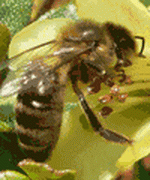
April 8, 2011 by Deborah Braconnier report

Honeybee

(PhysOrg.com) -- With the drastic rise in the disappearance of honeybee colonies throughout the world in recent years there has become a large focus on the study of honeybees and the effects of pesticides on their colonies. Termed 'colony collapse disorder' in 2006, the decline in honeybees throughout the world has been attributed to everything from pesticides to disease and parasites. The loss of the honeybee population is a concern for the agricultural community, given these bees are responsible for pollinating crops worldwide.

Dr. Jeffrey Pettis, head of the Bee Research Laboratory with the US Department of Agriculture recently addressed the All-Party Parliamentary Group on Science and Technology in Agriculture in England to discuss his recent study on the honeybees.

Pettis has found that the bees are apparently able to detect the pesticide residue found in they bring back to the hive. In examining honeybee hives, they have found cells containing pollen with high levels of pesticide have been sealed off by the bees using a waxy substance called propolis. While these bees are able to sense the contaminated pollen and try to seal it off from the rest of the hive, Pettis says this attempt is only proving futile and that the findings of sealed off cells in a hive are the biggest indicator of probable colony loss.

Pettis believes the decline in the honeybees can be attributed to what he calls the “3-P principle” which represents poor nutrition, pesticides, and pathogens. While the are a contributing factor to the decline, he does not believe they are the only factor. With the increase in more intensive farming of one crop, a honeybee’s food source in an area can go from that of multiple sources to only one source, leading to poor nutrition.

Beekeepers have also been using a substance to help control pests like the varroa mite that attacks honeybees. Unfortunately, the bees have also been found to entomb pollen cells they find containing this substance, showing that in may in fact also be harmful to the .

© 2010 PhysOrg.com

4.9 /5 (16 votes)  

Filter


Move the slider to adjust rank threshold, so that you can hide some of the comments.


Display comments: newest first

Chemstudent
Apr 08, 2011

Rank: 5 / 5 (6)
Poor little bees, they don't deserve all this trouble we're giving them.
ancible
Apr 09, 2011

Rank: 5 / 5 (1)
It certainly seems unkind and short-sighted, but remember that without we humans a massive traumatic event will occur on this planet capable of wiping out said bees (plus all even semi-intelligent life). And long, long before any entropic heat death of the universe.

I would submit that we are their only hope at long term existence and therefore the ends justify the means...

P.s. I am only so harsh in reasoning to lift the spirits of my fellow humans and therefore accelerate our technological advances through a positive outlook. I feel their tiny, industrious pain!
mjesfahani
Apr 09, 2011

Rank: not rated yet
I gave up stupid Avonex and foolish Beta Interferone 1b for MS and am using honey bees venom. Very usefull even much more that moneymaker western stupid medicines!
charldew
Apr 11, 2011

Rank: not rated yet
"without we humans a massive traumatic event will occur on this planet capable of wiping out said bees (plus all even semi-intelligent life".

What event, or type of event, is this and how is the human presence preventing it?
ancible
Apr 14, 2011

Rank: not rated yet
"without we humans a massive traumatic event will occur on this planet capable of wiping out said bees (plus all even semi-intelligent life".

What event, or type of event, is this and how is the human presence preventing it?


Collision with a very large asteroid, massive volcanic action, any near-complete death of flowering plants. As of right now, humans aren't preventing any of these but we are the bees only chance to get resettled upon other planets.
Rank 4.9 /5 (16 votes)
Relevant PhysicsForums posts

More news stories

Scientist: Evolution debate will soon be history

(AP) -- Richard Leakey predicts skepticism over evolution will soon be history. Not that the avowed atheist has any doubts himself.

Biology / Evolution

created 10 hours ago | popularity 3.3 / 5 (10) | comments 22

Thousands of shellfish found dead in Peru

Thousands of crustaceans were found dead off the coast of Lima following the mystery mass death of dolphins and pelicans, the Peruvian Navy said Friday.

Biology / Ecology

created 20 hours ago | popularity 4.8 / 5 (4) | comments 6

More plant species responding to global warming than previously thought

(Phys.org) -- Far more wild plant species may be responding to global warming than previous large-scale estimates have suggested.

Biology / Ecology

created May 22, 2012 | popularity 4.6 / 5 (14) | comments 18 | with audio podcast

Totally rad: Scientists create rewritable digital data storage in DNA

(Phys.org) -- Scientists from Stanford's Department of Bioengineering have devised a method for repeatedly encoding, storing and erasing digital data within the DNA of living cells.

Biology / Biotechnology

created May 21, 2012 | popularity 4.9 / 5 (17) | comments 11 | with audio podcast

For monogamous sparrows, it doesn't pay to stray (but they do it anyway)

It's quite common for a female song sparrow to stray from her breeding partner and mate with the male next door, but a new study shows that sleeping around can be costly.

Biology / Plants & Animals

created May 22, 2012 | popularity 5 / 5 (1) | comments 7 | with audio podcast


Dell tablet leak: 10.1-inch display, two-battery choice

(Phys.org) -- Headline after headline talks about vendors’ tablets in the wings as likely number-one contenders for the iPad. Such claims have justifiably been taken with a grain of salt, considering ...

SpotterRF debuts Radar Backpack Kit (w/ Video)

(Phys.org) -- SpotterRF has announced a special radar backpack kit designed to enhance situational awareness for soldiers on the ground. The company says its special radar is designed for warfighters as part ...

SpaceX capsule has 'new car' smell, astronauts say (Update)

SpaceX's Dragon cargo vessel smells like a new car, said astronauts at the International Space Station after opening the hatches Saturday following the spacecraft's landmark mission to the orbiting lab.

Astronomers seize last chance in lifetime for Venus Transit

Astronomers are gearing for one the rarest events in the Solar System: an alignment of Earth, Venus and the Sun that will not be seen for another 105 years.

Australia hails surprise super-telescope decision

Australia has hailed a surprise decision giving it a role in a radio telescope project aimed at revolutionising astronomy, vowing to draw on its decades of experience in space science.

Keep food safety in mind this memorial day weekend

(HealthDay) -- Picnics, parades and cookouts are as much a part of Memorial Day weekend as tributes to the United States' war veterans.