Halos Gone MAD
April 8, 2011 By Jon Voisey
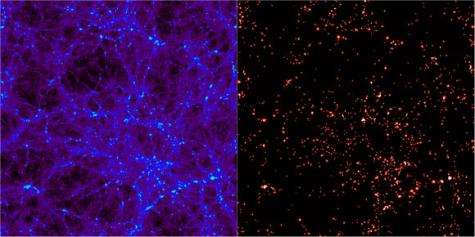
Distribution of dark matter when the Universe was about 3 billion years old, obtained from a numerical simulation of galaxy formation. The left panel displays the continuous distribution of dark matter particles, showing the typical wispy structure of the cosmic web, with a network of sheets and filaments, while the right panel highlights the dark matter halos representing the most efficient cosmic sites for the formation of star-bursting galaxies with a minimum dark matter halo mass of 300 billion times that of the Sun. Credit: VIRGO Consortium/Alexandre Amblard/ESA
One of the successes of the ΛCDM model of the universe is the ability for models to create structures of with scales and distributions similar to those we view in the universe today. Or, at least thats what astronomers tell us. While computer simulations can recreate numerical universes in a box, interpreting these mathematical approximations is a challenge in and of itself. To identify the components of the simulated space, astronomers have had to develop tools to search for structure. The results has been nearly 30 independent computer programs since 1974. Each promises to reveal the forming structure in the universe by finding regions in which dark matter halos form. To test these algorithms out, a conference was arranged in Madrid, Spain during the May of 2010 entitled Haloes going MAD in which 18 of these codes were put to the test to see how well they stacked up.
Numerical simulations for universes, like the famous Millennium Simulation begin with nothing more than particles. While these were undoubtedly small on a cosmological scale, such particles represent blobs of dark matter with millions or billions solar masses. As time is run forwards, they are allowed to interact with one another following rules that coincident with our best understanding of physics and the nature of such matter. This leads to an evolving universe from which astronomers must use the complicated codes to locate the conglomerations of dark matter inside which galaxies would form.
One of the main methods such programs use is to search for small overdensities and then grow a spherical shell around it until the density falls off to a negligible factor. Most will then prune the particles within the volume that are not gravitationally bound to make sure that the detection mechanism didnt just seize on a brief, transient clustering that will fall apart in time. Other techniques involve searching other phase spaces for particles with similar velocities all nearby (a sign that they have become bound).
To compare how each of the algorithms fared, they were put through two tests. The first, involved a series of intentionally created dark matter halos with embedded sub-halos. Since the particle distribution was intentionally placed, the output from the programs should correctly find the center and size of the halos. The second test was a full fledged universe simulation. In this, the actual distribution wouldnt be known, but the sheer size would allow different programs to be compared on the same data set to see how similarly they interpreted a common source.
In both tests, all the finders generally performed well. In the first test, there were some discrepancies based on how different programs defined the location of the halos. Some defined it as the peak in density, while others defined it as a center of mass. When searching for sub-halos, ones that used the phase space approach seemed to be able to more reliably detect smaller formations, yet did not always detect which particles in the clump were actually bound. For the full simulation, all algorithms agreed exceptionally well. Due to the nature of the simulation, small scales werent well represented so the understanding of how each detect these structures was limited.
The combination of these tests did not favor one particular algorithm or method over any other. It revealed that each generally functions well with regard to one another. The ability for so many independent codes, with independent methods means that the findings are extremely robust. The knowledge they pass on about how our understanding of the universe evolves allows astronomers to make fundamental comparisons to the observable universe in order to test the such models and theories.
The results of this test have been compiled into a paper that is slated for publication in an upcoming issue of the Monthly Notices of the Royal Astronomical Society.
Source: Universe Today
-
From lemons to lemonade: Reaction uses carbon dioxide to make carbon-based semiconductor,
32 comments
-
Thioridazine kills cancer stem cells in human while avoiding toxic side-effects of conventional cancer treatments,
3 comments
-
SpaceX private rocket blasts off for space station (Update),
42 comments
-
Climate scientists say they have solved riddle of rising sea,
30 comments
-
Research team claims to have found evidence Lake Cheko is impact crater for Tunguska Event,
18 comments
-
A Question relating Power
1 hour ago
-
Writing a book so im learning about things, i have some general questions please read
3 hours ago
-
Question about induced E field.
4 hours ago
-
Charging a capacitor in a tesla coil
4 hours ago
-
Water Rocket
8 hours ago
-
why do trucks have bigger brakes?
12 hours ago
- More from Physics Forums - General Physics
More news stories
Is a classical electrodynamics law incompatible with special relativity?
(Phys.org) -- The laws of classical electromagnetism that were developed in the 19th century are the same laws that scientists use today. They include Maxwell’s four equations along with the Lorentz la ...
Landmark calculation clears the way to answering how matter is formed
(Phys.org) -- An international collaboration of scientists, including Thomas Blum, associate professor of physics, is reporting in landmark detail the decay process of a subatomic particle called a kaon ...
May 25, 2012 |
4.2 / 5 (21) |
47
|
Lying in wait for WIMPs: Researchers seek to dramatically increase sensitivity of Large Underground Xenon detector
Although it's invisible, dark matter accounts for at least 80 percent of the matter in the universe. No one knows what it is, but most scientists would bet on weakly interacting massive particles, or WIMPs.
May 23, 2012 |
4 / 5 (7) |
15
|
Hall effect at the speed of light: How can you demonstrate relativistic effects with your mobile phone?
The relativistic Hall effect describing objects rotating at speeds comparable with the speed of light has been reported.
May 21, 2012 |
4.3 / 5 (3) |
8
Cloak of invisibility: Engineers use plasmonics to create an invisible photodetector
A team of engineers at Stanford and the University of Pennsylvania has for the first time used "plasmonic cloaking" to create a device that can see without being seen - an invisible machine that detects light. It is the first ...
May 21, 2012 |
4.8 / 5 (16) |
7
|
Scientist: Evolution debate will soon be history
(AP) -- Richard Leakey predicts skepticism over evolution will soon be history. Not that the avowed atheist has any doubts himself.
Dell tablet leak: 10.1-inch display, two-battery choice
(Phys.org) -- Headline after headline talks about vendors tablets in the wings as likely number-one contenders for the iPad. Such claims have justifiably been taken with a grain of salt, considering ...
SpotterRF debuts Radar Backpack Kit (w/ Video)
(Phys.org) -- SpotterRF has announced a special radar backpack kit designed to enhance situational awareness for soldiers on the ground. The company says its special radar is designed for warfighters as part ...
SpaceX capsule has 'new car' smell, astronauts say (Update)
SpaceX's Dragon cargo vessel smells like a new car, said astronauts at the International Space Station after opening the hatches Saturday following the spacecraft's landmark mission to the orbiting lab.
Thousands of shellfish found dead in Peru
Thousands of crustaceans were found dead off the coast of Lima following the mystery mass death of dolphins and pelicans, the Peruvian Navy said Friday.
Astronomers seize last chance in lifetime for Venus Transit
Astronomers are gearing for one the rarest events in the Solar System: an alignment of Earth, Venus and the Sun that will not be seen for another 105 years.
Apr 08, 2011
Rank: 3 / 5 (4)
Apr 08, 2011
Rank: not rated yet
If you assume nothing, then scientific inquiry or methodology is excluded.
Apr 09, 2011
Rank: 3 / 5 (2)
Apr 09, 2011
Rank: not rated yet
I don't even know if the 'tools' (mathematics) to get the 'job' done (explain data without overhauling existing physics) is sufficient.
Another-words, all other 'tools'("no other mathematical reasoning") yields 'Dark Matter' as an explanation.
The worst case scenario is when we look at the data and no other explanation or 'tool' other than 'Dark Matter' is imagined.
Of course, the 'job' is clear. To provide 'mechanics' for the observational data.
Most 'objects' in our human understanding are recognizable.
Even abstract explanations appeal to our perception and to our data, eventually.
So, the rest of the 'tools'(mathematics) point to "only the lack of sufficient matter".
cont...
Apr 09, 2011
Rank: not rated yet
I have made an attempt to understand the point you felt I missed. I feel I have made inroads into the insight of the point you felt I missed.
If not, you probably will be the first to let me know, that I am still missing your point. :)
Apr 13, 2011
Rank: not rated yet
Your assumption could very well be true <evil grin> But I valued your input as it made my (ad hoc) point clearer to me ;-)
Apr 13, 2011
Rank: 5 / 5 (2)