Hunting for gaps
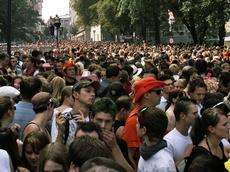
(PhysOrg.com) -- Researchers have developed a new model for the behavior of pedestrians and crowds. It can help to understand and prevent tragic crowd disasters, to develop better architectural designs and new navigation approaches in robotics.
During rush hours, every train station is flooded with people on the way to or from work. The crowds stream from the tracks to the exits, the escalators, the bus stops. Despite this, collisions are rare. Sometimes one person makes way, sometimes another, but everyone gets to the destination amazingly quickly. Mehdi Moussaid and Guy Theraulaz from the CNRS in Toulouse and Dirk Helbing from ETH Zurich have now developed a simple cognitive model that explains how pedestrians move and how the surprising self-organization of human flows comes about.
Computer simulation models of pedestrian and crowd behavior are not new per se. However, today's simulation softwares are often based on physics-inspired assumptions, such as repulsive forces between pedestrians. The new, psychologically based model, in contrast, assumes that pedestrians try to minimize the coverage of their vision field, while adjusting the walking speed to keep a safety distance from other people. It is based on two heuristic rules – decisions that people make without much thinking about their behavior. If you combine these rules with the contact forces that occur in extremely high pedestrian densities, the model can also realistically depict crowd disasters.
Hunting for gaps
Previously it was assumed that each obstacle has a repulsive effect on pedestrians. The new approach instead assumes that pedestrians are seeking gaps, and that groups are perceived as a whole. In contrast to previous models, which decompose a pedestrian’s environment into separate effects, the new approach describes the scene in a holistic, integrated manner. In response to a complex environment, a person may re-align, slow down his or her steps or deviate from a certain direction to avoid collisions. Nevertheless, nobody realistically calculates thousands of variations to select the optimum route. That is done, for example, by some approaches in robotics, where people are sometimes seen as a homo economicus, i.e. strict optimizers. However, it is sufficient to apply simple rules to find the almost perfect path of minimum effort through the crowd, says Helbing.
Approach simpler than expected
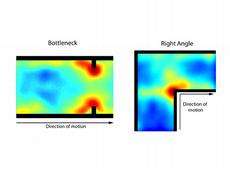
The researchers verified their model with different data sets, from the single individual up to flows of pedestrians at bottlenecks and in evacuation situations. Never before were so many different tests conducted to support a model, says Helbing, but this was necessary since the new model represents a paradigm shift. It is a scientific breakthrough, because experts believed that a cognitive approach would be much more complicated than a physical one. "Now we experience a big surprise: The cognitive model is substantially simpler!"
With the new model, researchers can simulate the behavior of individuals as well as the movements of crowds. The simulations demonstrate that pedestrian flows self-organize. When pedestrians walk in opposite directions, such as in a heavily frequented railway underpass, separate lanes of uniform walking direction form - both in the model and in reality. This minimizes mutual obstructions, and makes the flow of pedestrians more efficient. It may be seen as a result of collective intelligence.
If a crowd quake strikes
The model also shows what can happen if the pedestrian density exceeds a critical value. If people have to go shoulder to shoulder, stop-and-go waves may arise. If the density increases even further, the coordinated pattern breaks down completely, giving rise to a turbulent motion which can eventually lead to fatal crowd disasters, in which people are trampled to death.
Helbing has observed that, before such a disaster, the crowd undulates, and people trapped in the crowd are pushed back and forth and, in fact, into all possible directions. The forces are transmitted from one person to another and add up, sometimes over distances of more than 10 meters, and potentially with fatal consequences. “Force chains are forming, which can push people suddenly into unpredictable directions, almost like in an earthquake. " In such a "crowd quake", one can easily fall to the ground, and the disaster takes its course.
Real-time video analysis could help prevent disasters
... as it happened in Duisburg, Germany, recently. At the Love Parade in the summer of 2010, 21 people died in a crowd disaster, and over 500 were injured. The new model can help to elucidate the cause of the accident and plan prevention measures for future mass events. At first, it was assumed that the disaster had happened because people fell from a narrow staircase onto the crowd. A closer analysis, however, reveals that the crowd began to undulate before the panic broke out. "A crowd quake was the cause of the disaster." Crowd management at major events needs special tools to assess such situations. For example, a real-time analysis of surveillance videos can help to save lives, as it facilitates to recognize earlier where problems are building up.
The project illustrates what is planned on a much larger scale by the “FuturICT” EU flagship project, led by Helbing. Pedestrian crowds are a perfect example of a social system, in which social interactions can lead to unintended consequences. Even though normal pedestrians try to avoid harming others, crowd disasters have occurred again and again. How they happen has long been a mystery, but thanks to a better understanding of social interactions, the underlying mechanisms have been identified, and early warning signs as well. Moreover, one can take counter measures and prevent crises, as has been successfully shown by the re-organization of the Hajj, the annual Muslim pilgrimage to Mecca.
"From this perspective, the pedestrian crowd project fits the framework of FuturICT perfectly, which aims to develop new risk management tools. “Indeed, one of the goals of the project is to prevent disasters through the use of new computer technologies and by learning to better understand the complexity of social systems," says Helbing.
More information: Moussaid M, Helbing D, Théraulaz G. How simple rules determine pedestrian behavior and crowd disasters. PNAS. DOI: 10.1073/pnas.1016507108
Provided by ETH Zurich


