New fresh water in Arctic could shift Gulf Stream
Apr 05, 2011 By ARTHUR MAX , Associated Press
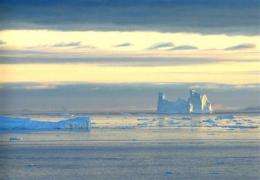
In this Thursday Aug. 18, 2005 file photo an iceberg is seen in Disko Bay, Greenland, above the arctic circle. Scientists are monitoring a massive pool of fresh water in the Arctic Ocean that could spill into the Atlantic and potentially alter the ocean currents that bring Western Europe its moderate climate. The oceanographers said Tuesday April 5, 2011, the unusual accumulation has been caused by Siberian and Canadian rivers dumping more water into the Arctic, and from melting sea ice. Both are consequences of global warming. (AP Photo/John McConnico, File)

Scientists are monitoring a massive pool of fresh water in the Arctic Ocean that could spill into the Atlantic and potentially alter the key ocean currents that give Western Europe its moderate climate.

The oceanographers said Tuesday the unusual accumulation has been caused by Siberian and Canadian rivers dumping more water into the Arctic and from melting sea ice. Both are consequences of global warming.

If it flushes into the Atlantic, the infusion of could, in the worst case, change the ocean current that brings warmth from the tropics to European shores, said Laura De Steur of the Royal Netherlands Institute for Sea Research.

German researcher Benjamin Rabe, of the Alfred Wegener Institute, said the Arctic's fresh water content had increased 20 percent since the 1990s - about 8,400 cubic kilometers. That is the equivalent of all the water in Lake Michigan and Lake Huron together or double the volume of water in Lake Victoria, Africa's largest lake.

Increased runoff from the great northern rivers "could potentially impact the large scale ocean circulation in the Atlantic Ocean. This is important for us in Western Europe because our climate is pretty much dictated by the Thermohaline ," said De Steur.

The Thermohaline current loops like a conveyer belt from the tropics to the North Atlantic, driven by the differences in and wind patterns. Warm water from the south gains in salinity and grows heavier as it cools. At its northern end, the current is further chilled by cold air and sinks, warming again and rising as it travels south.

That cycle could be affected when the pool of fresh water is released into the Atlantic, said De Steur and Rabe. The icy water has been kept bottled up in the Arctic by wind patterns, which have not shifted their general clockwise direction for the unusually long time of 12 years. Normally, the winds change at intervals of five to 10 years.

The two scientists spoke to The Associated Press as part of a European Union initiative, called Clamer, to collate and publicize information from 300 EU-funded research projects conducted over the last 13 years on climate change and marine ecology. Rabe and colleagues from the Alfred Wegener Institute in Bremerhaven, Germany, published their research last year in the journal on the effects of higher river runoff on ocean salinity.

De Steur said most of the excess fresh water has collected in the Canada Basin, but in the last three years changes also have been noticed in the Eurasian side of the Arctic Ocean.

"It's important to monitor this to see if this can be transported to the Atlantic, where it might potentially effect the Gulf Stream and the Thermohaline circulation," she said.

Rabe cautioned that scientists have not been studying the situation long enough to predict what may happen, and the results of model simulations also were inconclusive.

Explore further: The tropical upper atmosphere 'fingerprint' of global warming

5 /5 (2 votes)
add to favorites email to friend print save as pdf

Related Stories

Arctic Ocean waters warm suddenly

Oct 07, 2005

Water flowing from the North Atlantic Ocean into the Arctic provides evidence that the Arctic Ocean is warming, according to U.S. and European researchers.

Atlantic to Pacific feedback discovered

Feb 22, 2007

French scientists say an exchange of water vapor from the Atlantic to the Pacific might be an important feedback mechanism for abrupt climatic changes.

Salty oceans provide early warning for climate change

Jun 08, 2007

Monitoring the saltiness of the ocean water could provide an early indicator of climate change. Significant increases or decreases in salt in key areas could forewarn of climate change in 10 to 20 years time. Presenting their ...

Recommended for you

Russia evacuates drifting Arctic research station

5 hours ago

Russia has ordered the urgent evacuation of the 16-strong crew of a drifting Arctic research station after ice floe that hosts the floating laboratory began to disintegrate, officials said Thursday.

Bacterium from Canadian High Arctic and life on Mars

7 hours ago

(Phys.org) —The temperature in the permafrost on Ellesmere Island in the Canadian high Arctic is nearly as cold as that of the surface of Mars. So the recent discovery by a McGill University led team of ...

User comments : 1

Adjust slider to filter visible comments by rank

Display comments: newest first

apex01
5 / 5 (1) Apr 05, 2011
Oh no...it's going to be "The Day After Tomorrow"...

More news stories

A hidden population of exotic neutron stars

(Phys.org) —Magnetars – the dense remains of dead stars that erupt sporadically with bursts of high-energy radiation - are some of the most extreme objects known in the Universe. A major campaign using ...

Solar Kettle allows for boiling water off the grid

(Phys.org) —A company called Contemporary Energy has unveiled a new device it calls the Solar Kettle. It looks very much like a normal coffee thermos, but has flaps on one side that open to allow for collecting ...

Ferrets, pigs susceptible to H7N9 avian influenza virus

Chinese and U.S. scientists have used virus isolated from a person who died from H7N9 avian influenza infection to determine whether the virus could infect and be transmitted between ferrets. Ferrets are often used as a mammalian ...

Scientists develop cheaper, more efficient fuel cells

(Phys.org) —Using the Canadian Light Source (CLS) synchrotron, researchers have discovered a way to create cheaper fuel cells by dividing normally expensive platinum metal into nanoparticles (or even single ...