DARPA unveils new telescope to protect satellites from space debris
Apr 25, 2011 by Bob Yirka report

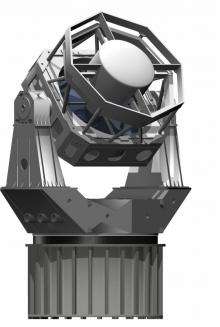
(PhysOrg.com) -- The U.S. Defense Department’s, Defense Advanced Research Projects Agency (DARPA) in conjunction with the U.S. Air Force (and many unknown contractors of course) has announced the addition of a new telescope which it intends to add to the Air Force’s existing Space Surveillance Network (SSN); dubbed the Space Surveillance Telescope (SST), it will be capable of scanning the skies faster than other existing telescope of its size and will be able to collect data faster for dimmer objects to boot. The new telescope’s main mission is to track space debris to help in collision avoidance with the many sensitive satellites now circling the Earth.

Nine years in development, and with a price tag of $110 million, the new telescope will likely become ever more crucial as more and more accumulates in orbit around the Earth as older satellites go off-line and new satellites are launched. The primary area of concern will be objects in geosynchronous orbit, (those traveling at speeds to match the Earth’s rotation so as to appear to hover in one place over the planet) as that’s where the military stations most of its spy satellites.

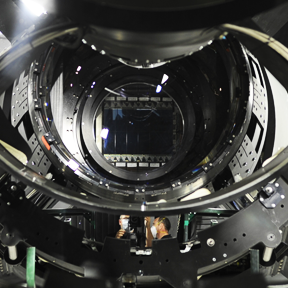
To achieve these new feats, engineers at MIT’s aerospace division, used a 3.5-meter aperture that connects to a curved charge-coupled device capable of capturing photons and turning them into electrons, which can then be digitally processed to produce the desired images. This technology allowed for an aperture that is more than three times the size of normal ground based telescopes and gives the telescope the ability to grab wide angle shots of the night sky, rather than the pin-point view that has been available up to now. Coupling that with a frame that allows the to move quickly in its base, the SST is expected to give the Air Force a very precise view of where space debris is located, and where it’s going, giving satellite operators ample time to alter the course of their spacecraft.
DARPA unveils new telescope to protect satellites from space debris

Current estimates suggest there are now up to 22,000 objects floating around in near Earth orbit, all of varying sizes and shapes, (and all catalogued in the SSN) and it has been noted that objects as small as just one centimeter are capable of inflicting a lot of damage to current, fragile satellites. If the SST performs well, it is likely the Air Force will deploy duplicate telescopes around the globe to offer a 360° view of the sky.

Explore further: NASA head views progress on asteroid lasso mission

More information: www.darpa.mil/Our_Work/TTO/Programs/Space_Surveillance_Telescope_(SST).aspx

Related Stories

Launch delayed for satellite to watch space debris

Jul 06, 2010

(AP) -- The launch of a new U.S. Air Force space surveillance satellite has been delayed due to a software problem in a rocket similar to the one that will lift the satellite into orbit.

New US satellite to monitor debris in Earth orbit

Jul 03, 2010

(AP) -- A new U.S. Air Force satellite will provide the first full-time, space-based surveillance of hundreds of satellites and thousands of pieces of debris that could crash into American and allied assets ...

Lockheed Martin submits bid for Space Fence

Nov 19, 2010

Lockheed Martin submitted its proposal today for the next phase of Space Fence, a program that will revamp the way the U.S. Air Force identifies and tracks objects in space.

Space Image: A Beehive of Satellites

Feb 12, 2009

The launch of the first artificial satellite by the then Soviet Union in 1957 marked the beginning of the utilization of space for science and commercial activity. During the Cold War, space was a prime area ...

Recommended for you

NASA head views progress on asteroid lasso mission

10 hours ago

Surrounded by engineers, NASA chief Charles Bolden inspected a prototype spacecraft engine that could power an audacious mission to lasso an asteroid and tow it closer to Earth for astronauts to explore.

Ecuador satellite collides with Russian space junk

10 hours ago

A small Ecuadoran satellite collided in orbit with the remains of a Russian rocket, but it is too soon to know how much damage it might have sustained, Quito's space agency said Thursday.

Forecast for Titan: Wild weather could be ahead

May 22, 2013

(Phys.org) —Saturn's moon Titan might be in for some wild weather as it heads into its spring and summer, if two new models are correct. Scientists think that as the seasons change in Titan's northern hemisphere, ...

SDO observes mid-level solar flare

May 22, 2013

UPDATE 16:30 p.m. EDT: The M7-class flare was also associated with a coronal mass ejection or CME, another solar phenomenon that can send billions of tons of particles into space. While this CME was not Ea ...

User comments : 2

Adjust slider to filter visible comments by rank

Display comments: newest first

Skepticus
not rated yet Apr 25, 2011
Splendid. A sharper eye to dodge the debris that DARPA's, Pentagon and the like projects chuck out undiscriminately with their rockets and spent sattelites. Nice "solution" indeed. I can do the same down here with banana peels, McDonals containers. I'd chuck them and keep an eye out to avoid stepping on them.
yyz
not rated yet Apr 25, 2011
The link is broken....try here: http://www.darpa....ACE.aspx

The Air Force already has experience with mega-CCDs and wide-field telescopes through its support of the PanSTARRS project. PanSTARRS is a survey telescope that is looking for Near Earth asteroids, other asteroids, comets, variable stars and the like. The PS1 telescope in Hawaii is a 1.8m design that provides a 3 degree FOV, delivered to a 1.4 gigapixel Orthogonal Transfer CCD: http://pan-starrs...ras.html

Interestingly, the USAF has as a stipulation for funding that PanSTARRS software must automatically block out trajectories of imaged satellites before being made available to researchers and the public. Unfortunately this has made roughly a quarter of all imaged fields unavailable and they must be reobserved: http://en.wikiped...itations

More news stories

A hidden population of exotic neutron stars

(Phys.org) —Magnetars – the dense remains of dead stars that erupt sporadically with bursts of high-energy radiation - are some of the most extreme objects known in the Universe. A major campaign using ...

Hubble reveals the ring nebula's true shape

(Phys.org) —The Ring Nebula's distinctive shape makes it a popular illustration for astronomy books. But new observations by NASA's Hubble Space Telescope of the glowing gas shroud around an old, dying, ...

NASA head views progress on asteroid lasso mission

Surrounded by engineers, NASA chief Charles Bolden inspected a prototype spacecraft engine that could power an audacious mission to lasso an asteroid and tow it closer to Earth for astronauts to explore.

Controlling mood through the motions of mitochondria

(Medical Xpress)—Regulating the distribution of power in neurons is done by a system that makes the national electric grid look simple by comparison. Each neuron has several thousand mitochondria confined ...

A quantum simulator for magnetic materials

Physicists understand perfectly well why a fridge magnet sticks to certain metallic surfaces. But there are more exotic forms of magnetism whose properties remain unclear, despite decades of intense research. ...