Cosmonaut: Russia needs space innovation now
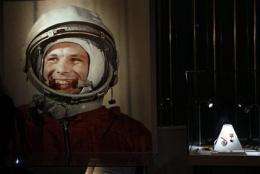
(AP) -- Russia risks losing its edge in space by relying exclusively on Soviet-era achievements and doing little to design new spacecraft, a Russian cosmonaut warned Monday as the nation marked the 50th anniversary of the first human spaceflight by Yuri Gagarin.
Svetlana Savitskaya, who flew two space missions in 1982 and 1984 and became the first woman to make a spacewalk, harshly criticized the Kremlin for paying little attention to achievements in space after the 1991 collapse of the Soviet Union.
"There's nothing new to be proud of in the last 20 years," said Savitskaya, a member of Russian parliament from the Communist Party.
While Russian's aging spacecraft will serve as the only link to the International Space Station after the U.S. space shuttle Atlantis closes out the U.S. program this summer, the Americans are working on a next-generation space ship and Russia has done virtually nothing to design a replacement to the 43-year old Soyuz spacecraft, Savitskaya said.
"If we won't be catching up on what we have missed in the last 20 years ... we will be left with nothing," Savitskaya told a news conference.
Space officials and astronauts from around the world arrived in Moscow to pay tributes to Gagarin, whose 108-minute flight on April 12, 1961 spurred America to race for the moon.
"We are all the sons of Yuri Gagarin," Jean-Jacques Dordain, the director of the European Space Agency, said at a Gagarin commemorative event.
"Without Gagarin going first, I probably wouldn't have gone to the moon," said Thomas Stafford, commander of the Apollo 10 mission that approached within eight miles (13 kilometers) of the moon in May 1969, the last U.S. mission before the U.S. moon landing three months later.
Before Gagarin's flight, many scientists were worried that humans wouldn't be able to survive in outer space.
"Some psychologists and other scientists said that a man could go mad when he is left to face the endless universe," said Boris Chertok, who was a deputy of Sergei Korolyov, the father of the Soviet space program.
Technological challenges also looked daunting after numerous equipment failures in experimental missions preceding Gagarin's flight. "We realized that the risks were very high," Chertok told reporters last week.
Chertok, 99, said the Soviet design team did all they could to minimize risks, but admitted that they still were too high by modern standards. He said he wouldn't have signed papers clearing the flight if it were to happen today.
Oleg Ivanovsky, who oversaw the construction and launch of the Vostok spacecraft that carried Gagarin, told The Associated Press that a risk assessment study put the odds of success of Gagarin's mission at only 50 percent.
The Soviet authorities had prepared several versions of the communique telling the world about the flight: one in case of success, another one in case of problems that could lead to Gagarin's landing in another country and a third one in case of a complete failure, said Vitaly Davydov, a deputy chief of the Russian space agency.
The Soviets were so obsessed about secrecy that they even lied about the location of launch pad used to send Gagarin's rocket into space, even though U.S. spy planes had photographed it a long time before.
"The government report didn't say where Gagarin was launched from and what rocket he was riding, and it also concealed details of his return," Chertok said. "The secrecy was excessive."
While Gagarin's smiling face made him a poster boy for the communist world, scientists behind the mission remained anonymous, with even their names being a top state secret. To the scientists' dismay, Soviet authorities made people with no relation to the space program claim public credit for Gagarin's mission.
"It was quite painful for us to see that," Chertok said.
A similar veil of secrecy surrounded Gagarin's death in a two-seater training jet crash on March 27, 1968, spurring conspiracy theories about the KGB staging it to punish him for his alleged opposition to the Communist regime.
An official panel has concluded that Gagarin's plane crashed after making a sharp maneuver to dodge an air balloon or avoid thick clouds, but many cosmonauts and technical experts have remained skeptical of the verdict.
Cosmonaut Vladimir Shatalov, who closely knew Gagarin and was to follow Gagarin on a training flight on the day of his death, told the AP that the most likely reason for the crash was another military jet flying too close by at high speed.
A turbulence or a shock wave from that plane crossing the sound barrier could have shattered Gagarin's plane cockpit and knocked him and his crewmate unconscious as their MiG-15 fell into a steep dive and slammed into a forest.
The official probe didn't seriously investigate that possible version of events, most likely because air force officials weren't interested in finding any truth that could have cost them their jobs, Shatalov said.
©2010 The Associated Press. All rights reserved. This material may not be published, broadcast, rewritten or redistributed.


