Citizen scientists making incredible discoveries
April 25, 2011 By Dauna Coulter
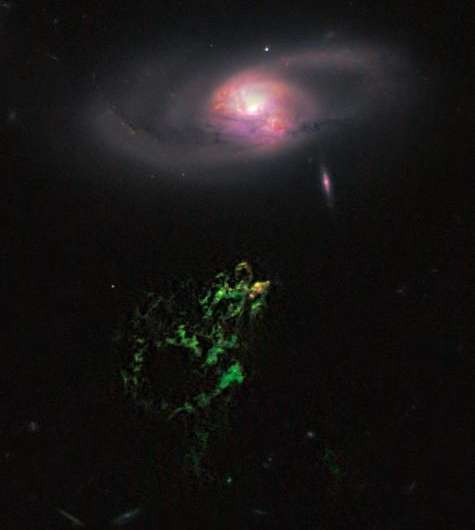
In this image, the Voorwerp floats near a spiral galaxy. Credit: NASA/ESA Hubble Space Telescope
"Somewhere, something incredible is waiting to be known," wrote Carl Sagan.
And now you can be the one to find it, thanks to Zooniverse, a unique citizen science website. Zooniverse volunteers, who call themselves "Zooites," are working on a project called Galaxy Zoo, classifying distant galaxies imaged by NASA's Hubble Space Telescope.
"Not only are people better than computers at detecting the subtleties that differentiate galaxies, they can do things computers can't do, like spot things that just look interesting," explains Zooniverse director Chris Lintott, an astronomer at the University of Oxford.
Zooite Hanny van Arkel, a Dutch schoolteacher, discovered this strange green object floating in her cosmic soup.
When van Arkel noticed this unusual greenish object and posted an image of it on the Galaxy Zoo forum, not even the experts knew what it was. They named it "Voorwerp," Dutch for "object."
Another group of Zooites found green "peas" in theirs, and dubbed themselves the "Peas-Corp."
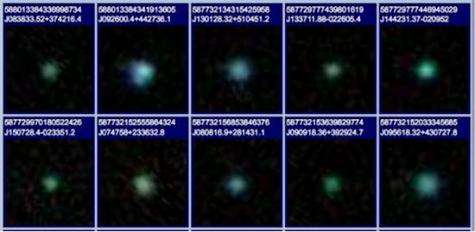
These "green peas" are actually galaxies. Credit: Carolin Cardamone and Sloan Digital Sky Survey
The peas turned out to be small, round green galaxies about a tenth the size of the Milky Way. These are now believed to be the most efficient star factories in the universe, forming huge numbers of stars in a hurry. "It was easy to find 'peas' by computer once we knew they were there, but without the human factor we'd never have noticed them," says Lintott.Lintott started Zooniverse in 2007 to solve a very large and unique problem: "I had too many galaxies on my hands," he explains.
Lintott was faced with classifying, by shape, one million galaxies imaged by the Sloan Digital Sky Survey. First he did what any self-respecting scientist would do.
"I asked a graduate student to classify them."
The student was good at it, but after he catalogued 50,000 images, it was obvious he needed help a lot of help -- sorting the other 950,000. The solution came to Lintott and the very relieved student while they were sitting in a pub.
"Why not ask for volunteers?"
Zooniverse and its first project, Galaxy Zoo, were born.
"We were blown away by the response. We had so many hits that our web server crashed on the first morning!"
They quickly solved the server problem and the project took off. With the Hubble Space Telescope, Galaxy Zoo is taking volunteers deeper into the cosmos than ever before. And the Zooniverse team has proven that the Zooites' classifications are as good as those by professional astronomers.
"Their contributions are extremely important," says Lintott. "They're helping us learn how galaxies form and evolve. And they take their work seriously."
But that doesn't prevent them from bringing a sense of adventure and just sheer fun to the research.
"Not long ago some Zooites asked us to take them on a pilgrimage to Zooniverse's birthplace. There was quite a celebration at the pub that night!"
After Galaxy Zoo kicked off, scientists began approaching Lintott at conferences asking for help. "They realized that we'd found a great way to sort a lot of data fast."
Zooniverse now offers several citizen science projects, including three more using NASA data. Moon Zoo volunteers use data from NASA's Lunar Reconnaissance Orbiter to count craters, helping write the history of the moon. Milky Way project participants scour infrared images gathered in two NASA Spitzer Space Telescope surveys of the Milky Way's inner regions. They help astronomers catalogue intriguing features, map our galaxy, and plan future research. Zooniverse's Planet Hunters are helping NASA's Kepler telescope find stars likely to host planets.
"I'd love to confirm one of their finds and be able to send an email to someone saying, 'You've found a planet!' "
Now, please excuse this writer. She has planet hunting to do.
More information: http://www.zooniverse.org/
Provided by Science@NASA
-
From lemons to lemonade: Reaction uses carbon dioxide to make carbon-based semiconductor,
32 comments
-
Thioridazine kills cancer stem cells in human while avoiding toxic side-effects of conventional cancer treatments,
3 comments
-
SpaceX private rocket blasts off for space station (Update),
42 comments
-
Climate scientists say they have solved riddle of rising sea,
30 comments
-
Research team claims to have found evidence Lake Cheko is impact crater for Tunguska Event,
18 comments
-
revamping general concept and cosmological principle
May 25, 2012
-
Transiting Exoplanet Light Curve
May 25, 2012
-
Math behind Theoretical Physics
May 24, 2012
-
Do we know whats at the center of galaxies yet?
May 23, 2012
-
Structure of the Milky Way?
May 20, 2012
-
What would it take to terraform Pluto and Charon?
May 19, 2012
- More from Physics Forums - General Astronomy
More news stories
SpaceX capsule has 'new car' smell, astronauts say (Update)
SpaceX's Dragon cargo vessel smells like a new car, said astronauts at the International Space Station after opening the hatches Saturday following the spacecraft's landmark mission to the orbiting lab.
Space & Earth / Space Exploration
19 hours ago |
4.5 / 5 (20) |
0
Astronomers seize last chance in lifetime for Venus Transit
Astronomers are gearing for one the rarest events in the Solar System: an alignment of Earth, Venus and the Sun that will not be seen for another 105 years.
19 hours ago |
5 / 5 (3) |
2
Australia hails surprise super-telescope decision
Australia has hailed a surprise decision giving it a role in a radio telescope project aimed at revolutionising astronomy, vowing to draw on its decades of experience in space science.
19 hours ago |
5 / 5 (4) |
1
Astronauts enter world's 1st private supply ship
(AP) -- Space station astronauts floated into the Dragon on Saturday, a day after its heralded arrival as the world's first commercial supply ship.
Space & Earth / Space Exploration
19 hours ago |
5 / 5 (5) |
0
Sophisticated simulations predict future warming
The chances of our planet being hit by a global warming of 3 degrees Celsius by 2050 is as likely as it being hit by an increase of 1.4 degrees, new research shows. Presented in the journal Nature Geoscience, the British study ...
Space & Earth / Earth Sciences
May 22, 2012 |
4.4 / 5 (9) |
51
Scientist: Evolution debate will soon be history
(AP) -- Richard Leakey predicts skepticism over evolution will soon be history. Not that the avowed atheist has any doubts himself.
Dell tablet leak: 10.1-inch display, two-battery choice
(Phys.org) -- Headline after headline talks about vendors tablets in the wings as likely number-one contenders for the iPad. Such claims have justifiably been taken with a grain of salt, considering ...
SpotterRF debuts Radar Backpack Kit (w/ Video)
(Phys.org) -- SpotterRF has announced a special radar backpack kit designed to enhance situational awareness for soldiers on the ground. The company says its special radar is designed for warfighters as part ...
Thousands of shellfish found dead in Peru
Thousands of crustaceans were found dead off the coast of Lima following the mystery mass death of dolphins and pelicans, the Peruvian Navy said Friday.
Keep food safety in mind this memorial day weekend
(HealthDay) -- Picnics, parades and cookouts are as much a part of Memorial Day weekend as tributes to the United States' war veterans.
Family history of Alzheimer's affects functional connectivity
(HealthDay) -- Cognitively normal individuals with a family history of late-onset Alzheimer's disease (AD) may display lower resting state functional connectivity in the default mode network (DMN) of the brain, ...

Apr 26, 2011
Rank: 5 / 5 (2)
Shameless plug, I've written about how amazingly cool and remarkable the Kepler mission is here:
A Plethora of Planets: http://www.isthis...planets/
I'm going to take a break from my exoplanet safari, and head over to the zooniverse to start classifying members of the Galaxy Zoo now.
Apr 26, 2011
Rank: 5 / 5 (2)
@Temple
Kepler is incredible. It has blown away the expectations I had for the mission before its launch, we now KNOW that habitable zone exoplanets are everywhere. I rank that finding up there with the discovery of heliocentrism and red-shift.
We're alive to see it.
Apr 26, 2011
Rank: 5 / 5 (1)
As I tried to capture what I feel:
"On the forefront of discovery, indeed even able to participate in the science itself, we are all living in a wondrous age of breakthrough, a renaissance of our knowledge of the universe, a time when the history of science is occurring before our eyes, the future textbooks recording a second chapter under the name Kepler, a chapter in which the dates are familiar and colourful to us, filled with the richness of our own lives, the period destined to become lore, to be dreamt of by our children's children."
There will be an epochal moment in human history when extra-solar life is discovered. This will likely be shortly followed by an even greater epochal moment when an extra-solar civilization is discovered.
Apr 27, 2011
Rank: not rated yet
What are your thoughts on the significance of the James Webb Telescope in regards to those epochal discoveries?
Apr 27, 2011
Rank: not rated yet
It looks like JWST will be able to 'sniff' out the spectroscopy of transiting exoplanets (gas giants better than smaller), and *that* is exciting. Detecting Oxygen in quantity in the atmosphere of an exoplanet would be *very* interesting. O2 isn't all that stable, it reacts with almost anything, and not too many things can generate O2 other than life.
If we find evidence of O2 in the atmosphere of an Earth-like rocky world, that will change things dramatically.
Of course the huge problem with the JWST is that there will be only one of them! And with so many planets out there, it may take a while to get mission time to observe enough exoplanets to detect that O2.
I suppose it all depends on the next multiplier in Drake's equation, how many planets which can support life (we now think this number is huge!) do support life?
Exciting times to say the least!