Treadmill tests for poison frogs prove toxic species are more physically fit
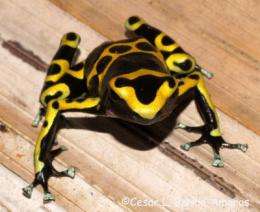
Dendrobates leucomelas, a poisonous frog from Venezuelan Guiana, has higher aerobic capacity than its nontoxic relatives. Credit: Photo courtesy of Cesar Barrio-Amoros (www.andigena.org).
The most toxic, brightly colored members of the poison frog family may also be the best athletes, says a new study.
So-named because some tribes use their skin secretions to poison their darts, the poison dart frogs of the Amazon jungle are well known for their bitter taste and beautiful colors. The spectacular hues of these forest frogs serve to broadcast their built-in chemical weapons: skin secretions containing nasty toxins called alkaloids. Like the red, yellow and black bands on a coral snake or the yellow stripes on a wasp, their contrasting color patterns warn would-be predators to stay away, said lead author Juan Santos of the National Evolutionary Synthesis Center in Durham, NC.
As it turns out, the most boldly-colored and bad-tasting species are also the most physically fit, the authors report this week in the journal Proceedings of the National Academy of Sciences.
In forests in Colombia, Ecuador, Venezuela, and Panamá, Santos subjected nearly 500 poison frogs representing more than 50 species to a frog fitness test. He measured their oxygen uptake during exercise using a rotating plastic tube, turning the tube like a hamster wheel to make the frogs walk.
Santos estimated the frogs' metabolic rates while at rest, and again after four minutes of exercise. The result? The most dazzling and deadly species had higher aerobic capacity than their drab, nontoxic cousins.
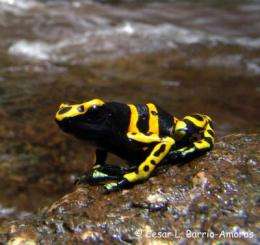
Dendrobates leucomelas, a poisonous frog from Venezuelan Guiana, has higher aerobic capacity than its nontoxic relatives. Credit: Photo courtesy of Cesar Barrio-Amoros (www.andigena.org)
"They're better able to extract oxygen from each breath and transport it to their muscles, just like well-trained athletes," Santos said.Poisonous species owe their athletic prowess to their unusual foraging habits, explained co-author David Cannatella of the University of Texas at Austin. Unlike snakes and other poisonous animals which make their own venom, poison frogs get their toxins from their food.
"They acquire their alkaloid chemicals by eating ants and mites," Cannatella said.
Because of their picky diet, poisonous frogs have to forage far and wide for food. "Nontoxic species basically stay in one place and don't move very much and eat any insect that comes close to them," Santos said. "But the bright, poisonous frogs are very picky about what they eat."
"It's not like a buffet where they can get everything they need to eat in one place," Cannatella added. "Ants and mites are patchy, so the frogs have to move around more to find enough food."
This combination of toxic skin and bold colors a syndrome known as aposematism evolved in tandem with specialized diet and physical fitness multiple times across the poison frog family tree, the authors explained. In some cases the frogs' physical fitness may have evolved before their unusual diet, making it possible to forage for harder-to-find food. But the specific sequence of events was likely different for different branches of the tree, Santos said.
The findings appear in the March 28 issue of Proceedings of the National Academy of Sciences.
More information: Santos, J. and D. Cannatella (2011). "Phenotypic integration emerges from aposematism and scale in poison frogs." Proceedings of the National Academy of Sciences. http://www.pnas.or … s.1010952108
Provided by National Evolutionary Synthesis Center
-
From lemons to lemonade: Reaction uses carbon dioxide to make carbon-based semiconductor,
32 comments
-
Thioridazine kills cancer stem cells in human while avoiding toxic side-effects of conventional cancer treatments,
3 comments
-
SpaceX private rocket blasts off for space station (Update),
42 comments
-
Climate scientists say they have solved riddle of rising sea,
30 comments
-
Research team claims to have found evidence Lake Cheko is impact crater for Tunguska Event,
18 comments
-
What would stain as translucent on light-coloured fabric?
9 hours ago
-
How do I identify different bacteria on culture plates?
19 hours ago
-
Why Do Dogs do Strange things...
May 25, 2012
-
What does exophillic and endophillic mean in terms of mosquito and their control?
May 24, 2012
-
Semen stains glows under black lights (uv light)?
May 23, 2012
-
Question on Human Chromosome 2
May 23, 2012
- More from Physics Forums - Biology
More news stories
Scientist: Evolution debate will soon be history
(AP) -- Richard Leakey predicts skepticism over evolution will soon be history. Not that the avowed atheist has any doubts himself.
8 hours ago |
3.4 / 5 (8) |
21
Thousands of shellfish found dead in Peru
Thousands of crustaceans were found dead off the coast of Lima following the mystery mass death of dolphins and pelicans, the Peruvian Navy said Friday.
18 hours ago |
4.8 / 5 (4) |
6
More plant species responding to global warming than previously thought
(Phys.org) -- Far more wild plant species may be responding to global warming than previous large-scale estimates have suggested.
May 22, 2012 |
4.6 / 5 (14) |
18
|
Totally rad: Scientists create rewritable digital data storage in DNA
(Phys.org) -- Scientists from Stanford's Department of Bioengineering have devised a method for repeatedly encoding, storing and erasing digital data within the DNA of living cells.
May 21, 2012 |
4.9 / 5 (17) |
11
|
For monogamous sparrows, it doesn't pay to stray (but they do it anyway)
It's quite common for a female song sparrow to stray from her breeding partner and mate with the male next door, but a new study shows that sleeping around can be costly.
May 22, 2012 |
5 / 5 (1) |
7
|
Dell tablet leak: 10.1-inch display, two-battery choice
(Phys.org) -- Headline after headline talks about vendors tablets in the wings as likely number-one contenders for the iPad. Such claims have justifiably been taken with a grain of salt, considering ...
SpotterRF debuts Radar Backpack Kit (w/ Video)
(Phys.org) -- SpotterRF has announced a special radar backpack kit designed to enhance situational awareness for soldiers on the ground. The company says its special radar is designed for warfighters as part ...
SpaceX capsule has 'new car' smell, astronauts say (Update)
SpaceX's Dragon cargo vessel smells like a new car, said astronauts at the International Space Station after opening the hatches Saturday following the spacecraft's landmark mission to the orbiting lab.
Astronomers seize last chance in lifetime for Venus Transit
Astronomers are gearing for one the rarest events in the Solar System: an alignment of Earth, Venus and the Sun that will not be seen for another 105 years.
Keep food safety in mind this memorial day weekend
(HealthDay) -- Picnics, parades and cookouts are as much a part of Memorial Day weekend as tributes to the United States' war veterans.
Australia hails surprise super-telescope decision
Australia has hailed a surprise decision giving it a role in a radio telescope project aimed at revolutionising astronomy, vowing to draw on its decades of experience in space science.
