Tokyo at risk: Can megacities cope with disaster?
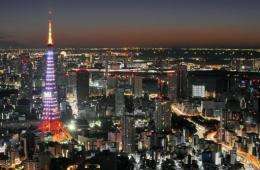
The cascade of catastrophe that has befallen Japan highlights the vulnerability of megacities to disaster, including fallout from a nuclear accident, say experts on urban risk.
Greater Tokyo, home to 35 million people, mostly escaped the devastation wrought by the March 11 9.0-magnitude earthquake and tsunami that swept the coast of northeastern Honshu.
Tokyo is also, according to the International Atomic Energy Agency (IAEA), beyond the reach of the radioactive plume emanating from the crippled Fukushima nuclear plant -- at least for now.
But what if the quake had struck nearer the city, like the Great Kanto earthquake of 1923? Or if the tsunami had occurred opposite Tokyo Bay? Or if the nuclear plant that had been crippled was an ageing facility at Hamaoka that lies 200 kilometres (120 miles) south, and thus upwind, of the capital?
"This incident puts in clear evidence the fragility of megacities in every aspect: physical, social, economic and ecological," said Fouad Bendimerad, head of the Earthquakes and Megacities Initiative, an international scientific organisation that analyses disaster risk.
"Many previous assumptions about the resiliency of megacities will be put into question."
Tokyo is hardly the only supercity facing multiple threats from natural and manmade disaster.
For Chris Ipsen, head of the Emergency Management Department for the city of Los Angeles, the drama unfolding in Japan is a reminder of how things might go horribly wrong in a crowded metropolis.
"It is something we definitely relate to. Obviously we have a lot of earthquake threat, it's our number one hazard. We face tsunami hazard as well," he said by phone.
But, Ipsen said, the chaos that could arise from a nuclear accident remains poorly understood.
"The new one for us is the radiation. We have several power plants here," he said.
Los Angeles' new 110-million dollar emergency operations center in downtown L.A. was put through its paces last July in a simulated radiation emergency -- the detonation of a small nuclear device, or "dirty bomb," somewhere in the city.
"We were quickly overwhelmed by the scenario," Ipsen said. "There are a lot of things we need to tweak."
South of Los Angeles, eight million people live within a 50-mile (80-kilometre) radius of North San Diego County's San Onofre Nuclear Generating Station, built in the 1970s.
In the eastern United States, the governor of New York state, Andrew Cuomo, last week called for the closure of the 40-year-old Indian Point nuclear plant, located only 55 kilometres (35 miles) from New York City.
The scenario that most haunts emergency planning experts is how to evacuate millions of people from a city when key infrastructure is down.
"The major problems in the evacuation of a megacity where you have a disaster are about transport, access roads, clogging and energy supplies that stop working," said Helena Molin Valdes, deputy head of the UN International Strategy for Disaster Reduction (UNISDR).
For Jorn Birkmann, an expert on vulnerability assessment and risk management at the UN University in Bonn, emptying the Japanese capital is simply not an option.
"An evacuation of over 35 million people within the urban agglomeration of Tokyo in a short time period seems to be very unrealistic if not impossible," he said by email.
Birkmann pointed out that a fifth of Tokyo's population is aged over 65, and thus less able to prepare and execute an evacuation. "If you assume that only half this group will need assistance, you are still talking about 3.5 million people."
Tokyo's municipal government has long had emergency response plans for earthquakes and tsunamis, the first involving evacuation to open spaces such as large parks to avoid fire hazard, and the latter to more distant higher ground.
In 1999, the city added measures for nuclear emergencies, said Takaaki Kato, a professor at the University of Tokyo's School of Engineering and one of the country's top experts and government advisors on earthquake risk.
"At present, Tokyo's metropolitan government has a plan for nuclear accidents composed of a preparedness plan and emergency response. the latter focuses on gathering information and distributing it to the public," he said by email.
Kato emphasised that evacuation of large numbers of people remains a hypothetical scenario, but said it was feasible.
"The most important factor will be orderly behaviour of the citizens and cool-headed understanding of the situation," he said.
All the experts interviewed agreed that cultural factors weigh heavily and Japan -- especially Tokyo -- is as well prepared for disaster as any society can be.
"If this had happened in a megacity with less preparedness capacity, the toll would have been in the millions, at least the hundreds of thousands," said Valdes, citing Mumbai and Dhaka as being particularly vulnerable.
"In this sense, the scenario in Japan is positive despite all these horrible impacts."
Since World War II, government at all levels in Japan has developed what is now a deeply-rooted, three-layered strategy for dealing with calamities.
They call it 'self help, mutual assistance, public assistance' -- people are trained since kindergarten," Valdes said.
But Birkmann said the unprecedented amalgam of disasters may have overloaded even Japan's capacity to cope.
"The cascading event of an earthquake, a tsunami and ... major difficulties with critical infrastructures might have reached a tipping point that one could not be prepared for," he said.
(c) 2011 AFP


