Fukushima: Sea contamination likely to be local - scientists
March 29, 2011 by Richard Ingham
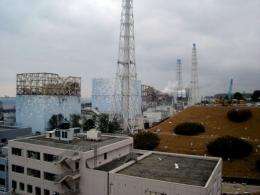
This handout picture from Tokyo Electric Power Company (TEPCO), taken on March 15, shows the four reactors of the Fukushima Dai-ichi (no.1) nuclear power plant. Radioactive contamination of the sea from Fukushima is likely to be only a local problem, but could lead to an exclusion zone if there is a major release of long-term pollutants, scientists say.
Radioactive contamination of the sea from Fukushima is likely to be only a local problem, but could lead to an exclusion zone if there is a major release of long-term pollutants, scientists say.
So far, the biggest contaminant identified by Japanese officials has been radioactive iodine 131.
Samples of water taken close to the plant have been as high as 1,850 times the legal limit of iodine, but levels have fallen back, Japanese officials said on Tuesday.
Radioactive iodine can enter the marine food chain, especially through seaweed, which absorbs this element readily.
"There is the potential, when you're talking about certain types of seafood, that you can have reconcentration," said Ed Lyman of the Union of Concerned Scientists (UCS), a respected US NGO that focuses on nuclear safety.
"So, even dilute levels of contamination can be enhanced in certain marine life, you know, just like mercury concentrates in large fish like tuna. Also, plants like seaweed are known to concentrate certain isotopes, and so are certain types of shellfish."
Radioactive elements are hazardous in food because when ingested their radiation can damage DNA in cells, with the potential to cause cancer.
However, the contamination from iodine 131 is short-lived because the element has a half life -- the pace at which it loses half of its radioactivity -- of only eight days.
"This means that after a few months, it will be harmless, basically," said Simon Boxall, a lecturer at Britain's National Oceanography Centre at the University of Southampton, southern England, who praised early measures to stop fishing around the plant after the March 11 disaster.
"What worries me more is if caesium and plutonium get into the system," he said, referring to two radioactive heavy metals whose half-lives are around 30 years and potentially thousands of years respectively.
"That's more concerning, because that can build up in the sediments" of the sea bed at Fukushima, said Boxall.
At high levels, this could lead to the imposition of an exclusion zone of catches of fish and seafood, a measure that could last "years and years," he said.
"It's hard to know (how long) until they start taking measurements and determine how extensive the pollution is.
"You would basically not fish in an exclusion zone, period. And beyond the exclusion zone there would be an additional zone where you would come from time to time and see if there's any radioactivity."
Fukushima's plant operator, the Tokyo Electric Power Co. (TEPCO), reported on Saturday that levels of caesium were almost 80 times the legal maximum. On Monday it also said that plutonium, at very low and harmless levels, had been found at five locations in soil at the plant.
Given the scale of the Pacific -- the world's vastest body of water -- radioactivity in the sea at Fukushima will be flushed out beyond the local area by tides and currents and dilute to very low levels, Boxall said.
"It will get into the (ocean) food chain but only in that vicinity," he said. "Should people in Hawaii and California be concerned? The answer is no."
The Pacific, thanks to its size, is one of the cleanest seas in the world for radioactive contamination, according to the Woods Hole Oceanographic Institution in Massachusetts.
In 1990, radiation in the surface North Pacific was four becquerels of caesium 137 per cubic metre, while in the South Pacific it was 1.6 Bq/m3, it says. Most of it came from atmospheric nuclear tests before these blasts were stopped.
The most polluted seas were the Baltic, hit by fallout from the 1986 Chernobyl disaster, with 125 Bq/m3; the Irish Sea, with 55 Bq/m3 due to radioactive releases from Britain's Sellafield plant; and the Black Sea, also contaminated by Chernobyl, with 52 Bq/m3.
By comparison, the US Environmental Protection Agency (EPA) sets a maximum of 3,700 Bq/m3 of caesium in drinking water.
(c) 2011 AFP
-
From lemons to lemonade: Reaction uses carbon dioxide to make carbon-based semiconductor,
32 comments
-
Thioridazine kills cancer stem cells in human while avoiding toxic side-effects of conventional cancer treatments,
3 comments
-
SpaceX private rocket blasts off for space station (Update),
42 comments
-
Climate scientists say they have solved riddle of rising sea,
30 comments
-
Research team claims to have found evidence Lake Cheko is impact crater for Tunguska Event,
18 comments
-
Hypothetical desert earth
1 hour ago
-
More human population = greater mass?
May 25, 2012
-
Conversion from aircraft bearing to normal degrees
May 23, 2012
-
Interpretation/Analysis of the Lab results(HEPA filter)
May 22, 2012
-
Has anyone here attended the The Urbino Summer School in Paleoclimatology?
May 22, 2012
-
Earthquakes: Mag 6 N. Italy and Mag 5.6 W. Bulgaria
May 21, 2012
- More from Physics Forums - Earth
More news stories
SpaceX capsule has 'new car' smell, astronauts say (Update)
SpaceX's Dragon cargo vessel smells like a new car, said astronauts at the International Space Station after opening the hatches Saturday following the spacecraft's landmark mission to the orbiting lab.
Space & Earth / Space Exploration
15 hours ago |
4.5 / 5 (19) |
0
Australia hails surprise super-telescope decision
Australia has hailed a surprise decision giving it a role in a radio telescope project aimed at revolutionising astronomy, vowing to draw on its decades of experience in space science.
15 hours ago |
5 / 5 (3) |
1
Astronomers seize last chance in lifetime for Venus Transit
Astronomers are gearing for one the rarest events in the Solar System: an alignment of Earth, Venus and the Sun that will not be seen for another 105 years.
15 hours ago |
5 / 5 (1) |
1
Astronauts enter world's 1st private supply ship
(AP) -- Space station astronauts floated into the Dragon on Saturday, a day after its heralded arrival as the world's first commercial supply ship.
Space & Earth / Space Exploration
15 hours ago |
5 / 5 (5) |
0
Dragon arrives at space station in historic 1st (Update 2)
The privately bankrolled Dragon capsule made a historic arrival at the International Space Station on Friday, triumphantly captured by astronauts wielding a giant robot arm.
Space & Earth / Space Exploration
May 25, 2012 |
5 / 5 (10) |
19
Dell tablet leak: 10.1-inch display, two-battery choice
(Phys.org) -- Headline after headline talks about vendors tablets in the wings as likely number-one contenders for the iPad. Such claims have justifiably been taken with a grain of salt, considering ...
Scientist: Evolution debate will soon be history
(AP) -- Richard Leakey predicts skepticism over evolution will soon be history. Not that the avowed atheist has any doubts himself.
SpotterRF debuts Radar Backpack Kit (w/ Video)
(Phys.org) -- SpotterRF has announced a special radar backpack kit designed to enhance situational awareness for soldiers on the ground. The company says its special radar is designed for warfighters as part ...
Thousands of shellfish found dead in Peru
Thousands of crustaceans were found dead off the coast of Lima following the mystery mass death of dolphins and pelicans, the Peruvian Navy said Friday.
Keep food safety in mind this memorial day weekend
(HealthDay) -- Picnics, parades and cookouts are as much a part of Memorial Day weekend as tributes to the United States' war veterans.
Family history of Alzheimer's affects functional connectivity
(HealthDay) -- Cognitively normal individuals with a family history of late-onset Alzheimer's disease (AD) may display lower resting state functional connectivity in the default mode network (DMN) of the brain, ...
Mar 30, 2011
Rank: not rated yet
It does accumulate in plants much easier though.
So acute exposure is still the biggest concern here and unless a fish is just saturated in concentration, I doubt it'll be a major exposure risk.
It would be nice if these articles would start stating what the legal maximum is in Japan, or at least a comparison to EPA regions XX. Also, what their levels are would be nice to know.
80 times may be scary sounding, but it's only 2 orders of magnitude, which more than likely raises the risk from 1 in a million to 1 in 10,000.