More possible branches to the domain of life
March 30, 2011 by Deborah Braconnier report

More possible branches to the domain of life

Enlarge

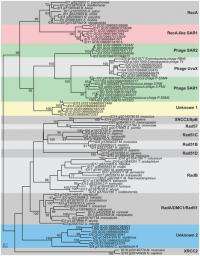
Phylogenetic tree of the RecA superfamily. Image credit: Plos One, doi:10.1371/journal.pone.0018011

(PhysOrg.com) -- When it comes to the current domain of life, we are familiar with the three branches: bacteria, archaea, and eukaryotes. However, Jonathan Eisen of UC Davis and his team have published possible evidence in PLOS One that shows the possibility of a fourth branch.

The domain of life has changed quite a bit over the years. Until the 1990s, there were only two branches, eukaryotes and one for everything else. That second branch was then broken down into the bacteria and archaea branches.

Utilizing a technique called metagenomics, Eisen and his team were able to sequence a series of samples taken from a collection of taken during the Global Ocean Sampling Expedition. They found a sampling of sequences that belonged to superfamilies of known as recA and rpoB. However, these samplings were unlike any that have been seen before.

Eisen and his team are unsure what organism these genes could belong too. Two possibilities being addressed are that of a very unusual and new virus, or the possibility of a fourth branch in the domain of life.

There is debate about the possibility of a fourth domain and where these sequences came from. Radhey Gupta from McMaster University suggests that the sequences could be from cellular organisms living in an environment that caused rapid and that the addition of a fourth domain could just add confusion.

Further study of the samples will be conducted to determine if these two new gene families have rapidly evolved or if they come from a cellular organism with a strange .

This is not the first time talk of a fourth domain has been approached. Many believe the could represent a fourth domain. As the largest known virus, the mimivirus, while seen as a , also shows many genes only found in cellular organisms.

Should the mimivirus be determined to be a fourth branch, then the new sequences discovered by Eisen and his team could represent a fifth branch. It appears as if the possibility of our domain of life growing a bit bigger with new branches could be in the future.

More information: Wu D, Wu M, Halpern A, Rusch DB, Yooseph S, et al. (2011) Stalking the Fourth Domain in Metagenomic Data: Searching for, Discovering, and Interpreting Novel, Deep Branches in Marker Gene Phylogenetic Trees. PLoS ONE 6(3): e18011. doi:10.1371/journal.pone.0018011

© 2010 PhysOrg.com

4.1 /5 (16 votes)  

Filter


Move the slider to adjust rank threshold, so that you can hide some of the comments.


Display comments: newest first

Caliban
Mar 30, 2011

Rank: not rated yet
No way to know for sure, until the organisms that generate them are discovered.

Or, possible evidence for the Panspermia hypothesis?

Beard
Apr 02, 2011

Rank: not rated yet
They caught some skin cells from Cthulhu.
Rank 4.1 /5 (16 votes)
Relevant PhysicsForums posts

More news stories

Scientist: Evolution debate will soon be history

(AP) -- Richard Leakey predicts skepticism over evolution will soon be history. Not that the avowed atheist has any doubts himself.

Biology / Evolution

created 5 hours ago | popularity 2.8 / 5 (6) | comments 18

Thousands of shellfish found dead in Peru

Thousands of crustaceans were found dead off the coast of Lima following the mystery mass death of dolphins and pelicans, the Peruvian Navy said Friday.

Biology / Ecology

created 15 hours ago | popularity 4.8 / 5 (4) | comments 5

More plant species responding to global warming than previously thought

(Phys.org) -- Far more wild plant species may be responding to global warming than previous large-scale estimates have suggested.

Biology / Ecology

created May 22, 2012 | popularity 4.6 / 5 (14) | comments 18 | with audio podcast

Totally rad: Scientists create rewritable digital data storage in DNA

(Phys.org) -- Scientists from Stanford's Department of Bioengineering have devised a method for repeatedly encoding, storing and erasing digital data within the DNA of living cells.

Biology / Biotechnology

created May 21, 2012 | popularity 4.9 / 5 (17) | comments 11 | with audio podcast

For monogamous sparrows, it doesn't pay to stray (but they do it anyway)

It's quite common for a female song sparrow to stray from her breeding partner and mate with the male next door, but a new study shows that sleeping around can be costly.

Biology / Plants & Animals

created May 22, 2012 | popularity 5 / 5 (1) | comments 7 | with audio podcast


Dell tablet leak: 10.1-inch display, two-battery choice

(Phys.org) -- Headline after headline talks about vendors’ tablets in the wings as likely number-one contenders for the iPad. Such claims have justifiably been taken with a grain of salt, considering ...

SpotterRF debuts Radar Backpack Kit (w/ Video)

(Phys.org) -- SpotterRF has announced a special radar backpack kit designed to enhance situational awareness for soldiers on the ground. The company says its special radar is designed for warfighters as part ...

SpaceX capsule has 'new car' smell, astronauts say (Update)

SpaceX's Dragon cargo vessel smells like a new car, said astronauts at the International Space Station after opening the hatches Saturday following the spacecraft's landmark mission to the orbiting lab.

Australia hails surprise super-telescope decision

Australia has hailed a surprise decision giving it a role in a radio telescope project aimed at revolutionising astronomy, vowing to draw on its decades of experience in space science.

Keep food safety in mind this memorial day weekend

(HealthDay) -- Picnics, parades and cookouts are as much a part of Memorial Day weekend as tributes to the United States' war veterans.

Astronomers seize last chance in lifetime for Venus Transit

Astronomers are gearing for one the rarest events in the Solar System: an alignment of Earth, Venus and the Sun that will not be seen for another 105 years.