The most distant mature galaxy cluster
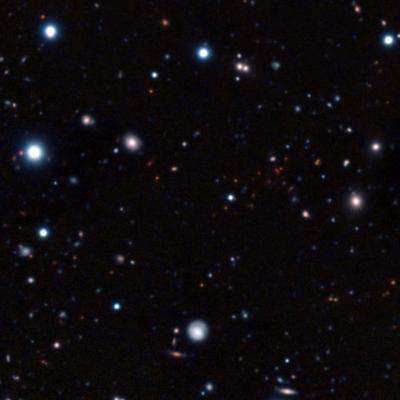
This image is a composite of very long exposures taken with ESO’s Very Large Telescope in Chile and the NAOJ’s Subaru telescope on Hawaii. Most of the visible objects are very faint and distant galaxies. The clump of faint red objects to the right of center is the most remote mature cluster of galaxies yet found. Credit: ESO/R. Gobat et al.
Astronomers have used an armada of telescopes on the ground and in space, including the Very Large Telescope at ESO's Paranal Observatory in Chile to discover and measure the distance to the most remote mature cluster of galaxies yet found. Although this cluster is seen when the Universe was less than one quarter of its current age it looks surprisingly similar to galaxy clusters in the current Universe.
"We have measured the distance to the most distant mature cluster of galaxies ever found", says the lead author of the study in which the observations from ESO's VLT have been used, Raphael Gobat (CEA, Paris). "The surprising thing is that when we look closely at this galaxy cluster it doesn't look young -- many of the galaxies have settled down and don't resemble the usual star-forming galaxies seen in the early Universe."
Clusters of galaxies are the largest structures in the Universe that are held together by gravity. Astronomers expect these clusters to grow through time and hence that massive clusters would be rare in the early Universe. Although even more distant clusters have been seen, they appear to be young clusters in the process of formation and are not settled mature systems.
The international team of astronomers used the powerful VIMOS and FORS2 instruments on ESO's Very Large Telescope (VLT) to measure the distances to some of the blobs in a curious patch of very faint red objects first observed with the Spitzer space telescope. This grouping, named CL J1449+0856, had all the hallmarks of being a very remote cluster of galaxies. The results showed that we are indeed seeing a galaxy cluster as it was when the Universe was about three billion years old -- less than one quarter of its current age.
Once the team knew the distance to this very rare object they looked carefully at the component galaxies using both the NASA/ESA Hubble Space Telescope and ground-based telescopes, including the VLT. They found evidence suggesting that most of the galaxies in the cluster were not forming stars, but were composed of stars that were already about one billion years old. This makes the cluster a mature object, similar in mass to the Virgo Cluster, the nearest rich galaxy cluster to the Milky Way.
Further evidence that this is a mature cluster comes from observations of X-rays coming from CL J1449+0856 made with ESA's XMM-Newton space observatory. The cluster is giving off X-rays that must be coming from a very hot cloud of tenuous gas filling the space between the galaxies and concentrated towards the centre of the cluster. This is another sign of a mature galaxy cluster, held firmly together by its own gravity, as very young clusters have not had time to trap hot gas in this way.
As Gobat concludes: "These new results support the idea that mature clusters existed when the Universe was less than one quarter of its current age. Such clusters are expected to be very rare according to current theory, and we have been very lucky to spot one. But if further observations find many more then this may mean that our understanding of the early Universe needs to be revised."
Provided by
ESO
-
From lemons to lemonade: Reaction uses carbon dioxide to make carbon-based semiconductor,
32 comments
-
Thioridazine kills cancer stem cells in human while avoiding toxic side-effects of conventional cancer treatments,
3 comments
-
SpaceX private rocket blasts off for space station (Update),
42 comments
-
Climate scientists say they have solved riddle of rising sea,
30 comments
-
Research team claims to have found evidence Lake Cheko is impact crater for Tunguska Event,
18 comments
-
revamping general concept and cosmological principle
May 25, 2012
-
Transiting Exoplanet Light Curve
May 25, 2012
-
Math behind Theoretical Physics
May 24, 2012
-
Do we know whats at the center of galaxies yet?
May 23, 2012
-
Structure of the Milky Way?
May 20, 2012
-
What would it take to terraform Pluto and Charon?
May 19, 2012
- More from Physics Forums - General Astronomy
More news stories
SpaceX capsule has 'new car' smell, astronauts say (Update)
SpaceX's Dragon cargo vessel smells like a new car, said astronauts at the International Space Station after opening the hatches Saturday following the spacecraft's landmark mission to the orbiting lab.
Space & Earth / Space Exploration
15 hours ago |
4.5 / 5 (19) |
0
Australia hails surprise super-telescope decision
Australia has hailed a surprise decision giving it a role in a radio telescope project aimed at revolutionising astronomy, vowing to draw on its decades of experience in space science.
15 hours ago |
5 / 5 (3) |
1
Astronomers seize last chance in lifetime for Venus Transit
Astronomers are gearing for one the rarest events in the Solar System: an alignment of Earth, Venus and the Sun that will not be seen for another 105 years.
15 hours ago |
5 / 5 (1) |
1
Astronauts enter world's 1st private supply ship
(AP) -- Space station astronauts floated into the Dragon on Saturday, a day after its heralded arrival as the world's first commercial supply ship.
Space & Earth / Space Exploration
15 hours ago |
5 / 5 (5) |
0
Dragon arrives at space station in historic 1st (Update 2)
The privately bankrolled Dragon capsule made a historic arrival at the International Space Station on Friday, triumphantly captured by astronauts wielding a giant robot arm.
Space & Earth / Space Exploration
May 25, 2012 |
5 / 5 (10) |
19
Dell tablet leak: 10.1-inch display, two-battery choice
(Phys.org) -- Headline after headline talks about vendors tablets in the wings as likely number-one contenders for the iPad. Such claims have justifiably been taken with a grain of salt, considering ...
Scientist: Evolution debate will soon be history
(AP) -- Richard Leakey predicts skepticism over evolution will soon be history. Not that the avowed atheist has any doubts himself.
SpotterRF debuts Radar Backpack Kit (w/ Video)
(Phys.org) -- SpotterRF has announced a special radar backpack kit designed to enhance situational awareness for soldiers on the ground. The company says its special radar is designed for warfighters as part ...
Thousands of shellfish found dead in Peru
Thousands of crustaceans were found dead off the coast of Lima following the mystery mass death of dolphins and pelicans, the Peruvian Navy said Friday.
Keep food safety in mind this memorial day weekend
(HealthDay) -- Picnics, parades and cookouts are as much a part of Memorial Day weekend as tributes to the United States' war veterans.
Family history of Alzheimer's affects functional connectivity
(HealthDay) -- Cognitively normal individuals with a family history of late-onset Alzheimer's disease (AD) may display lower resting state functional connectivity in the default mode network (DMN) of the brain, ...
Mar 09, 2011
Rank: not rated yet
Mar 09, 2011
Rank: 4.8 / 5 (6)
The paper lists the redshift at z=2.09, which puts the distance to the protocluster ~10 billion light years(H=70): http://www.eso.or...1108.pdf
As noted in the paper, the distance and size of CL J1449 is comparable to the well known protocluster MRC 1138-262 (containing the Spiderweb Galaxy): http://www.esa.in...x_0.html
Mar 09, 2011
Rank: 5 / 5 (2)
Mar 09, 2011
Rank: 5 / 5 (2)
Well, it says we are seeing it as it was when the universe was 3billion years old... So I guess it must be something like 10.7 billion light years away...
But yeah, kinda funny that the article is essentialy about how these guys have measured and calculated the distance - but then neglect to mention what it is :)
Mar 09, 2011
Rank: 1.9 / 5 (14)
Mar 09, 2011
Rank: 3 / 5 (3)
Now, I'm not saying that any aspect of current theory is wrong, although history points out that we are almost certainly wrong about something. I would like to point out that this "Mature" galaxy cluster is very faint, while "Young" quasars and such are very bright. It is very reasonable to assume that there is at least some kind of observational bias based on what we can see, even if it does not overthrow any theories.
Mar 09, 2011
Rank: 1 / 5 (4)
http://www.physor...752.html
Mar 09, 2011
Rank: 5 / 5 (9)
Mar 09, 2011
Rank: 4.7 / 5 (7)
Five stars for that. Please keep religion out of physical sciences. It should only apply to sciences like archeology and sociology.
Just kidding. Sociology is hardly a science.
Mar 10, 2011
Rank: 2 / 5 (3)
That means that the further away from any point of observation, the more redshifted the light will appear to be.
From any point in such a universe, space will appear to be expanding (or contracting away from the observer, as when the observer is at the event horizon of an ordinary black hole).
As the centre of the Schwarzschild black hole is equally distributed in every direction, no gravitational pull is experienced by the observer (unlike at the event horizon of a small dense Black hole).
In other words, an infinite universe should appear just like our current universe. Many mysteries (dark matter, dark energy, before the big bang etc) are replaced by one ie where does the CMBR come from and why?
Mar 10, 2011
Rank: 4.3 / 5 (7)
That's a gigantic leap in logic and away from observation.
Mar 10, 2011
Rank: 4 / 5 (4)
Mar 11, 2011
Rank: 2 / 5 (3)
you've both assumed a small dense black hole and thus drifted way off my point. A Schwarzschild black hole can have any density at all eg a Schwarzschild black hole with a density of 1^-26 kg/m^3 would have a radius of 13.4 billion light years. I've given the density of baryonic matter in our universe.
The light coming from any massive body, say the earth, is red shifted as measured by an observer in space. This is called gravitational redshift. The greater the height above the earth, the less the redshift is as measured by that space observer.
Now if that observer was at the centre of a sphere/halo of massive bodies then that observer would measure redshift with distance from the observer in any direction.
With me so far?
Mar 12, 2011
Rank: 1 / 5 (2)
Now if the universe was infinite then the accumulation of matter in any direction would form a Schwarzschild radius as calculated above.
As for the math:
Schwarzschild Radius:
r=2Gm/c^2=(3c^2/8Gdpi)^.5 where G=Gravitational Constant =6.67359*10^-11, m=mass in kg, c=speed of light, d=density in kg/m^3, result in meters (1 light year = 9.461*10^15m), equation gives radius for a given mass or a given density.
Note that with dark matter, the current universe would be Schwarzschild radius much smaller than 13.5 billion light years, so there can be no cold dark matter OR we can not possibly see across to the other side of the centre of the Schwarzschild radius.
Gravitational Redshift is given by:
=(1-(2Gm)/c^2r)^.5
where is the ratio between the observer's clock and the observed clock.
So we have your philosophical opposition to my argument, now let's see where you think my math is wrong...or is your opposition entirely philosophical???
Mar 12, 2011
Rank: 1.8 / 5 (4)
Light is ever more redshifted with distance from the observer. For Olber's paradox to work there must be no red shift ie the light must retain it its energy level. Thus visible light emitted from 10 billion light years distant is not in the visible range. Eventually, light from a great enough distance would lose all its energy (in a flat universe).
But the universe isn't flat due to the Schwarzschild Radius, which causes RELATIVE curvature.
The only difference between my solution and the big bang universe is that at the threshold of the observable universe, galaxies observed at that distance will be no younger and no different to galaxies found locally, and this is what is actually observed eg
The most distant mature galaxy cluster
http://www.physor...ter.html
Massive galaxies formed when universe was young
http://www.physor...ung.html
My model is consistent with actual observations...
Mar 12, 2011
Rank: 4 / 5 (4)
Btw, a Schwarzschild BH is not to be expected in reality as the condition of a vanishing angular momentum is equivalent to an unstable equilibrium.
Mar 12, 2011
Rank: 2.3 / 5 (3)
the Schwarzschild equation I gave allows you to calculate a radius of ANY density. The volume and mass come out of the same equation, or are you saying that Schwarzschild's equation, r=2Gm/c^2=(3c^2/8Gdpi)^.5, is flawed????
Being unstable only means that a Schwarzschild black hole can not persist indefinitely, it does not mean it can't exist. Unstable particles, so unstable that they can exist for only tiny fractions of a second are non-the-less considered real particles ~ indeed, even resonances are considered real particles.
Show me the flaw in Schwarzschild's math. Otherwise, a Schwarzschild radius can have any density. If the mass or volume are not right then you don't have a Schwarzschild radius in the first place, thus your objection was circular and non-mathematical. (Or isn't physics based on math any more???)
Mar 12, 2011
Rank: 4.2 / 5 (5)
The Schwarzchild solution to Einstein's field equations gives the metric, which determines that any non-rotating and non-charged mass that is smaller than its Schwarzschild radius forms a black hole. Any physical object with R<RsubS becomes a blackhole.
There is no flaw in the Schwarzchild equations, only in your understanding of them.
Mar 12, 2011
Rank: 3.7 / 5 (3)
Rather, the (matter) density inside a sphere with a given radius is defined by the volume of the sphere and the mass within.
More succinct: Density follows from mass and radius. Radius does not follow from density.
And btw, the specific formula is irrelevant in this consideration.
Mar 12, 2011
Rank: 3.7 / 5 (3)
I'm speaking instead of the dynamical rotational instability of a physical system with "infalling" masses. For the system to remain in a non-rotating condition, the incoming masses would have to be distributed in perfect spherical symmetry.
Mar 12, 2011
Rank: 3.7 / 5 (3)
Whether the radius in question is a Schwarzschild radius or not, is irrelevant in this consideration.
Mar 12, 2011
Rank: 3.7 / 5 (3)
Mar 12, 2011
Rank: 3 / 5 (2)
Mar 12, 2011
Rank: 3.7 / 5 (3)
A Schwarzchild radius is not a physical radius. This is your fundamental misunderstanding and it's a big one.
A schwarzchild radius for a given mass is the delineating limit that determines the critical density at which a singularity occurs. For example, for the Earth, the SR is 9mm. That means if you compressed all the mass of the Earth into a volume with a radius of 9mm, it would become a blackhole.
Mar 12, 2011
Rank: 1 / 5 (3)
why perfect symmetry in a universe sized Schwarzschild radius? It may collapse, but that would take billion of years. If there is enough matter the Schwarzschild radius is the result ~ think of an Olber's paradox using gravity instead of light...
Mar 12, 2011
Rank: 1 / 5 (3)
So the universe doesn't have a density (despite the figure often being speculated???)
If we drop the density then we still have the calculation for any accumulated mass ie the sun would be about 3km. We can also consider much greater mass eg 8.5*10^52kg. Tells what the size of that black hole, just for interest sake...
Here's Schwarzschild's formula ~ r=2Gm/c^2, G =6.67359*10^-11. I get 13.4 billion light years...
Mar 12, 2011
Rank: 1 / 5 (4)
Great, then show where my math is wrong. And while you're at it, tell Astrophysicist Fulvio Melia who, in his book 'The Edge of Infinity: Supermassive Black Holes in the Universe', writes: "The Schwarzschild radius of a sphere with a uniform density equal to the critical density is equal to the radius of the visible universe". It depends on the figure you use for the density of the universe, but at 1*10^-26kg/m^3 that would be around 13 billion light years.
What Schwarzschild radius do you calculate for these estimations of the mass of the universe??? http://hypertextb...on.shtml Or was your claim to mathematical competence a little optimistic?
Mar 12, 2011
Rank: 3.7 / 5 (3)
Again this shows YOUR inability to properly understand the content of what you've read. Space can be flat while spacetime is not.
According to the very equations that you are attempting to tout when r<r sub s the curvature becomes timelike and no longer couples to coordinate space.
Substantial misunderstanding further reinforced by your posting above.
Mar 12, 2011
Rank: 1 / 5 (3)
Galaxies, clusters of galaxies, and any collection of matter has an escape velocity. If that escape velocity reaches the speed of light then you have a Schwarzschild black hole. Sure, such a radius might collapse, but a universe sized, low density black hole would take billions of years to do so.
You are considering only the small dense collapsed mass (you're thinking 3mm, I'm thinking 13 billion light years ~ there's a difference). If we simply added matter to the surface of an Earth-like object then eventually the gravitational pull from that object would be strong enough to prevent light from escaping.
Just repeating that I am wrong only tells me and anybody else reading that you want me to be wrong, not that I am wrong. Show me the math, starting with Schwarzschild's elegant simplicity, with observations of scientists like Fulvio Melia, and tell us where we have erred...
And you have contradicted yourself ~ "A Schwarzchild radius is not a physical radius."
Mar 12, 2011
Rank: 3.7 / 5 (3)
Mar 12, 2011
Rank: 1 / 5 (2)
For all five figures given? Or did you average them??
I'm not considering a radius less than the Schwarzschild radius, and your equation only refers to the coupling of an object with the space outside it. If the whole universe was a Schwarzschild radius then we'd be inside it, so your equation does not apply.
On my original point (of being at the event horizon of a Schwarzschild radius in every direction) the Schwarzschild radius is relative ie if you jump ten billion light years to the left then the universe (not the distribution of matter but the density, Hubble's constant, red shift with distance etc) would be much the same ie the universe would vary little from what we observe locally (in the universe visible to us, a little further after James Webb).
Mar 12, 2011
Rank: 3.7 / 5 (3)
The given density of the observable universe is 3 x 10^-30 g/cm3
From which based on estimation of the size of the observable universe, the given mass for the observable Universe is 3 x 10^55 g
Do you take issue with this, or do you want me to do your math homework for you too?
Tell that to Schwarzschild, Eddington, and Krauss.
Mar 12, 2011
Rank: 1 / 5 (2)
Are you having to descend to insults? I said, and I quote,
I said nothing about expanding the Earth, only of adding matter to it. And yes, the escape velocity would eventually reach the speed of light. The equation is very simple equation ~
V=(2Gm/(R+h))^.5
Mar 12, 2011
Rank: 4 / 5 (3)
The ONLY thing that matters is density. There is no such thing as a low density blackhole. All blackholes are of a minimum density given by the Schwarzschild equations, hence my statement, that I still assert: You do not understand the Schwarzschild Metric.
Mar 12, 2011
Rank: 1 / 5 (3)
Your density figure is very low (3*10-27kg/m^3). Where does that come from? No dark matter?
Let's go with 6 billion lightyears. How dense would matter be in the Schwarzschild Black Hole you that you calculated ie radius of 6 billion light years, mass of 3*10^52kg. My math doesn't quite gell with your, so I'll give two versions (the Schwarzschild calculator I'm using could be off):
for a radius of 6 billion light years I get a density of 4.9kg/m^3 and a total mass of 3.8*10^52kg, or for a mass of 3.0*10^52kg I get a radius of 4.738 billion light years and a density of 8*10^-26 kg/m^3
Either way, the Schwarzschild radius that YOU calculated has a pretty low density...
Mar 12, 2011
Rank: 1 / 5 (3)
We're talking past each other on the Earth analogy. If I add matter of the same density as the Earth to the Earth's surface. That will also increase its radius, and as you calculated previously a low density Schwarzschild radius is possible (your 6 billion light year calculation has a density much lower than the matter on Earth).
I did not say that the same matter would be expanded nor that the volume would remain constant with an increased mass (as you say, the density would increase etc).
You calculated a Schwarzschild radius of 6 billion light years that would have a density of between 4.9kg/m^3 and 8*10^-26 kg/m^3
Your own math, your own initial density, mass and volume figures, all I've done is to calculate the density for the volume and mass you gave...
Mar 12, 2011
Rank: 5 / 5 (2)
No, I didn't.
/facepalm
Density for the observable universe, that is a universe with a radius of 41.5 BILLION light years is 3 x 10^-30 g/cm3.
So we can observe dark matter now?
YYZ, help me out here.
Mar 12, 2011
Rank: 4.3 / 5 (4)
Basically what your source, Fulvio Melia, stated in that book was a determination of whether the Universe is open or closed. That book, by the way was published in 2003. Melia wrote this book before the Boomerang experiment, which determined the size of the hot and cold spots of the CMB. The Boomerang experiment showed that the Universe was flat, not curved, not closed. Melia's book was based upon the mathematics around Supernovae that indicated a closed Universe. We have subsequently explained that the Universe itself is NOT closed. It is flat, and open, as evidenced by the acceleration of space. Of further interest is that we've since discovered that the observations of supernovae were flawed.
We live in a Quantum Universe. Not a singularity. Our current model of cosmology states as much, and as someone who states they follow current science, and has such a base of subscribers, you should know better.
Mar 12, 2011
Rank: 3 / 5 (2)
Not that I'm aware of, but many observers are considering it a done deal, especially with the observational evidence surrounding the bullet galaxy. We can't observe black holes directly but I'm sure their mass was included in your calculated density/mass.
Mar 12, 2011
Rank: 1 / 5 (2)
A singularity with that density? I don't think so. If the universe was compacted down to 6 billion light years radius then it would collapse and form a small dense black hole with a singularity at its centre, though we haven't observed one of those either and, as I recall, there was a lot of scientific debate about whether *all* black holes have a singularity or not and there are (or were) some scientists holding out on the issue (that not all BH include a singularity).
If there were a singularity with the mass given then it would be a bit more compact than 6 billion light years. With the density of the sun, for instance (1.4g/cm^3, it would only require a volume of 2.14*10^55cm^3 or a radius of 1.72*10^16 meters or just 1.8 light years (to enclose the mass of the universe).
And that still doesn't look like a singularity to me...
Mar 12, 2011
Rank: 1 / 5 (2)
I basically agree with what you've said about what Melia was trying to do, it was the fact that his calculation (given the data in his day) was valid ie
"The Schwarzschild radius of a sphere with a uniform density equal to the critical density is equal to the radius of the visible universe".
But you've since done the calculation yourself and declared it valid, so we are no longer arguing that point.
The sticking point is whether or not a six billion light year radius with the mass of the universe could be any denser than somewhere between 4.9kg/m^3 and 8*10^-26 kg/m^3 and include a singularity and if so how. After all, wouldn't a 6 billion light year Schwarzschild radius collapse further? Or would you predict that it remain the same despite having so little mass in such a vast area?
Gravity can accumulate ~ Olber should have hypothesized the effect of gravity in an infinite universe...
Mar 12, 2011
Rank: 1 / 5 (2)
I have over 7,000 subscribers in total, but only 102 in my Physical Sciences group ~ it is very much a boutique list :)
My suggested model did not predict that we lived inside a Schwarzschild radius, but I raised that possibility only as an example of a low density Schwarzschild radius. We have to say "if the universe were denser" eg dark matter would do it, or "if the universe were a lot bigger" to get a Schwarzschild radius to fit.
If the universe was infinite, however, then the accumulated mass in any direction from an observer on Earth would add up to a Schwarzschild radius. However this is a *relative* Schwarzschild radius because the mass is relatively evenly distributed in every direction. So when you move, say 10 billion light years to the left, the situation remains the same ~ a Schwarzschild radius in every direction.
Mar 12, 2011
Rank: 1 / 5 (2)
BTW if the visible universe were a Schwarzschild radius and we were in the middle of it then light from ever more distant objects would be ever more BLUE shifted, which is not exactly what we observe
Mar 12, 2011
Rank: 5 / 5 (4)
No one here is arguing that the Schwarzschild metric is wrong. We're all telling you that you're not understanding it accurately.
Now to address a piece of your nonsense. No, it isn't. You asked me, based on the mass of the Universe, what the Schwarzschild radius is. I answered based on the current accepted density of the observable Universe. THERE IS NO SUCH THING. The Schwarzschild equation produces a scaling constant based upon mass.
Mar 12, 2011
Rank: 5 / 5 (2)
For a given mass you can calculate the Schwarzschild radius.
For a given density and volume, you can determine the mass.
The diameter of the Observable Universe is 93 billion light years, or 8.798291412*10^28 cm.
The density of the universe is 3 x 10^-30 g/cm3
The volume of the Universe is given by (4/3)pi r^3
(4/3)pi*((8.798291412*10^28)/2)= 1.8427098442720912547214362241284 * 10^30 cm^3
M=VD for mass.
Out of characters, so go ahead, get your mass from that, and use the equation.
Mar 12, 2011
Rank: 1 / 5 (3)
You've erroneously plugged in the *diameter* of the universe when your equation calls for the *radius*.
As the diameter is generally given as 93.2 billion light years I'll run with that. I get a diameter of 8.817*10^26 meters or a radius of 4.409*10^26 meters.
Thus Volume = 4/3(Pi*(4.409*10^26)^3)=3.589*10^80 cubic meters.
Multiplying that by your density figure of 3*10^-27 kg/m^3 we get 1.077*10^54 kg
If I substitute the density given in Wikipedia, 9.30*10^-27 kg/m^3 I get 3.34*10^54 kg compared to the figure they give of 3.35*10^54 kg, so I think I must be on the right track...
A Schwarzschild radius with the given density would be 24.5 Billion light years and have a mass of 1.56*10^53 kg
With the given mass we get a radius of 169.1 billion light years and a density of 6.28*10^-29 kg/m^3 in other words anything smaller would be very black indeed. With the given radius and mass the current universe would be well and truly a Schwarzschild black hole...
Mar 12, 2011
Rank: 1 / 5 (3)
PS when I said 'given' I meant the density you gave and the mass I calculated using that density.
So, where's this singularity I've heard so much about???
Mar 12, 2011
Rank: 4 / 5 (4)
4/3 * pi *(d/2) or 4/3 *pi * r
Like I said, pay attention. So Schwarszchild radii have mass?
Nope. Try again. I even did the work for you.
Mar 13, 2011
Rank: 4 / 5 (1)
The Schwarszchild radius is a function of mass and volume. Given a particular mass you can derive the volume and radius. You did it yourself in the above posts.
Given a mass and a volume, you can calculate the density... (that is the definition of density).
So... given a particular radius, a physical radius, I can calculate the amount of mass it would take to make that correspond to a Schwarzschild radius. From there to volume, density, etc.
Thats all the guys are doing bro. Thats it. Now as to the rest of the bs about the flat static universe... that is (probably) just crapola.
Mar 13, 2011
Rank: 3.7 / 5 (3)
And no one said static universe.
Mar 14, 2011
Rank: 4 / 5 (4)
Furthermore, he confuses rotational instability with radioactivity.
Your words are crisp, clear, precise, and few.
His words are a tangled mess arising from and leading to confusion.
Mar 16, 2011
Rank: 1 / 5 (2)
4/3 * pi *(d/2) or 4/3 *pi * r
Sorry, I thought your error was much smaller. The formula for volume is:
4/3*pi*r^3
ie radius cubed ie radius times radius times radius.
When I checked the correct formula with data in wikipedia I got the correct answer ~ your formula is off by more than a magnitude ie it isn't even in the right universe.
So, where did you study junior high math...home schooling perhaps???
Nope. Try again. I even did the work for you.
I checked my math against the Wikipedia data and came up with the correct solution.
Find wikipedia data here (scroll down to Matter Content):
http://en.wikiped...universe
All of my math has been accurate, you can't use the formula for the volume of sphere ~ why am I wasting my breath???
Mar 16, 2011
Rank: 1 / 5 (2)
in limited space one is bound to summarise and take verbal shortcuts to fit the desired statements into the limited wordcount, thus one can easily be misunderstood.
There are two ideas being discussed, the Schwarzschild radius and the infinite universe. Some of the statements you quoted refer to one, some to the other.
Let's consider the Schwarzschild radius. Agree or disagree (given reasons, please :) with these statements in turn so we can see exactly where we diverge. I won't go very far into my idea as we seem to diverge early on...
1) All objects in space have an escape velocity (eg asteroids, planets, solar systems, galaxies, clusters of galaxies, superclusters);
2) The escape velocity of such an object could reach the speed of light if its mass was confined in a volume given by the Schwarzschild radius;
3) if the radius of the universe was 46.6 billion light years and the density was 8.27*10-26kg/m^3 or more then by the formula r=(3c^2/8Gdpi)^.5 (Schwarzschild radius
Mar 16, 2011
Rank: 1 / 5 (2)
I've been debating basic arithmetic (Skeptic_Heretic gives 4/3 * pi *(d/2) or 4/3 *pi * r for the volume of sphere :( when I only wanted to mention the possibility of an infinite universe model. There are bound to be reasonable objections to such models but all I've been getting is junior high math errors and philosophical objections to the Schwarzschild radius being used to describe a low density black hole.
Thanks for showing that the basic idea regarding the Schwarzschild radius is OK even if you don't agree with the model I used to construct with it.
Note that none of the objections that frajo raised corresponded with anything you said ~ this is typical of the discussion so far: they don't like what I said, but not for any physics or math reasons.
Mar 16, 2011
Rank: 1 / 5 (1)
Of course not. You immediately focused in on d/2 and ignore the fact that although notated improperly, the figure was indeed cubed.
So go ahead and give me the answer for the figures you ran. After all, if you see a flaw with the results of my calculations as opposed to my copying and pasting of them to satisfy your undue ego, then you should have a result that fits the SR formulae. It isn't philosophical, idiot. A Schwarszchild radius is a boundary condition, not a physical object.
And again, THERE IS NO SUCH THING AS A LOW DENSITY BLACK HOLE.
Mar 16, 2011
Rank: 1 / 5 (1)
Dunning Krueger comes to mind here Stonedjek.
Mar 18, 2011
Rank: 1 / 5 (3)
I did run your figures but I'll run them again here to please you, using the correct formula (which you initially gave and then discarded)
Volume=(4/3)pi r^3
Diameter given (by you) is 93 billion light years, radius from diameter is 46.5 billion light years
light year=9.46*10^17cm thus 46.5 billion light years=4.40*10^28cm
Thus
Volume=(4/3)pi (4.40*10^28)^3=3.57*10^86cm^3
You made the same error in your last post above ~ you gave the formula "(4/3)pi r^3" but never cubed the radius hence your volume figure is way way way out.
Running your figures we get a Schwarzschild radius of 169 billion light years.
Please try to get the basic arithmetic correct ~ I ran your figures (twice now) and they came the same. You didn't bother to cube the radius AS YOUR OWN formula says you should.
Mar 18, 2011
Rank: 1 / 5 (3)
Skeptic_Heretic
Every mass has an escape velocity. Please try to explain, using the math, why the escape velocity from a cluster of galaxies can not rise to above that of light as the formula given by Schwarzschild predicts?
I have absolutely no doubt that there are valid objections to my model and I'd be interested to see what they are. Unfortunately your objections are very low level eg not being able to find the cube function on your calculator...
The objection to my overall model, that I thought would be raised, is that the model predicts that spacetime curvature is relative and not absolute ie the same piece of space may be observed/measured as having different curvature depending on the position and motion of the observer. That is a more interesting discussion on my view, not whether or not Schwarzschild's formula holds for large expansions of matter of any density...
Mar 18, 2011
Rank: 3.7 / 5 (3)
Secondly,
Explain how you get a low density superluminal escape velocity. Gravity follows the inverse square law. Your density must exceed the limit imposed by the Schwarszchild formulae in order to have a superluminal escape velocity.
Mar 18, 2011
Rank: 1 / 5 (2)
I've done the entire calculation several times, so what are you talking about???
Ask Schwarzschild, it's his formula. But the problem is really no different for a black hole *of any mass*. Gravity adds up even though it is subject to the inverse square law. Light is also subject to the inverse square law but that *was never raised as an objection to Olber's paradox*, or are you going to question that one as well??
Now I have stepped through the calculation twice. On the last occasion I showed that your figure for the volume of the universe was out by over fifty magnitudes (your figure, without cubing the radius, is 1.8427098442720912547214362241284 * 10^30 cm^3 and mine, correctly applying the formula, is 3.57*10^86cm^3)
Mar 18, 2011
Rank: 5 / 5 (1)
Mar 18, 2011
Rank: 2.5 / 5 (2)
A SR is not the singularity itself. The black hole itself occupies a point in space, not a volume of space. The effect of the blackhole is manifest at the Schwarzschild radius. What you miss, probably due to a lack of understanding of the necessary calculus, you ignore that space is warped by the presence of the singularity. The radius of terminal escape velocity does not indicate or describe the density or volume of the degenerate matter.
Mar 18, 2011
Rank: 4 / 5 (4)
You don't have a model.
A Schwarzschild black hole is a black hole with zero angular momentum. You don't get this kind of thing with any real physical process.
Mar 18, 2011
Rank: 1 / 5 (2)
If cosmic ray particles have a gravitational potential then an escape velocity can be calculated as can the escape velocity of a particle inside the LHC. Gravity is around 10^-40 the strength of the electromagnetic force and so isn't going to have much of an effect, but it still exists. Even neutrinos curve spacetime if they have a mass, but they don't curve it very much.
The same could be said about dark energy, cold dark matter, and anything to do with 'SUSY'....doesn't seemed to have stopped anyone...
Mar 18, 2011
Rank: 1 / 5 (3)
Calculus?? You're having trouble with the volume of a sphere (the radius or half the diameter is CUBED).
Space is not 'warped'. Space-Time is curved. There is nothing in the universe that 'warps' space ~ general relativity makes no such prediction.
'Degenerate Matter'??? Do you get all your physics from philosophy magazines???
Mar 18, 2011
Rank: 3.7 / 5 (3)
Beyond that, you seriously have never heard the term degenerate matter?
Mar 18, 2011
Rank: 5 / 5 (2)
Mar 19, 2011
Rank: 1 / 5 (5)
There is no such thing as warped space ~ that is seen only in science fiction movies. Try a basic text like 'SpaceTime Physics' by Edwin F Taylor and John Archibald Wheeler, especially section 1.2 'Surveying Spacetime'. The idea of a 'lattice of clocks', section 2.6, will help you visualise just what space-time is and what it is that is curving.
Space does not warp. Space is just space. You can't make up General Relativity ~ there are rules and conventions that we have to follow and new ideas must be consistent with existing math, observation and measurement. The model I have suggested is consistent with the math but is not the way the math is usually applied. Objections should consider why the math can't be applied as I have done, not whether or not the math is correct (it is, I remembered to cube the radius, you didn't).
I'm unsubscribing from this discussion. I suggest you pick up a book on basic relativity theory and start reading ~ and if you find a refere
Mar 19, 2011
Rank: 3.7 / 5 (3)
Better yet, call Dr. Melia and ask him what his stance is today considering the Boomerang evidence.
Mar 20, 2011
Rank: 5 / 5 (2)
That must be why so many physicists have used the term and non-fiction books have it in the title.
Yeah!
You need to do that. Several would be a good idea.
For instance this guy has written some stuff.
Black Holes And Time Warps
K. S. Thorne, "Warping Spacetime," in The Future of Theoretical Physics and Cosmology: Celebrating Stephen Hawking's 60th Birthday,
K.S. Thorne, "Spacetime Warps and the Quantum World: Speculations About the Future," in R.H. Price, ed., The Future of Spacetime (W.W. Norton, New York, 2002).
Ethelred