2 new crustaceans discovered in Iberian Peninsula
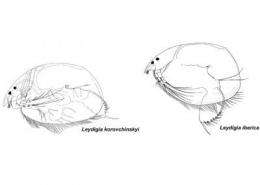
A team of scientists has described two cladocerous crustaceans, which could be endemic to the Iberian Peninsula, and which were found in two lagoons, one in the lower basin of the Guadalquivir river, and the other in the grasslands of Extremadura. Both of these arthropods may today inhabit more areas in the Mediterranean region.
"These two new crustaceans (Leydigia) are a species of living fossil and are very powerful bio-geographic and historical indicators", Miguel Alonso, one of the authors of the study, and a researcher in the Department of Ecology of the University of Barcelona (UB), tells SINC.
The first of the species discovered on the Peninsula, Leydigia iberica, had been previously described with the name Leydigia acanthocercoides. The crustacean was found in the Longuilla lagoon, in the lower basin of the Guadalquivir river.
"Leydigia acanthocercoides had always been cited in the Iberian Peninsular, and it is very probable that many crustaceans that have been identified with this name belong to one of the new species discovered. However, it is possible that Leydigia acanthocercoides does not even exist on the Peninsula", explains Alonso.
The second kind, Leydigia korovchinskyi, was discovered in the Chaparral lagoon, a cattle watering hole on the grasslands of Extremadura. These cladocerous crustaceans are one millimetre long and inhabit bodies of fresh water that frequently dry out.
The research, which has recently been published in the journal Zootaxa, shows that the arthropods are very ancient – from the Permian period (250 million years ago), and have a very slow rate of morphological change. "This is why we think they divided a long time ago", the researcher adds.
The Mediterranean region – a "hotbed"
The two crustaceans seem to be endemic to the Iberian Peninsula. However, the study shows that they may be distributed across a more extensive area the length of the Mediterranean region. All these areas are "a hotbed of endemism for cladocerous crustaceans, as is also the case in Japan and eastern Russia", says Alonso.
In Spain, these endemic species are some of the faunal remnants from before the Pleistocene fauna, more than 1.8 million years ago, due to the "marginal" nature of their habitat during glaciations. The crustaceans did not colonise new territories until after the ice had melted.
More information: Alexey A. Kotov y Miguel Alonso. "Two new species of Leydigia Kurz, 1875 (Chydoridae, Cladocera) from Spain". Zootaxa 2673, Nov 2010. ISSN 1175-5326.
Provided by FECYT - Spanish Foundation for Science and Technology


