Researchers discover arctic blooms occurring earlier
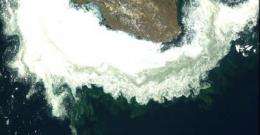
Ice edge blooms often follow retreating ice, as shown here on July 5, 2007, south of Wrangel Island in the eastern Chukchi Sea. Satellite data captured by the NASA MODIS-Aqua sensor, processed by Mati Kahru. Credit: Scripps Institution of Oceanography, UC San Diego
Warming temperatures and melting ice in the Arctic may be behind a progressively earlier bloom of a crucial annual marine event, and the shift could hold consequences for the entire food chain and carbon cycling in the region.
Scientists at Scripps Institution of Oceanography at UC San Diego, along with colleagues in Portugal and Mexico, plotted the yearly spring bloom of phytoplanktontiny plants at the base of the ocean food chainin the Arctic Ocean and found the peak timing of the event has been progressing earlier each year for more than a decade. The researchers analyzed satellite data depicting ocean color and phytoplankton production to determine that the spring bloom has come up to 50 days earlier in some areas in that time span.
The earlier Arctic blooms have roughly occurred in areas where ice concentrations have dwindled and created gaps that make early blooms possible, say the researchers, who publish their findings in the March 9 edition of the journal Global Change Biology.
During the one- to two-week spring bloom, which occurs in warm as well as cold regions, a major influx of new organic carbon enters the marine ecosystem through a massive peak in phytoplankton photosynthesis, which converts carbon dioxide into organic matter as part of the global carbon cycle. Phytoplankton blooms stimulate production of zooplankton, microscopic marine animals, which become a food source for fish.
Mati Kahru, lead author of the study and a research oceanographer in the Integrative Oceanography Division at Scripps, said it's not clear if the consumers of phytoplankton are able to match the earlier blooms and avoid disruptions of their critical life-cycle stages such as egg hatching and larvae development.
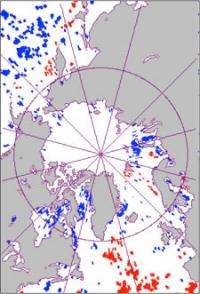
Significant trends toward earlier phytoplankton blooms (blue) were detected in about 11 percent of the area of the Arctic Ocean closest to the North Pole, delayed blooms (red) were evident to the south. Credit: Scripps Institution of Oceanography, UC San Diego
"The spring bloom provides a major source of food for zooplankton, fish and bottom-dwelling animals," he said. "The advancement of the bloom time may have consequences for the Arctic ecosystem."Such a match or mismatch in timing could explain much of the annual variability of fish stocks in the region.
"The trend towards earlier phytoplankton blooms can expand into other areas of the Arctic Ocean and impact the whole food chain," say the authors, who used satellite data from 1997-2010 to create their bloom maps.
Provided by
University of California - San Diego
-
From lemons to lemonade: Reaction uses carbon dioxide to make carbon-based semiconductor,
30 comments
-
Thioridazine kills cancer stem cells in human while avoiding toxic side-effects of conventional cancer treatments,
3 comments
-
SpaceX private rocket blasts off for space station (Update),
42 comments
-
Climate scientists say they have solved riddle of rising sea,
30 comments
-
Research team claims to have found evidence Lake Cheko is impact crater for Tunguska Event,
18 comments
-
More human population = greater mass?
May 25, 2012
-
Conversion from aircraft bearing to normal degrees
May 23, 2012
-
Interpretation/Analysis of the Lab results(HEPA filter)
May 22, 2012
-
Has anyone here attended the The Urbino Summer School in Paleoclimatology?
May 22, 2012
-
Earthquakes: Mag 6 N. Italy and Mag 5.6 W. Bulgaria
May 21, 2012
-
determining time frame for most recent geological layers
May 17, 2012
- More from Physics Forums - Earth
More news stories
SpaceX capsule has 'new car' smell, astronauts say (Update)
SpaceX's Dragon cargo vessel smells like a new car, said astronauts at the International Space Station after opening the hatches Saturday following the spacecraft's landmark mission to the orbiting lab.
Space & Earth / Space Exploration
12 hours ago |
4.6 / 5 (16) |
0
Australia hails surprise super-telescope decision
Australia has hailed a surprise decision giving it a role in a radio telescope project aimed at revolutionising astronomy, vowing to draw on its decades of experience in space science.
12 hours ago |
5 / 5 (2) |
0
Astronomers seize last chance in lifetime for Venus Transit
Astronomers are gearing for one the rarest events in the Solar System: an alignment of Earth, Venus and the Sun that will not be seen for another 105 years.
12 hours ago |
5 / 5 (1) |
0
Astronauts enter world's 1st private supply ship
(AP) -- Space station astronauts floated into the Dragon on Saturday, a day after its heralded arrival as the world's first commercial supply ship.
Space & Earth / Space Exploration
12 hours ago |
5 / 5 (5) |
0
Dragon arrives at space station in historic 1st (Update 2)
The privately bankrolled Dragon capsule made a historic arrival at the International Space Station on Friday, triumphantly captured by astronauts wielding a giant robot arm.
Space & Earth / Space Exploration
May 25, 2012 |
5 / 5 (10) |
19
Dell tablet leak: 10.1-inch display, two-battery choice
(Phys.org) -- Headline after headline talks about vendors tablets in the wings as likely number-one contenders for the iPad. Such claims have justifiably been taken with a grain of salt, considering ...
Scientist: Evolution debate will soon be history
(AP) -- Richard Leakey predicts skepticism over evolution will soon be history. Not that the avowed atheist has any doubts himself.
Keep food safety in mind this memorial day weekend
(HealthDay) -- Picnics, parades and cookouts are as much a part of Memorial Day weekend as tributes to the United States' war veterans.
SpotterRF debuts Radar Backpack Kit (w/ Video)
(Phys.org) -- SpotterRF has announced a special radar backpack kit designed to enhance situational awareness for soldiers on the ground. The company says its special radar is designed for warfighters as part ...
Thousands of shellfish found dead in Peru
Thousands of crustaceans were found dead off the coast of Lima following the mystery mass death of dolphins and pelicans, the Peruvian Navy said Friday.
Family history of Alzheimer's affects functional connectivity
(HealthDay) -- Cognitively normal individuals with a family history of late-onset Alzheimer's disease (AD) may display lower resting state functional connectivity in the default mode network (DMN) of the brain, ...

Mar 02, 2011
Rank: 3.7 / 5 (3)
I don't know about that.
But -you're getting warmer!
It is troubling chiefly because a number of migratory species depend upon the food sources arising from these blooms for their survival, and their migrations have been tuned to the cycle prevalent for the past several thousands of years. If that timing is altered significantly over a short enough timespan, it would wreak havoc among those migratory species, as their depended-upon food source might not be available at the critical time when they are present to consume it.
Mar 02, 2011
Rank: 4 / 5 (4)
Mar 03, 2011
Rank: 2.3 / 5 (7)
Mar 03, 2011
Rank: 5 / 5 (4)
http://nsidc.org/...icenews/
I don't know if that will come through well or not so I will also put it in this way (the site has a problem with URLs).
"nsidc.org/arcticseaicenews/"
Are you one of the folks who believes that the globe is cooling now? If so, you really need to do some reading.
The arctic ice has been declining for decades. Not monotonically, but in a clearly statistically valid way. Read the article I gave you and watch it over the next few months to see if we have records set. So far it is setting records for each month since December. I don't consider that a long trend but I do find it interesting. Please show me your source showing a monotonic decline.
Mar 03, 2011
Rank: 1 / 5 (1)
The NSIDC record is only a 30 year record though, so "an all-time low" may not be very significant. Time will tell.
Mar 04, 2011
Rank: 1 / 5 (3)
I suspect the ice minimums are most telling.
Here are side by side images of polar minimum from September 19, 2007 and 2010:
http:/igloo.atmos.uiuc.edu/cgi-bin/test/print.sh?fm=09&fd=19&fy=2007&sm=09&sd=19&sy=2010
It's quite apparent the sea ice minimum from this past season is substanatially greater. In fact every year since 2007 is obviously greater.
You can enter all sorts of dates. But sadly, winter 2004/2005 data is unavailable.
It is apparent the sea ice is substantially reduced from earlier decades though.
It's also interesting to study the increasing maximum winter snow cap.
And here's a graph of the Antarctic sea ice which indicates it's generally been trending above the mean for the past two years (but it's dipped a little recently):
http:/arctic.atmos.uiuc.edu/cryosphere/IMAGES/seaice.recent.antarctic.png
Anyway, it's too early to say the recent sea ice advances indicate a long term trend, but it is a hopeful sign.
Apr 01, 2011
Rank: 1 / 5 (1)
Apr 01, 2011
Rank: 1 / 5 (3)
"The advancement of the bloom time may have consequences for the Arctic ecosystem."
Do you think?
Apr 02, 2011
Rank: 5 / 5 (2)
It's just another report of a trend where AGW warming is effecting the global ecosystem. Come on ryygesogn2, think of the poor algae having to live longer because arctic winters are shorter and the water is warmer. It's a good thing right?