Ants, termites boost wheat yields
March 30, 2011

Ants, termites boost wheat yields

Enlarge

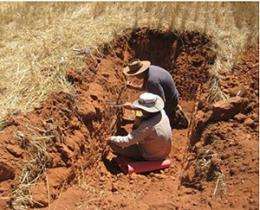
CSIRO scientists counting termite tunnels under one of the plots of the study. Credit: Theo Evans, CSIRO Entomology, Canberra

(PhysOrg.com) -- In an exciting experiment with major implications for food production under climate change, CSIRO and University of Sydney scientists have found allowing ants and termites to flourish increased a wheat crop's yield by more than one third.

The study, carried out on a farm in an arid area 100 km northeast of Geraldton in Western Australia, showed and termites help improve water infiltration and levels. Effectively they play a similar role in dry climates to earthworms in wet climates.

"The areas of the farm where we didn't apply pesticides produced a 36 percent higher yield of wheat than the control area," said Dr. Nathan Lo, from the University of Sydney's School of Biological Sciences, the co-author of a paper published today in Nature Communications.

"There are two main reasons we think this has happened. Firstly, the termites and ants create a lot of tunnels under the soil when they forage away from their nests, and this helps water absorption. This is particularly important in dry areas where rain is very sporadic.

"Secondly, bacteria in termite guts are able to fix significant amounts of nitrogen from the air. Some of this nitrogen is transferred to termite tunnels, helping to improve plant growth."

Dr. Lo said the results were exciting as they promised to reduce the need for increasingly expensive and environmentally harmful petroleum-based products such as herbicides, pesticides and fertilisers.

"The number of arid farming areas, particularly in a country such as Australia, promises to increase as a result of . To find out that ants and can increase in this way is a really exciting result."

Provided by University of Sydney

4.9 /5 (7 votes)  

Filter


Move the slider to adjust rank threshold, so that you can hide some of the comments.


Display comments: newest first

jtdrexel
Mar 30, 2011

Rank: not rated yet
Does this mean that the ants will be swarming the field? If so, how does a farmer harvest his crop in this condition? Will he be needing a suit to keep the ants out? Could someone who knows more about this topic explain?
JRDarby
Mar 30, 2011

Rank: not rated yet
Fascinating results, and ones that show the integration and balance produced over aeons by the creative hand of selection (if you'll pardon the anthropomorphism).

But everyone in my family was a farmer or grew up on a farm two generations back and I've heard them talk several times about how the fire ants in east Texas hurt the crops. I wonder how they meant that.
neiorah
Mar 30, 2011

Rank: not rated yet
Yea they did not mention which kind of ant was there
djr
Mar 30, 2011

Rank: not rated yet
itdrexel - I am just a back yard gardener - but I have ant colonies all over my property - most of them perfectly harmless - they sometimes start biting if you sit right on the nest - but you just get up and move. I am sure that a farmer using heavy equipment would not be bothered by ants in the field. Some varieties of ants are more aggressive (fire ants in southern u.s.) - but I don't think they would attack a moving tractor.

David.
Moebius
Mar 30, 2011

Rank: not rated yet
If they could make the ants carnivorous they wouldn't need pesticides or fertilizer.
Janina
Mar 31, 2011

Rank: not rated yet
I'm curious what exact ant they're talking about, and which precise termite. It makes sense mechanically, for a field of wheat. But in my backyard polyculture in Northern California, US, the argentine ants can wreak havoc. Left unchecked by me they would've eaten all the wild bird's forage, my food, everything. They were even attacking and killing foraging native bees at one point, until I started baiting them and disrupting their nests and aphid and scale farms. Local natural predators couldn't keep up with the ant destruction.

I've also heard of formosa termites destroying wild mushroom habitat.

Perhaps the ants and termites are useful, albeit suboptimal, in a severely disturbed land type monoculture? Kind of like invasive weeds are better than bare dirt?
Rank 4.9 /5 (7 votes)
Relevant PhysicsForums posts

More news stories

SpaceX capsule has 'new car' smell, astronauts say (Update)

SpaceX's Dragon cargo vessel smells like a new car, said astronauts at the International Space Station after opening the hatches Saturday following the spacecraft's landmark mission to the orbiting lab.

Space & Earth / Space Exploration

created 12 hours ago | popularity 4.6 / 5 (16) | comments 0

Australia hails surprise super-telescope decision

Australia has hailed a surprise decision giving it a role in a radio telescope project aimed at revolutionising astronomy, vowing to draw on its decades of experience in space science.

Space & Earth / Astronomy

created 12 hours ago | popularity 5 / 5 (2) | comments 0

Astronomers seize last chance in lifetime for Venus Transit

Astronomers are gearing for one the rarest events in the Solar System: an alignment of Earth, Venus and the Sun that will not be seen for another 105 years.

Space & Earth / Astronomy

created 12 hours ago | popularity 5 / 5 (1) | comments 0

Astronauts enter world's 1st private supply ship

(AP) -- Space station astronauts floated into the Dragon on Saturday, a day after its heralded arrival as the world's first commercial supply ship.

Space & Earth / Space Exploration

created 12 hours ago | popularity 5 / 5 (5) | comments 0

Dragon arrives at space station in historic 1st (Update 2)

The privately bankrolled Dragon capsule made a historic arrival at the International Space Station on Friday, triumphantly captured by astronauts wielding a giant robot arm.

Space & Earth / Space Exploration

created May 25, 2012 | popularity 5 / 5 (10) | comments 19


Dell tablet leak: 10.1-inch display, two-battery choice

(Phys.org) -- Headline after headline talks about vendors’ tablets in the wings as likely number-one contenders for the iPad. Such claims have justifiably been taken with a grain of salt, considering ...

Scientist: Evolution debate will soon be history

(AP) -- Richard Leakey predicts skepticism over evolution will soon be history. Not that the avowed atheist has any doubts himself.

Keep food safety in mind this memorial day weekend

(HealthDay) -- Picnics, parades and cookouts are as much a part of Memorial Day weekend as tributes to the United States' war veterans.

SpotterRF debuts Radar Backpack Kit (w/ Video)

(Phys.org) -- SpotterRF has announced a special radar backpack kit designed to enhance situational awareness for soldiers on the ground. The company says its special radar is designed for warfighters as part ...

Thousands of shellfish found dead in Peru

Thousands of crustaceans were found dead off the coast of Lima following the mystery mass death of dolphins and pelicans, the Peruvian Navy said Friday.

Family history of Alzheimer's affects functional connectivity

(HealthDay) -- Cognitively normal individuals with a family history of late-onset Alzheimer's disease (AD) may display lower resting state functional connectivity in the default mode network (DMN) of the brain, ...