Two new plants discovered in Spain
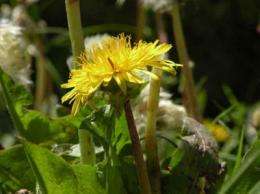
Just when everyone thought that almost every plant species on the Iberian Peninsula had been discovered, Spanish researchers have discovered Taraxacum decastroi and Taraxacum lacianense, two dandelions from the Pyrenees and the Cordillera Cantábrica mountain range, respectively. This finding confirms Spain's privileged position as a hotbed of biodiversity.
"It's hard to find new species now in Spain. It depends on the complexity of the group of plants you study", Antonio Galán de Mera, lead author of the study and a researcher in the Department of Biology (Botany) at the San Pablo-CEU University in Madrid, tells SINC.
According to the study, which has been published in Annales Botanici Fennici, it has been no easy task to identify these two new plants. "We had to compare them with numerous examples from Europe (above all in Spain and Portugal), which were lent to us from the collections of other colleagues", says Galán de Mera.
Taraxacum decastroi and Taraxacum lacianense are plants with long leaves and little pollen, because they reproduce by means of seeds without fertilisation. They also have "fairly characteristic" fruits with little ornamentation, "which differentiates them from other species in the Peninsula", the scientist adds.
T. decastroi, which takes its name from the naturalist Emilio de Castro y Pérez de Castro, is a plant from the Pyrenees fir forests of Lérida, while T. lacianense, first spotted by José Alfredo Vicente Orellana, grows in the birch woods of the Montes de León mountains, specifically in the area of Laciana. Both plants live in moist environments and face certain threats.
"Taraxacum lacianense lives in environments that are very vulnerable to becoming dried out. In addition, the bogland in which it grows is in the birch woods of the Montes de León, which are seriously threatened by open cast coal mining", the biologist explains.
New plants, greater biodiversity
The description of Taraxacum decastroi and Taraxacum lacianense represent two new additions to the floral biodiversity of the Iberian Peninsula, and they go to join more than 50 other species within the Taraxacum genus on the Iberian Peninsula. Both species are related to Taraxacum reophilum of the Alps.
In Spain, "it is impossible to pinpoint" the number of new plants that still remain to be discovered "although genus studies can always throw up surprises", says the researcher, who is currently studying another "probable" new species in the province of Madrid related with a forest group. The team has also found another in Portugal, Segovia and Asturias.
The two new species will be included in the chapter on the Taraxacum genus in the work Flora Ibérica, which has been published by the Spanish National Research Council (CSIC) since 1986. The Botany Department of the San Pablo-CEU University collaborates on this initiative by means of its herbarium, which conserves plants from the Iberian Peninsula and South America.
More information: Galán de Mera, Antonio; Vicente Orellana, José Alfredo. "Taraxacum decastroi and T-lacianense (Asteraceae), two new species from the Iberian Peninsula". Annales Botanici Fennici 47(4): 307-311, 2010.
Provided by FECYT - Spanish Foundation for Science and Technology


