Mysterious noctilucent clouds as seen from space
February 10, 2011 By Nancy Atkinson
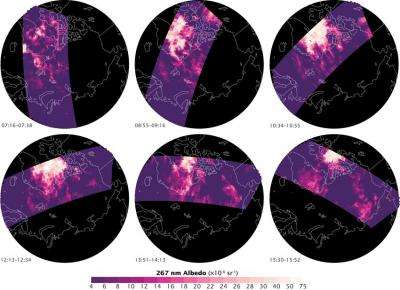
Polar mesospheric clouds (PMCs) observed by the Ozone Monitoring Instrument (OMI) on the Aura satellite. Maps by Robert Simmon. Credit: NAS
Mysterious "night shining" or noctilucent clouds are beautiful to behold, and are usually seen during the summertime, appearing at sunset. They are thin, wavy ice clouds that form at very high altitudes and reflect sunlight long after the Sun has dropped below the horizon. Scientists dont know exactly why they form, but continue to observe them both from Earth and from space. These images were taken by the Ozone Monitoring Instrument (OMI) on NASAs Aura satellite.
Also called polar mesospheric clouds, they are puzzling scientists with their recent dramatic changes. They used to be considered rare, but now the clouds are growing brighter, are seen more frequently, are visible at lower and lower latitudes than ever before, and as these satellite image reveal they are now even appearing during the day.
Noctilucent clouds form in an upper layer of the Earths atmosphere called the mesosphere during the Northern Hemispheres summer at an altitude of 80 km (50 miles). They can start forming as early as May, and extend through August. They can also be seen in high latitudes during the summer months in the Southern Hemisphere.
What could the observed changes mean? Some scientists believe they are a good gauge of even the tiniest changes in the atmosphere, as they are extremely sensitive to changes in atmospheric water vapor and temperature. The clouds form only when temperatures drop below -130 degrees Celsius (-200 Fahrenheit), when the scant amount of water high in the atmosphere freezes into ice clouds.
Scientist Matthew DeLand of Science Systems and Applications Inc. and NASAs Goddard Space Flight Center has been monitoring polar mesospheric clouds with instruments that were actually designed to study ozone, including the OMI, which provides more detailed and frequent observations than previous instruments. This gives DeLand a way to refine his previous measurements of a long-term trend towards more and brighter noctilucent clouds linked to rising greenhouse gases.
These images at the top of this article show OMI measurements of polar mesospheric clouds on July 10, 2007. The clouds, detectable because they are the only things that reflect light in this part of the atmosphere, are shown in white and pink. The Aura satellite travels in a polar orbit, circling from south to north as the Earth turns beneath it. As a result, the satellite gets several opportunities to image the poles every day. This series of images shows the clouds over six consecutive orbits between 7:16 and 15:52 Universal Time. Throughout the day, a wide area of polar mesospheric clouds developed over northern Greenland and Canada, peaking around 10:30 UTC (the third orbit).
Another instrument observing these clouds is the Solar Backscatter Ultraviolet (SBUV) instruments, which have flown on seven different satellites over the past 32 years, and that wealth of data is showing how the clouds change throughout the day.
DeLand now has an index to help correct the SBUV measurement trends to account for the time of day. The correction allows him to develop a more accurate view of the long-term trend. Even with the corrections, the trend indicates that the atmosphere has been responding to increased greenhouse gases over the past 30 years.
The fact that polar mesospheric clouds are getting brighter suggests that the mesosphere is getting colder and more humid, says DeLand. Increasing greenhouse gases in the atmosphere could account for both phenomena.
Provided by Universe Today
-
From lemons to lemonade: Reaction uses carbon dioxide to make carbon-based semiconductor,
30 comments
-
Thioridazine kills cancer stem cells in human while avoiding toxic side-effects of conventional cancer treatments,
3 comments
-
SpaceX private rocket blasts off for space station (Update),
42 comments
-
Climate scientists say they have solved riddle of rising sea,
30 comments
-
Research team claims to have found evidence Lake Cheko is impact crater for Tunguska Event,
18 comments
-
Hypothetical desert earth
44 minutes ago
-
More human population = greater mass?
May 25, 2012
-
Conversion from aircraft bearing to normal degrees
May 23, 2012
-
Interpretation/Analysis of the Lab results(HEPA filter)
May 22, 2012
-
Has anyone here attended the The Urbino Summer School in Paleoclimatology?
May 22, 2012
-
Earthquakes: Mag 6 N. Italy and Mag 5.6 W. Bulgaria
May 21, 2012
- More from Physics Forums - Earth
More news stories
SpaceX capsule has 'new car' smell, astronauts say (Update)
SpaceX's Dragon cargo vessel smells like a new car, said astronauts at the International Space Station after opening the hatches Saturday following the spacecraft's landmark mission to the orbiting lab.
Space & Earth / Space Exploration
14 hours ago |
4.5 / 5 (19) |
0
Australia hails surprise super-telescope decision
Australia has hailed a surprise decision giving it a role in a radio telescope project aimed at revolutionising astronomy, vowing to draw on its decades of experience in space science.
14 hours ago |
5 / 5 (3) |
1
Astronomers seize last chance in lifetime for Venus Transit
Astronomers are gearing for one the rarest events in the Solar System: an alignment of Earth, Venus and the Sun that will not be seen for another 105 years.
14 hours ago |
5 / 5 (1) |
0
Astronauts enter world's 1st private supply ship
(AP) -- Space station astronauts floated into the Dragon on Saturday, a day after its heralded arrival as the world's first commercial supply ship.
Space & Earth / Space Exploration
14 hours ago |
5 / 5 (5) |
0
Dragon arrives at space station in historic 1st (Update 2)
The privately bankrolled Dragon capsule made a historic arrival at the International Space Station on Friday, triumphantly captured by astronauts wielding a giant robot arm.
Space & Earth / Space Exploration
May 25, 2012 |
5 / 5 (10) |
19
Dell tablet leak: 10.1-inch display, two-battery choice
(Phys.org) -- Headline after headline talks about vendors tablets in the wings as likely number-one contenders for the iPad. Such claims have justifiably been taken with a grain of salt, considering ...
Scientist: Evolution debate will soon be history
(AP) -- Richard Leakey predicts skepticism over evolution will soon be history. Not that the avowed atheist has any doubts himself.
SpotterRF debuts Radar Backpack Kit (w/ Video)
(Phys.org) -- SpotterRF has announced a special radar backpack kit designed to enhance situational awareness for soldiers on the ground. The company says its special radar is designed for warfighters as part ...
Thousands of shellfish found dead in Peru
Thousands of crustaceans were found dead off the coast of Lima following the mystery mass death of dolphins and pelicans, the Peruvian Navy said Friday.
Keep food safety in mind this memorial day weekend
(HealthDay) -- Picnics, parades and cookouts are as much a part of Memorial Day weekend as tributes to the United States' war veterans.
Family history of Alzheimer's affects functional connectivity
(HealthDay) -- Cognitively normal individuals with a family history of late-onset Alzheimer's disease (AD) may display lower resting state functional connectivity in the default mode network (DMN) of the brain, ...