5 standout species for extensive green roofs
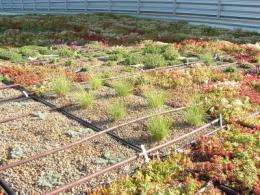
This is a view of a green roof module planted with blue grama grass in the first season of the trials. Credit: Photo by Jennifer Bousselot
Used throughout the world to lessen the environmental impact of urbanization, green roofs can offer a wide range of ecological and aesthetic benefits. A new study from researchers at Colorado State University's Department of Horticulture and Landscape Architecture published in HortScience evaluated six plant species to determine the plants' ability to thrive on extensive green roofs in Colorado. Five plants that survived the 2-year experiment are recommended for use in semiarid regions.
Extensive green roofs are characterized by shallow-depth (typically less than 15 than centimeters deep) growing media. Previous research on species that can survive and thrive on extensive green roofs has shown that succulents outperform most non-succulents. Jennifer Bousselot, who led the Colorado study, noted that other green roof studies conducted elsewhere in the United States evaluated nonsucculents that were "typically native to areas with high annual precipitation and relatively deep soil profiles." The CSU researchers postulated that plants native to the Rocky Mountain region, especially those that inhabit areas with shallow, rocky, well-drained soils, may be better suited for use in extensive green roof systems. According to Bousselot, until this study extensive green roofs have not been scientifically evaluated in the high-elevation, semiarid climate of Colorado.
Though visual assessment and visual ratings have traditionally been used for measuring plant success on green roofs, these methods are usually subjective and not quantitative. To obtain more accurate data, the Colorado State University scientists compared digital image analysis data (DIA)a process that incorporates periodic photographing of plants and digital analysis of the imageswith manually collected converted two-dimensional data (C2D). The team determined that DIA and C2D are both useful for quantifying plant cover. "The DIA analysis appears to be a reliable substitution for the less accurate C2D method. Additionally, DIA can be used to estimate biomass accumulation, specifically for groundcover species."
The researchers examined plant area covered for six species. Plant cover increased for all six during the 2008 growing season, but one species, Kannah Creek Buckwheat, experienced low winter survival and was removed from the study in 2009. Of the remaining five species evaluated, blue grama and hardy ice plant outperformed small-leaf pussytoes, brittle pricklypear, and spearleaf stonecrop. Bousselot noted that because five species survived over the 2 years of this study, these species should be considered for use on extensive green roofs in semiarid regions.
More information: The complete study and abstract are available on the ASHS HortScience electronic journal web site: http://hortsci.ash … ct/45/8/1288
Provided by American Society for Horticultural Science
-
From lemons to lemonade: Reaction uses carbon dioxide to make carbon-based semiconductor,
28 comments
-
Thioridazine kills cancer stem cells in human while avoiding toxic side-effects of conventional cancer treatments,
3 comments
-
SpaceX private rocket blasts off for space station (Update),
41 comments
-
Climate scientists say they have solved riddle of rising sea,
30 comments
-
Scotland passes turbine test to harness tidal power,
41 comments
-
How do I identify different bacteria on culture plates?
8 hours ago
-
Why Do Dogs do Strange things...
May 25, 2012
-
What does exophillic and endophillic mean in terms of mosquito and their control?
May 24, 2012
-
Semen stains glows under black lights (uv light)?
May 23, 2012
-
Question on Human Chromosome 2
May 23, 2012
-
How important is composition of TBST in diluting antibodies and Western Blotting?
May 22, 2012
- More from Physics Forums - Biology
More news stories
Thousands of shellfish found dead in Peru
Thousands of crustaceans were found dead off the coast of Lima following the mystery mass death of dolphins and pelicans, the Peruvian Navy said Friday.
7 hours ago |
4.7 / 5 (3) |
4
It's in the genes: Research pinpoints how plants know when to flower
Scientists believe they've pinpointed the last crucial piece of the 80-year-old puzzle of how plants "know" when to flower.
22 hours ago |
3.9 / 5 (8) |
1
|
Researchers solve structure of human protein critical for silencing genes
In a study published in the journal Cell on May 24, Cold Spring Harbor Laboratory (CSHL) scientists describe the three-dimensional atomic structure of a human protein bound to a piece of RNA that "guides" the pr ...
23 hours ago |
4.7 / 5 (7) |
0
|
More plant species responding to global warming than previously thought
(Phys.org) -- Far more wild plant species may be responding to global warming than previous large-scale estimates have suggested.
May 22, 2012 |
4.6 / 5 (14) |
18
|
Totally rad: Scientists create rewritable digital data storage in DNA
(Phys.org) -- Scientists from Stanford's Department of Bioengineering have devised a method for repeatedly encoding, storing and erasing digital data within the DNA of living cells.
May 21, 2012 |
4.9 / 5 (15) |
11
|
SpotterRF debuts Radar Backpack Kit (w/ Video)
(Phys.org) -- SpotterRF has announced a special radar backpack kit designed to enhance situational awareness for soldiers on the ground. The company says its special radar is designed for warfighters as part ...
Australia hails surprise super-telescope decision
Australia has hailed a surprise decision giving it a role in a radio telescope project aimed at revolutionising astronomy, vowing to draw on its decades of experience in space science.
Astronomers seize last chance in lifetime for Venus Transit
Astronomers are gearing for one the rarest events in the Solar System: an alignment of Earth, Venus and the Sun that will not be seen for another 105 years.
SpaceX capsule has 'new car' smell, astronauts say
SpaceX's Dragon cargo vessel smells like a new car, said astronauts at the International Space Station after opening the hatches Saturday following the spacecraft's landmark mission to the orbiting lab.
Family history of Alzheimer's affects functional connectivity
(HealthDay) -- Cognitively normal individuals with a family history of late-onset Alzheimer's disease (AD) may display lower resting state functional connectivity in the default mode network (DMN) of the brain, ...
Astronauts enter world's 1st private supply ship
(AP) -- Space station astronauts floated into the Dragon on Saturday, a day after its heralded arrival as the world's first commercial supply ship.