Soap films help to solve mathematical problems
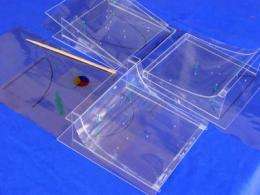
Soap films help to solve mathematical problems. Credit: Criado et al.
Soap bubbles and films have always fascinated children and adults, but they can also serve to solve complex mathematical calculations. This is shown by a study carried out by two professors at the University of Malaga (Spain), who have succeeded in solving classic problems using just such an innovative procedure.
"With the aid of soap films we have solved variational mathematical problems, which appear in the formulation of many physical problems", explains Carlos Criado, professor at the University of Málaga, speaking to SINC. Together with his colleague Nieves Álamo, he has just published his work in the American Journal of Physics.
Soap films always adopt the shape which minimises their elastic energy, and therefore their area, so that they turn out to be ideal in the calculus of variations, "where we look for a function that minimises a certain quantity (depending on the function)", adds the researcher.
"Of course there are other ways to solve variational problems, but it turns out to be surprising, fun and educative to obtain soap films in the shape of brachistochrones, catenaries and semicircles", Criado emphasises.
The professor offers the example of the famous problem of the brachistochrone curve. What shape must a wire be in order that a ball travels down it from one end to the other (at a different height) as rapidly as possible? The answer is the brachistochrone (from the Greek brachistos, the shortest, and cronos, time), the curve of fastest descent.
New methods for old problems
The mathematician Johann Bernoulli found the answer centuries ago when he realised that it was a cycloid (the curve described by a point on a circle rolling along a line). That was the origin of the calculus of variations, which was also used in other classic problems, like that of the catenary (the shape of a chain suspended by its endpoints) and the isoperimetric curve (a curve which maximises the area it encloses).
The study shows that these calculations may be related to Plateau's problem, that is, to find the shape adopted by a soap film under certain boundary restrictions. Besides, the researchers show how to design the experiments, constraining the soap films between two surfaces in such a way as to obtain the appropriate curves.
More information: C. Criado y N. Alamo. "Solving the brachistochrone and other variational problems with soap films". American Journal of Physics 78 (12): 1400-1405, Dec 2010.
Provided by FECYT - Spanish Foundation for Science and Technology
-
From lemons to lemonade: Reaction uses carbon dioxide to make carbon-based semiconductor,
28 comments
-
Thioridazine kills cancer stem cells in human while avoiding toxic side-effects of conventional cancer treatments,
3 comments
-
SpaceX private rocket blasts off for space station (Update),
41 comments
-
Climate scientists say they have solved riddle of rising sea,
30 comments
-
Scotland passes turbine test to harness tidal power,
41 comments
-
Solar Sail Physics - Do they work on a large scale?
1 hour ago
-
How should I switch an air conditioner off?
1 hour ago
-
Question about current decay in R-L circuit
2 hours ago
-
Elementary time - how does it work?
4 hours ago
-
How can squinting be used by both a myopic & hyperopic eye?
7 hours ago
-
The need for practical electronic and mechanical skills for aspiring experimentalists
12 hours ago
- More from Physics Forums - General Physics
More news stories
Landmark calculation clears the way to answering how matter is formed
(Phys.org) -- An international collaboration of scientists, including Thomas Blum, associate professor of physics, is reporting in landmark detail the decay process of a subatomic particle called a kaon ...
May 25, 2012 |
4.6 / 5 (17) |
43
|
Is a classical electrodynamics law incompatible with special relativity?
(Phys.org) -- The laws of classical electromagnetism that were developed in the 19th century are the same laws that scientists use today. They include Maxwell’s four equations along with the Lorentz la ...
Lying in wait for WIMPs: Researchers seek to dramatically increase sensitivity of Large Underground Xenon detector
Although it's invisible, dark matter accounts for at least 80 percent of the matter in the universe. No one knows what it is, but most scientists would bet on weakly interacting massive particles, or WIMPs.
May 23, 2012 |
4.2 / 5 (6) |
15
|
Hall effect at the speed of light: How can you demonstrate relativistic effects with your mobile phone?
The relativistic Hall effect describing objects rotating at speeds comparable with the speed of light has been reported.
May 21, 2012 |
4.3 / 5 (3) |
8
Cloak of invisibility: Engineers use plasmonics to create an invisible photodetector
A team of engineers at Stanford and the University of Pennsylvania has for the first time used "plasmonic cloaking" to create a device that can see without being seen - an invisible machine that detects light. It is the first ...
May 21, 2012 |
4.8 / 5 (16) |
7
|
SpotterRF debuts Radar Backpack Kit (w/ Video)
(Phys.org) -- SpotterRF has announced a special radar backpack kit designed to enhance situational awareness for soldiers on the ground. The company says its special radar is designed for warfighters as part ...
Australia hails surprise super-telescope decision
Australia has hailed a surprise decision giving it a role in a radio telescope project aimed at revolutionising astronomy, vowing to draw on its decades of experience in space science.
Astronomers seize last chance in lifetime for Venus Transit
Astronomers are gearing for one the rarest events in the Solar System: an alignment of Earth, Venus and the Sun that will not be seen for another 105 years.
Thousands of shellfish found dead in Peru
Thousands of crustaceans were found dead off the coast of Lima following the mystery mass death of dolphins and pelicans, the Peruvian Navy said Friday.
SpaceX capsule has 'new car' smell, astronauts say
SpaceX's Dragon cargo vessel smells like a new car, said astronauts at the International Space Station after opening the hatches Saturday following the spacecraft's landmark mission to the orbiting lab.
Family history of Alzheimer's affects functional connectivity
(HealthDay) -- Cognitively normal individuals with a family history of late-onset Alzheimer's disease (AD) may display lower resting state functional connectivity in the default mode network (DMN) of the brain, ...
Jan 27, 2011
Rank: 1 / 5 (2)