First rocky planet discovered: NASA spots tiny Earth-like planet, too hot for life
January 10, 2011 by Kerry Sheridan

The Kepler spacecraft has spotted the smallest-ever planet outside our solar system

Enlarge

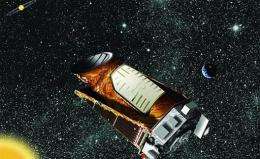
The smallest-ever planet outside our solar system has been spotted by NASA's Kepler spacecraft, seen here in a 2009 artist conception, -- a rocky planet similar in size to the Earth, the US space agency said on Monday.

(PhysOrg.com) -- NASA has spotted a tiny, rocky planet about the size of Earth doing a speedy orbit of a star outside our solar system, but its scorching temperatures are too hot for life, the space agency said Monday.

NASA's Kepler mission confirmed the discovery of its first rocky planet, named Kepler-10b. Measuring 1.4 times the size of Earth, it is the smallest planet ever discovered outside our solar system.

The discovery of this so-called exoplanet is based on more than eight months of data collected by the spacecraft from May 2009 to early January 2010.

This video is not supported by your browser at this time.

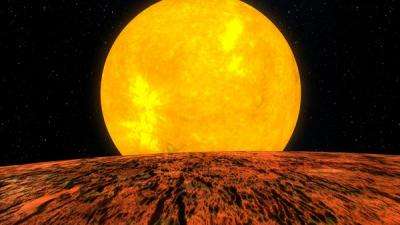
What Is Planet Kepler-10b Like? Kepler-10b as a scorched world, orbiting at a distance that’s more than 20 times closer to its star than Mercury is to our own Sun. The daytime temperature’s expected to be more than 2,500 degrees Fahrenheit, hotter than lava flows here on Earth. Intense radiation from the star has kept the planet from holding onto an atmosphere, but the animation shows flecks of silicates and iron that have boiled off a molten surface and are swept away by the stellar radiation, much like a comet’s tail when its orbit brings it close to the Sun. Many years ago, before Kepler, our team built a robotic telescope at Lick Observatory to learn to do transit photometry. We called it the “Vulcan Telescope,” named after the hypothetical planet that scientists in the 1800’s thought might exist between the Sun and Mercury. A planet that might explain the small deviations in Mercury’s orbit that were later explained with Einstein’s theory of general relativity. Vulcan is the god of fire in Roman mythology, a name befitting of a world so close to the Sun. When I saw the artist’s rendering of Kepler-10b for the first time, the thought that immediately came to my mind was that this is our planet Vulcan. We’d come full circle in our quest and we know that we’ve only begun to imagine the possibilities. Credit: NASA/Kepler Mission/Dana Berry

"All of Kepler's best capabilities have converged to yield the first solid evidence of a rocky planet orbiting a star other than our sun," said Natalie Batalha, Kepler's deputy science team lead at NASA's Ames Research Center in Moffett Field, Calif., and primary author of a paper on the discovery accepted by the Astrophysical Journal. "The Kepler team made a commitment in 2010 about finding the telltale signatures of small planets in the data, and it's beginning to pay off."

Kepler's ultra-precise photometer measures the tiny decrease in a star's brightness that occurs when a planet crosses in front of it. The size of the planet can be derived from these periodic dips in brightness. The distance between the planet and the star is calculated by measuring the time between successive dips as the planet orbits the star.

Kepler is the first NASA mission capable of finding Earth-size planets in or near the habitable zone, the region in a planetary system where liquid water can exist on the planet's surface. However, since it orbits once every 0.84 days, Kepler-10b is more than 20 times closer to its star than Mercury is to our sun and not in the habitable zone.
First rocky planet discovered
Enlarge

Imagined View from Planet Kepler-10b (Artist's Depiction) Credit: NASA/Kepler Mission/Dana Berry

Kepler-10 was the first star identified that could potentially harbor a small transiting planet, placing it at the top of the list for ground-based observations with the W.M. Keck Observatory 10-meter telescope in Hawaii.
Scientists waiting for a signal to confirm Kepler-10b as a planet were not disappointed. Keck was able to measure tiny changes in the star's spectrum, called Doppler shifts, caused by the telltale tug exerted by the orbiting planet on the star.

"The discovery of Kepler 10-b is a significant milestone in the search for planets similar to our own," said Douglas Hudgins, Kepler program scientist at NASA Headquarters in Washington. "Although this planet is not in the habitable zone, the exciting find showcases the kinds of discoveries made possible by the mission and the promise of many more to come," he said.

Knowledge of the planet is only as good as the knowledge of the star it orbits. Because Kepler-10 is one of the brighter stars being targeted by Kepler, scientists were able to detect high frequency variations in the star's brightness generated by stellar oscillations, or starquakes. This analysis allowed scientists to pin down Kepler-10b's properties.

There is a clear signal in the data arising from light waves that travel within the interior of the star. Kepler Asteroseismic Science Consortium scientists use the information to better understand the star, just as earthquakes are used to learn about Earth's interior structure. As a result of this analysis, Kepler-10 is one of the most well characterized planet-hosting stars in the universe.

That's good news for the team studying Kepler-10b. Accurate stellar properties yield accurate planet properties. In the case of Kepler-10b, the picture that emerges is of a rocky planet with a mass 4.6 times that of Earth and with an average density of 8.8 grams per cubic centimeter -- similar to that of an iron dumbbell.

Ames manages Kepler's ground system development, mission operations and science data analysis. NASA's Jet Propulsion Laboratory in Pasadena, Calif., managed Kepler mission development.

Provided by NASA

4.8 /5 (13 votes)  

Filter


Move the slider to adjust rank threshold, so that you can hide some of the comments.


Display comments: newest first

Quantum_Conundrum
Jan 10, 2011

Rank: 4.5 / 5 (4)
Seems to suggest this is the dead remnant core of a much more massive planet which migrated inward and has been destroyed by stellar winds and ejecta.

This thing would be like the pits of hell, BTW.

The incredible density means it has a radius of 9070km, or 1.42 earth radii, and surface gravity 2.281g, which is almost as high as the gravity at the top of Jupiter's clouds.
Paljor
Jan 18, 2011

Rank: not rated yet
Is that your explanation of how mercury formed too? Also remember that the planet is slightly larger than earth.
Rank 4.8 /5 (13 votes)
Relevant PhysicsForums posts
  • revamping general concept and cosmological principle
    createdMay 25, 2012
  • Transiting Exoplanet Light Curve
    createdMay 25, 2012
  • Math behind Theoretical Physics
    createdMay 24, 2012
  • Do we know whats at the center of galaxies yet?
    createdMay 23, 2012
  • Structure of the Milky Way?
    createdMay 20, 2012
  • What would it take to terraform Pluto and Charon?
    createdMay 19, 2012
  • More from Physics Forums - General Astronomy

More news stories

Australia hails surprise super-telescope decision

Australia has hailed a surprise decision giving it a role in a radio telescope project aimed at revolutionising astronomy, vowing to draw on its decades of experience in space science.

Space & Earth / Astronomy

created 8 hours ago | popularity 5 / 5 (2) | comments 0

Astronomers seize last chance in lifetime for Venus Transit

Astronomers are gearing for one the rarest events in the Solar System: an alignment of Earth, Venus and the Sun that will not be seen for another 105 years.

Space & Earth / Astronomy

created 8 hours ago | popularity 5 / 5 (1) | comments 0

SpaceX capsule has 'new car' smell, astronauts say

SpaceX's Dragon cargo vessel smells like a new car, said astronauts at the International Space Station after opening the hatches Saturday following the spacecraft's landmark mission to the orbiting lab.

Space & Earth / Space Exploration

created 8 hours ago | popularity 4.5 / 5 (11) | comments 0

Astronauts enter world's 1st private supply ship

(AP) -- Space station astronauts floated into the Dragon on Saturday, a day after its heralded arrival as the world's first commercial supply ship.

Space & Earth / Space Exploration

created 8 hours ago | popularity 5 / 5 (4) | comments 0

Dragon makes history with space station docking

The private company SpaceX made history Friday with the docking of its Dragon capsule to the International Space Station, the most impressive feat yet in turning routine spaceflight over to the commercial ...

Space & Earth / Space Exploration

created 23 hours ago | popularity 4.9 / 5 (9) | comments 0


SpotterRF debuts Radar Backpack Kit (w/ Video)

(Phys.org) -- SpotterRF has announced a special radar backpack kit designed to enhance situational awareness for soldiers on the ground. The company says its special radar is designed for warfighters as part ...

Thousands of shellfish found dead in Peru

Thousands of crustaceans were found dead off the coast of Lima following the mystery mass death of dolphins and pelicans, the Peruvian Navy said Friday.

Family history of Alzheimer's affects functional connectivity

(HealthDay) -- Cognitively normal individuals with a family history of late-onset Alzheimer's disease (AD) may display lower resting state functional connectivity in the default mode network (DMN) of the brain, ...

Transvaginal mesh op restores pelvic organ prolapse at price

(HealthDay) -- Transvaginal mesh (TVM) procedures are effective for anatomical restoration of pelvic organ prolapse (POP), but patients report a worsening of sexual function following surgery, according to ...

Travel to high altitudes tied to Crohn's, colitis flare-ups

(HealthDay) -- People with inflammatory bowel disease, which includes Crohn's disease and colitis, may be at increased risk for flare-ups when they fly or travel to high altitudes for skiing or mountain climbing, ...

It's in the genes: Research pinpoints how plants know when to flower

Scientists believe they've pinpointed the last crucial piece of the 80-year-old puzzle of how plants "know" when to flower.