Death in the bat caves: Experts call for action against fast-moving disease
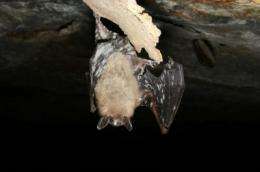
A team of wildlife experts led by UC Davis called today for a national fight against a new fungus that has killed more than one million bats in the eastern United States and is spreading fast throughout North America. The new disease has been named "white-nose syndrome." It affects bats' facial skin and wing membranes. Sick bats appear to be coated with frost. The fungal spots of white-nose syndrome can be seen on this hibernating Myotis bat's nose, as well as on its wing and tail membranes. Credit: Alan Hicks, New York Department of Environmental Conservation
A team of wildlife experts led by UC Davis called today for a national fight against a new fungus that has killed more than 1 million bats in the eastern United States and is spreading fast throughout North America.
"If we lose bats, we lose keystone species in some communities, predators that consume enormous numbers of insects, and beautiful wildlife species that are important parts of North America's biodiversity," said Janet Foley, a UC Davis professor of veterinary medicine at the Center for Vectorborne Diseases.
Foley and her co-authors' call to action appears today online in the Early View section of the journal Conservation Biology.
Bats are essential members of natural ecosystems, hunting insects, pollinating plants and scattering seeds, Foley said. "Bats do the jobs at night that birds do during the day. But because they are most active in darkness, few people are aware of how many bats live around us and how valuable they are."
The new fungal disease has been named "white-nose syndrome." Scientists think the fungus, which normally lives in soil, somehow traveled to cave walls where bats hibernate in winter and began infecting the animals' facial skin and wing membranes.
Sick bats appear to be coated with frost. They fly more than normal, which uses up fat reserves, and also lose water at a faster rate than normal. Disoriented, they move to exposed places, such as cave entrances.
Eventually, they starve, freeze or die of dehydration.
The first infected bats were found by a cave explorer near Albany, N.Y., in February 2006. Since then, infected bats have been found northward to Ontario and Quebec in Canada, south to Tennessee and west to Oklahoma. The authors write that they expect white-nose syndrome to cross the Rocky Mountains and enter California in the next several years.
There are 23 species of bats in California that hibernate in caves, and so are vulnerable to white-nose syndrome.
Foley said the fungus does not appear to be a threat to people or animals other than bats.
The National Wildlife Health Center, a program of the U.S. Geological Survey, identified the white-nose fungus, Geomyces destructans, in 2007.
"In the three years since its discovery, white-nose syndrome has changed the focus of bat conservation in North America," said Foley. "A national response is required, and our epidemiological roadmap is designed to help emerging state and national plans to combat white-nose syndrome across the United States."
Foley and her collaborators developed their recommendations at a workshop in Colorado in August funded by the National Park Service.
The authors' recommendations include: an outbreak investigation network that would establish a standard diagnosis and case definitions; bat population monitoring; and improved public awareness of the problem. "Scientists, policy makers and members of the public will all have a voice in the coming debate over the best course of action," Foley said. They also call for further studies of chemical and biological agents known to kill the fungus but not yet proven safe for bats, as well as study of treatments for similar diseases.
More information: Full text of study, "Investigating and Managing the Rapid Emergence of White Nose Syndrome, a Novel, Fatal Infectious Disease of Hibernating Bats": http://onlinelibra … 39/earlyview
Provided by University of California - Davis
-
From lemons to lemonade: Reaction uses carbon dioxide to make carbon-based semiconductor,
28 comments
-
Thioridazine kills cancer stem cells in human while avoiding toxic side-effects of conventional cancer treatments,
3 comments
-
SpaceX private rocket blasts off for space station (Update),
41 comments
-
Climate scientists say they have solved riddle of rising sea,
30 comments
-
Scotland passes turbine test to harness tidal power,
40 comments
-
How do I identify different bacteria on culture plates?
4 hours ago
-
Why Do Dogs do Strange things...
20 hours ago
-
What does exophillic and endophillic mean in terms of mosquito and their control?
May 24, 2012
-
Semen stains glows under black lights (uv light)?
May 23, 2012
-
Question on Human Chromosome 2
May 23, 2012
-
How important is composition of TBST in diluting antibodies and Western Blotting?
May 22, 2012
- More from Physics Forums - Biology
More news stories
Thousands of shellfish found dead in Peru
Thousands of crustaceans were found dead off the coast of Lima following the mystery mass death of dolphins and pelicans, the Peruvian Navy said Friday.
3 hours ago |
5 / 5 (1) |
0
Researchers solve structure of human protein critical for silencing genes
In a study published in the journal Cell on May 24, Cold Spring Harbor Laboratory (CSHL) scientists describe the three-dimensional atomic structure of a human protein bound to a piece of RNA that "guides" the pr ...
19 hours ago |
4.7 / 5 (7) |
0
|
It's in the genes: Research pinpoints how plants know when to flower
Scientists believe they've pinpointed the last crucial piece of the 80-year-old puzzle of how plants "know" when to flower.
18 hours ago |
3.9 / 5 (8) |
1
|
More plant species responding to global warming than previously thought
(Phys.org) -- Far more wild plant species may be responding to global warming than previous large-scale estimates have suggested.
May 22, 2012 |
4.7 / 5 (13) |
16
|
Totally rad: Scientists create rewritable digital data storage in DNA
(Phys.org) -- Scientists from Stanford's Department of Bioengineering have devised a method for repeatedly encoding, storing and erasing digital data within the DNA of living cells.
May 21, 2012 |
4.9 / 5 (15) |
11
|
SpotterRF debuts Radar Backpack Kit (w/ Video)
(Phys.org) -- SpotterRF has announced a special radar backpack kit designed to enhance situational awareness for soldiers on the ground. The company says its special radar is designed for warfighters as part ...
Family history of Alzheimer's affects functional connectivity
(HealthDay) -- Cognitively normal individuals with a family history of late-onset Alzheimer's disease (AD) may display lower resting state functional connectivity in the default mode network (DMN) of the brain, ...
Transvaginal mesh op restores pelvic organ prolapse at price
(HealthDay) -- Transvaginal mesh (TVM) procedures are effective for anatomical restoration of pelvic organ prolapse (POP), but patients report a worsening of sexual function following surgery, according to ...
Travel to high altitudes tied to Crohn's, colitis flare-ups
(HealthDay) -- People with inflammatory bowel disease, which includes Crohn's disease and colitis, may be at increased risk for flare-ups when they fly or travel to high altitudes for skiing or mountain climbing, ...
Astronomers seize last chance in lifetime for Venus Transit
Astronomers are gearing for one the rarest events in the Solar System: an alignment of Earth, Venus and the Sun that will not be seen for another 105 years.
Australia hails surprise super-telescope decision
Australia has hailed a surprise decision giving it a role in a radio telescope project aimed at revolutionising astronomy, vowing to draw on its decades of experience in space science.
Jan 19, 2011
Rank: 5 / 5 (1)