The little Cepheid that stopped
January 14, 2011 By Jon Voisey, Universe Today
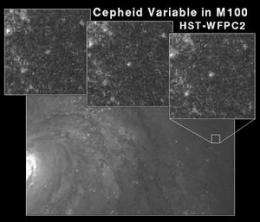
Cepheid Variable Star. Credit: Hubble Space Telescope
When Hubble first discovered a Cepheid variable in the galaxy M31, the universe grew. Previously, many astronomers had held that the fuzzy spiral nebulae were small patches of gas and dust within our own galaxy, but through the Period-Luminosity relationship which allowed him to determine the distance, Hubble demonstrated that these were island universes, or galaxies in their own right.
Soon after, Hubble (as well as other astronomers) began searching other fuzzy patches for Cepheids. Among them was the spiral galaxy M33 in which he discovered 35 Cepheids. Among them was V19 which had a 54.7 day period, an average magnitude of 19.59 ± 0.23 MB, and an amplitude of 1.1 magnitudes. But according to recent work revealed at the recent American Astronomical Society meeting, V19 no longer seems to be pulsating as a Cepheid.
The new research uses observations from the 3.5m Wisconsin, Indiana, Yale, and NOAO (WIYN) Observatory as well as the 1.3m Robotically Controlled Telescope (RCT) operated jointly by a group of universities and research institutions. The new observations confirm a 2001 report that found V19 had decreased its brightness amplitude to at least less than 10% of the magnitude reported by Hubble in 1926, and possibly further as any fluctuations were below the threshold detectable by the instruments.
Now, if any variation exists, it is less than 0.1 magnitudes. The new study reports that there may be some small fluctuations, but due to inherent uncertainty in the observations, it barely exceeds the background noise and the announcers did not commit to these findings. Instead, they pledged to continue observations with larger instruments to the equation to push down the instrumental error as well as adding spectroscopic measurements to investigate other changes in the star. Another of the peculiar changes V19 has undergone is an increase of about half of a magnitude to 19.08 ± 0.05.
These changes are strikingly similar to another, more famous star: Polaris. Due to its much closer nature, observations have been much more frequent and with lower detection thresholds. This star had previously been reported to have an amplitude of 0.1 magnitudes which, according to a 2004 study, had decreased to 0.03 magnitudes. Additionally, based on ancient records, astronomers have estimated that Polaris has also brightened about a full magnitude in the past 2,000 years.
According to Edward Guinan of Villanova University and one of the members of the new observational team, both stars are experiencing unexpectedly fast and large changes in their pulsation properties and brightness that are not yet explained by theory.
The primary explanation for this dramatic change is simple evolution: As the stars have aged, they have moved out of the instability strip, a region on the HR diagram in which stars are prone to pulsations. But these stars may not be entirely lost from the family of periodic variables. In 2008, a study led by Hans Bruntt of the University of Sidney suggested that Polaris amplitude may be increasing. The team found that from 2003 to 2006, the scale of the oscillations had increased by 30%.
This has led other astronomers to suspect that there may be an additional effect in play in Cepheids known as the Blazhko Effect. This effect, often seen in RR Lyrae stars (another type of periodic variables), is a periodic variation of the variation. While no firm explanation exists for this effect, astronomers have suggested that it may be due to multiple pulsational modes that interfere constructively and destructively and occasionally forming resonances.
Ultimately, these strange changes in brightness are unexplained and will require astronomers to have to carefully monitor these stars, as well as other Cepheids to search for causes.
Provided by Universe Today
-
From lemons to lemonade: Reaction uses carbon dioxide to make carbon-based semiconductor,
28 comments
-
Thioridazine kills cancer stem cells in human while avoiding toxic side-effects of conventional cancer treatments,
3 comments
-
SpaceX private rocket blasts off for space station (Update),
41 comments
-
Climate scientists say they have solved riddle of rising sea,
30 comments
-
Scotland passes turbine test to harness tidal power,
40 comments
-
revamping general concept and cosmological principle
May 25, 2012
-
Transiting Exoplanet Light Curve
May 25, 2012
-
Math behind Theoretical Physics
May 24, 2012
-
Do we know whats at the center of galaxies yet?
May 23, 2012
-
Structure of the Milky Way?
May 20, 2012
-
What would it take to terraform Pluto and Charon?
May 19, 2012
- More from Physics Forums - General Astronomy
More news stories
Australia hails surprise super-telescope decision
Australia has hailed a surprise decision giving it a role in a radio telescope project aimed at revolutionising astronomy, vowing to draw on its decades of experience in space science.
5 hours ago |
5 / 5 (1) |
0
Astronomers seize last chance in lifetime for Venus Transit
Astronomers are gearing for one the rarest events in the Solar System: an alignment of Earth, Venus and the Sun that will not be seen for another 105 years.
5 hours ago |
5 / 5 (1) |
0
SpaceX capsule has 'new car' smell, astronauts say
SpaceX's Dragon cargo vessel smells like a new car, said astronauts at the International Space Station after opening the hatches Saturday following the spacecraft's landmark mission to the orbiting lab.
Space & Earth / Space Exploration
5 hours ago |
4.5 / 5 (4) |
0
Astronauts enter world's 1st private supply ship
(AP) -- Space station astronauts floated into the Dragon on Saturday, a day after its heralded arrival as the world's first commercial supply ship.
Space & Earth / Space Exploration
5 hours ago |
5 / 5 (3) |
0
Dragon makes history with space station docking
The private company SpaceX made history Friday with the docking of its Dragon capsule to the International Space Station, the most impressive feat yet in turning routine spaceflight over to the commercial ...
Space & Earth / Space Exploration
20 hours ago |
4.9 / 5 (8) |
0
SpotterRF debuts Radar Backpack Kit (w/ Video)
(Phys.org) -- SpotterRF has announced a special radar backpack kit designed to enhance situational awareness for soldiers on the ground. The company says its special radar is designed for warfighters as part ...
Family history of Alzheimer's affects functional connectivity
(HealthDay) -- Cognitively normal individuals with a family history of late-onset Alzheimer's disease (AD) may display lower resting state functional connectivity in the default mode network (DMN) of the brain, ...
Thousands of shellfish found dead in Peru
Thousands of crustaceans were found dead off the coast of Lima following the mystery mass death of dolphins and pelicans, the Peruvian Navy said Friday.
Transvaginal mesh op restores pelvic organ prolapse at price
(HealthDay) -- Transvaginal mesh (TVM) procedures are effective for anatomical restoration of pelvic organ prolapse (POP), but patients report a worsening of sexual function following surgery, according to ...
Travel to high altitudes tied to Crohn's, colitis flare-ups
(HealthDay) -- People with inflammatory bowel disease, which includes Crohn's disease and colitis, may be at increased risk for flare-ups when they fly or travel to high altitudes for skiing or mountain climbing, ...
High-speed method to aid search for solar energy storage catalysts
Eons ago, nature solved the problem of converting solar energy to fuels by inventing the process of photosynthesis.
Jan 14, 2011
Rank: not rated yet
Jan 15, 2011
Rank: 1 / 5 (2)
Jan 15, 2011
Rank: not rated yet
IIRC, it was spotted by studying a 'runaway' Cepheid that was ploughing through a gas cloud...