New species abound in Peru, but so do threats
December 28, 2010 by Roberto Cortijo
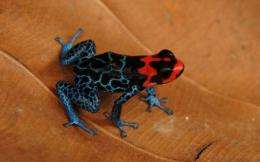
A "Ranitomeya amazonica", a frog with an incredible burst of flames on its head, and contrasting water-patterned legs - one of the species announced by WWF in a new report. Each year, a new bird is found and every four years a new mammal discovered in the Peruvian Amazon, a haven for biodiversity where conservation and danger often go hand in hand.
Each year, a new bird is found and every four years a new mammal discovered in the Peruvian Amazon, a haven for biodiversity where conservation and danger often go hand in hand.
Although Peru is known for its Andes mountain range, the Amazon actually covers 60 percent of the country's territory. It is a hotbed of bio-activity and is home to 25,000 species of plants -- 10 percent of the world's stock.
Thanks to the Amazon, Peru has the world's second-largest bird population (1,800 species) and is among the top five countries for mammals (515 species) and reptiles (418 species).
This year alone, scientists stumbled upon a previously unknown leech and a new type of mosquito.
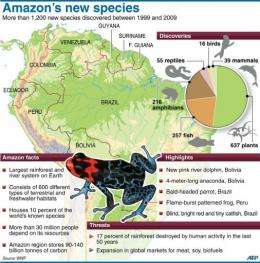
Graphic on a WWF study reporting the discovery of new species in the Amazon region over the past decade.
The animal population has grown in recent years, namely adding a mini poison dart frog with a fire-red head and blue legs (Ranitomeya amazonica), a purple-throated Sunangel hummingbird (Heliangelus viola) and a "tyrannosaurus leech" with eight teeth (Tyrannobdella reina).More than 1,200 new species of plants or animals have been discovered in 10 years in the Amazon, according to the Worldwide Fund for Nature. But paradoxically, the novel species are often discovered during the very activities that threaten the Amazon the most.
"Most of these discoveries don't happen during scientific expeditions, which are often costly. They most often come when workers are digging exploration sites for oil, mining or lumber companies," said WWF Peru's Amazon program director Michael Valqui.
"This type of discovery is also simultaneously endangering the species that is being discovered in its one and only habitat."
Peru, home to one of the biggest forest lands -- 700,000 square kilometers (270,270 square miles) -- is also a magnet for resource extraction.
The number of concessions granted has doubled since 2006 to cover 16 percent of the territory, according to the Observatory of Mining Conflicts in Latin America.
At the same time, Peru boasts of being on the cutting edge of conservation, with 15 percent of its territory under protected status.
"And we're aiming for 30 percent," said Environment Minister Antonio Brack.
Environmentalists, though, worry about the future of biodiversity and the species living outside these protected zones.
"There are no clear signals as to what the country intends to do to protect biodiversity," said Ivan Lanegra, representative of the influential government-funded Peruvian ombudsman office.
Gerard Herail of France's IRD research and development institute in Lima noted that "a mining or hydrocarbons firm is not innately destructive. The key is whether or not it is 'clean'," or uses cleaner methods and technologies.
More species are disappearing than are being discovered around the world, noted Ernesto Raez, who heads the Sustainable Development Center at Cayetano Heredia University in Lima.
"In other words, species are disappearing before we discover them," he added.
But the IRD says the very context of their disappearance allows the group to "develop biodiversity conservation strategies," such as those deployed successfully for the huge arapaima or paiche fish (Arapaima gigas), one of the largest freshwater fish in the world.
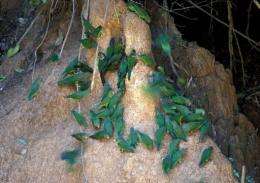
Parrots in Peru's Amazon Jungle. Although Peru is known for its Andes mountain range, the Amazon actually covers 60 percent of the country's territory. It is a hotbed of bio-activity and is home to 25,000 species of plants -- 10 percent of the world's stock.
Twenty-one species remain in "critical danger" of extinction in Peru, according to 2004 numbers, including the short-tailed chinchilla (Chinchilla brevicaudata) and the sharp-eared bat (Tompoeas ravus). The leaf-eared mouse (phyllotis andinum) is believed to have already disappeared.The Lima gecko (Phyllodactylus sentosus), a minuscule nocturnal lizard also in critical danger, illustrates the sometimes complex relationship between threat and conservation.
The gecko finds its habitat in the darkest corners of the huacas, pre-Hispanic burial grounds or ritual sites that dot Lima and the coast.
"But archeologists' maintenance work, crucial for conservation, is exactly what's destroying the gecko's habitat" and triggering its downfall, said Valqui.
(c) 2010 AFP
-
From lemons to lemonade: Reaction uses carbon dioxide to make carbon-based semiconductor,
28 comments
-
Thioridazine kills cancer stem cells in human while avoiding toxic side-effects of conventional cancer treatments,
3 comments
-
SpaceX private rocket blasts off for space station (Update),
41 comments
-
Climate scientists say they have solved riddle of rising sea,
30 comments
-
Scotland passes turbine test to harness tidal power,
40 comments
-
How do I identify different bacteria on culture plates?
1 hour ago
-
Why Do Dogs do Strange things...
17 hours ago
-
What does exophillic and endophillic mean in terms of mosquito and their control?
May 24, 2012
-
Semen stains glows under black lights (uv light)?
May 23, 2012
-
Question on Human Chromosome 2
May 23, 2012
-
How important is composition of TBST in diluting antibodies and Western Blotting?
May 22, 2012
- More from Physics Forums - Biology
More news stories
Thousands of shellfish found dead in Peru
Thousands of crustaceans were found dead off the coast of Lima following the mystery mass death of dolphins and pelicans, the Peruvian Navy said Friday.
47 minutes ago |
not rated yet |
0
Researchers solve structure of human protein critical for silencing genes
In a study published in the journal Cell on May 24, Cold Spring Harbor Laboratory (CSHL) scientists describe the three-dimensional atomic structure of a human protein bound to a piece of RNA that "guides" the pr ...
16 hours ago |
4.7 / 5 (7) |
0
|
It's in the genes: Research pinpoints how plants know when to flower
Scientists believe they've pinpointed the last crucial piece of the 80-year-old puzzle of how plants "know" when to flower.
15 hours ago |
4.2 / 5 (6) |
1
|
Copy of the genetic makeup travels in a protein suitcase
Scientists from the Institute for Physical and Theoretical Chemistry at the University of Bonn have succeeded for the first time in the real time filming of the transport of an important information carrier in biological ...
21 hours ago |
not rated yet |
0
|
'Transformer' protein makes different sized transport pods
These spheres may look almost identical, but subtle differences between them revealed a molecular version of the robots from Transformers. Each sphere is a vesicle, a pod that cells use to transport materials ...
22 hours ago |
not rated yet |
0
SpotterRF debuts Radar Backpack Kit (w/ Video)
(Phys.org) -- SpotterRF has announced a special radar backpack kit designed to enhance situational awareness for soldiers on the ground. The company says its special radar is designed for warfighters as part ...
Astronauts enter world's 1st private supply ship
(AP) -- Space station astronauts floated into the Dragon on Saturday, a day after its heralded arrival as the world's first commercial supply ship.
Australia hails surprise super-telescope decision
Australia has hailed a surprise decision giving it a role in a radio telescope project aimed at revolutionising astronomy, vowing to draw on its decades of experience in space science.
SpaceX capsule has 'new car' smell, astronauts say
SpaceX's Dragon cargo vessel smells like a new car, said astronauts at the International Space Station after opening the hatches Saturday following the spacecraft's landmark mission to the orbiting lab.
Astronomers seize last chance in lifetime for Venus Transit
Astronomers are gearing for one the rarest events in the Solar System: an alignment of Earth, Venus and the Sun that will not be seen for another 105 years.
Travel to high altitudes tied to Crohn's, colitis flare-ups
(HealthDay) -- People with inflammatory bowel disease, which includes Crohn's disease and colitis, may be at increased risk for flare-ups when they fly or travel to high altitudes for skiing or mountain climbing, ...

Dec 28, 2010
Rank: 3.8 / 5 (4)
Dec 28, 2010
Rank: 1 / 5 (2)
Translation: We need more of your tax money.
Dec 28, 2010
Rank: 1 / 5 (1)
Diversity makes life worth living.
Dec 28, 2010
Rank: 1 / 5 (2)
creative dreamer who experiences his awareness through
these creatures. There should be new humans coming forth who have far reaching abilities.
Dec 28, 2010
Rank: not rated yet
Dec 28, 2010
Rank: 1 / 5 (1)
Dec 29, 2010
Rank: 5 / 5 (1)
If only it had!