Northern wildfires threaten runaway climate change, study reveals
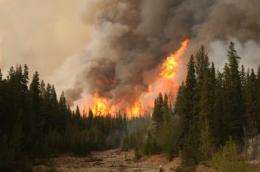
This is an image of wildfires in the Alaskan Interior. A new study reveals that climate change is causing these fires to burn more fiercely over the last decade which has resulted in an increase in greenhouse gases being pumped into the atmosphere. Credit: David Wright, US Forest Service
Climate change is causing wildfires to burn more fiercely, pumping more greenhouse gases into the atmosphere than previously thought, according to a new study to be published in Nature Geoscience this week.
This is the first study to reveal that fires in the Alaskan interior - an area spanning 18.5 million hectares - have become more severe in the past 10 years, and have released much more carbon into the atmosphere than was stored by the region's forests over the same period.
"When most people think of wildfires, they think about trees burning, but most of what fuels a boreal fire is plant litter, moss and organic matter in surface soils," said University of Guelph professor Merritt Turetsky, lead author of the study.
"These findings are worrisome because about half the world's soil carbon is locked in northern permafrost and peatland soils. This is carbon that has accumulated in ecosystems a little bit at a time for thousands of years, but is being released very rapidly through increased burning."
The results of this study are important for countries currently meeting in Mexico for climate talks, added the integrative biology professor.
"Essentially this could represent a runaway climate change scenario in which warming is leading to larger and more intense fires, releasing more greenhouse gases and resulting in more warming. This cycle can be broken for a number of reasons, but likely not without dramatic changes to the boreal forest as we currently know it."
This study is part of a growing body of evidence that northern systems are bearing the brunt of climate change, said co-author Jennifer Harden, a U.S. Geological Survey scientist.
"This includes longer snow-free seasons, changes in vegetation, loss of ice and permafrost, and now fire, which is shifting these systems from a global carbon sink toward a carbon source."
The researchers visited almost 200 forest and peatland sites shortly after blazes were extinguished to measure how much biomass burnt.
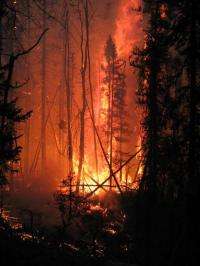
This is an image of wildfires in the Alaskan Interior. A new study reveals that climate change is causing these fires to burn more fiercely over the last decade which has resulted in an increase in greenhouse gases being pumped into the atmosphere. Credit: Roger Ottmar, US Forest Service
"We've been chasing fires in this region for a number of years, which is how we amassed this unique data set," said Turetsky.
They also looked at fire records kept since the 1950s.
"Over the past 10 years, burned area has doubled in interior Alaska, mostly because of increased burning late in the fire season," said co-author Eric Kasischke, a University of Maryland professor. "This is the first study that has demonstrated that increases in burned area are clearly linked to increases in fire severity. This not only impacts carbon storage, but also will accelerate permafrost loss and changes in forest cover."
More severe burning also raises a number of health concerns, as fire emissions contain mercury and particulate matter that can cause respiratory issues, said Turetsky.
"We are hoping people will recognize the seriousness of climate change for northern regions and people living in them. Wildfire is going to play a more and more important role in shaping the north."
Provided by University of Guelph
-
From lemons to lemonade: Reaction uses carbon dioxide to make carbon-based semiconductor,
28 comments
-
Thioridazine kills cancer stem cells in human while avoiding toxic side-effects of conventional cancer treatments,
3 comments
-
SpaceX private rocket blasts off for space station (Update),
41 comments
-
Climate scientists say they have solved riddle of rising sea,
30 comments
-
Scotland passes turbine test to harness tidal power,
40 comments
-
More human population = greater mass?
22 hours ago
-
Conversion from aircraft bearing to normal degrees
May 23, 2012
-
Interpretation/Analysis of the Lab results(HEPA filter)
May 22, 2012
-
Has anyone here attended the The Urbino Summer School in Paleoclimatology?
May 22, 2012
-
Earthquakes: Mag 6 N. Italy and Mag 5.6 W. Bulgaria
May 21, 2012
-
determining time frame for most recent geological layers
May 17, 2012
- More from Physics Forums - Earth
More news stories
Astronomers seize last chance in lifetime for Venus Transit
Astronomers are gearing for one the rarest events in the Solar System: an alignment of Earth, Venus and the Sun that will not be seen for another 105 years.
1 hour ago |
5 / 5 (1) |
0
Australia hails surprise super-telescope decision
Australia has hailed a surprise decision giving it a role in a radio telescope project aimed at revolutionising astronomy, vowing to draw on its decades of experience in space science.
1 hour ago |
not rated yet |
0
SpaceX capsule has 'new car' smell, astronauts say
SpaceX's Dragon cargo vessel smells like a new car, said astronauts at the International Space Station after opening the hatches Saturday following the spacecraft's landmark mission to the orbiting lab.
Space & Earth / Space Exploration
1 hour ago |
not rated yet |
0
Astronauts enter world's 1st private supply ship
(AP) -- Space station astronauts floated into the Dragon on Saturday, a day after its heralded arrival as the world's first commercial supply ship.
Space & Earth / Space Exploration
1 hour ago |
5 / 5 (2) |
0
Dragon arrives at space station in historic 1st (Update 2)
The privately bankrolled Dragon capsule made a historic arrival at the International Space Station on Friday, triumphantly captured by astronauts wielding a giant robot arm.
Space & Earth / Space Exploration
23 hours ago |
5 / 5 (8) |
16
Transvaginal mesh op restores pelvic organ prolapse at price
(HealthDay) -- Transvaginal mesh (TVM) procedures are effective for anatomical restoration of pelvic organ prolapse (POP), but patients report a worsening of sexual function following surgery, according to ...
Family history of Alzheimer's affects functional connectivity
(HealthDay) -- Cognitively normal individuals with a family history of late-onset Alzheimer's disease (AD) may display lower resting state functional connectivity in the default mode network (DMN) of the brain, ...
SpotterRF debuts Radar Backpack Kit (w/ Video)
(Phys.org) -- SpotterRF has announced a special radar backpack kit designed to enhance situational awareness for soldiers on the ground. The company says its special radar is designed for warfighters as part ...
Travel to high altitudes tied to Crohn's, colitis flare-ups
(HealthDay) -- People with inflammatory bowel disease, which includes Crohn's disease and colitis, may be at increased risk for flare-ups when they fly or travel to high altitudes for skiing or mountain climbing, ...
Thousands of shellfish found dead in Peru
Thousands of crustaceans were found dead off the coast of Lima following the mystery mass death of dolphins and pelicans, the Peruvian Navy said Friday.
Oldest Jewish archaeological evidence on the Iberian Peninsula
German archaeologists of the Friedrich Schiller University Jena found one of the oldest archaeological evidence so far of Jewish Culture on the Iberian Peninsula at an excavation site in the south of Portugal, ...

Dec 05, 2010
Rank: 3 / 5 (10)
Dec 06, 2010
Rank: 3.7 / 5 (3)
Charcoal is a stable solid rich in carbon content, and thus, can be used to lock carbon in the soil. Let the tree fall over and die on it's own releases carbon too and a forest without fires is carbon neutral. Carbon only gets sequestered in tree matter when trees peat, etc are growing(increasing their mass by adding mostly carbon from the air). If you want less carbon over the long term you need to either bury the tree or burn to a carbon dense charcoal or ash so a new tree can grow in it's place.
or maybe I've misunderstood the carbon cycle? any thoughts?
Dec 06, 2010
Rank: 5 / 5 (1)
Could someone please explain how climate change causes fires to burn "more fiercely"? I know that in the lower 48, forest fires are more intense now than in the past due to long periods of fire suppression allowing underbrush and other plant litter to accumulate and fuel hotter fires. Has this also happened in Alaska? I don't understand how climate change in and of itself would cause fires to be more intense. (This is a serious question, not a denial of change.)
Dec 06, 2010
Rank: not rated yet
Yes, you have it exactly right. Without fires, the amount of carbon stored long term would be much less. Most non-fire biomass decays quickly, creating greenhouse gasses and raising the acidity of ground water which leaches into lakes and rivers. The fires stop that decay process and store the carbon long term as char. Unfortunately, the average natural fire only consumes between 20 and 30 percent of the avialable biomass. The average time span between natural fires without human intervention is between 40 and 150 years, depending on local conditions. Many plants and animals depend on the fires for survival, and many species would go extinct without them. The giant redwoods and the animals that depend on them are a good example of that. The 10 to 20 years following a fire are the time when a forest will consume the most carbon. From the time a forest reaches maturity to the next fire is the time it consumes the least carbon. It's not a sink when in equilibrium.
Dec 06, 2010
Rank: 3.4 / 5 (5)
Dec 06, 2010
Rank: 4 / 5 (4)
The reason they postulate for more CO2 and fiercer fires is: "Over the past 10 years, burned area has doubled in interior Alaska, mostly because of increased burning late in the fire season,"
What they seem to be saying is that more area is burning and, since it is later in the season (as the data shows winter coming on later) the ground is drier than usual. Those two issues mean that the fire will be hotter (burning deeper) and the area will be larger (affecting more carbon stores). I have been involved in large fires in California and the bigger they are the more "fierce" and dangerous they become. Very large fires produce their own local weather patterns with large updrafts to bring oxygen to the base of the fires. Those fires are much hotter than small fires.
Dec 06, 2010
Rank: not rated yet
I personally thought modern's post was funny, and thermo's post was an accurate summary of the above article.
The part of the article that thermo repeated is probably correct, and seems logical, however the rest of the article is dead backwards in regard to forest fires and long term carbon sequestration. I love it when these guys mix credible science with pure science fiction. The average person wouldn't have a clue.
Dec 06, 2010
Rank: 1.8 / 5 (5)
You stated that very large fires are hotter than small fires.
Are you confusing the amount of heat generated with the temperature of combustion?
Some peer reviewed studies to back up that sweeping statement would be in order.
Dec 06, 2010
Rank: 5 / 5 (4)
There is a theoretical flame temperature called the adiabatic flame temperature in which combustion is assumed to take place without loss of energy during the time the flame is completely burning the fuel:
http://en.wikiped...perature
In computing the adiabatic flame temperature the amount of heat generated is assumed to go completely to raising the temperature of the combustion products and the rate of combustion is considered to be almost instantaneous.
Continued
Dec 06, 2010
Rank: 5 / 5 (4)
There is another feature of burning in air which has to do with the increase in NOx production with temperature.
http://en.wikiped...wiki/NOx
Fires involving biomass or coal have both thermal NOx and fuel NOx. However, as you can see from the article I quoted above, the amount of NOx is dependent on the temperature of the combustion products. One of the most prevalent tools for NOx control is called "Staged combustion" in which oxygen is introduced in stages to slow the combustion of the fuel. That means that the temperature of the flame (combustion products) can be controlled by the rate at which the oxygen is introduced to the fuel (this can become very complex when you start considering "diffusion limitations).
Continued
Dec 06, 2010
Rank: 5 / 5 (4)
http://www.samiac...ners.htm
Now, let me try to tie this back to forest fires (or tundra fires). When there is a small fire the updraft is not as strong as when there is a large fire. In fact, there are "fire storms"
http://en.wikiped...irestorm
The resulting inrush of air (oxygen) works like a bellows to more quickly ignite and sustain ignition of the fuel. The bottom line is an increase in the temperature. This can be expected for any large scale fire and is something that is feared by firefighters when forest fires start.
Let me know if this is not clear enough. I hope you can see that I am not confusing heat with the temperature of combustion and the temperature of combustion can vary widely depending on the available oxygen.
Dec 07, 2010
Rank: 5 / 5 (1)
Dec 07, 2010
Rank: 5 / 5 (1)
Dec 07, 2010
Rank: 5 / 5 (1)