Researchers discover how feathers get their shine, inspire ideas for creating gloss
Dec 01, 2010
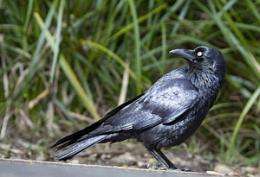
Integrated Bioscience Ph.D. student Rafael Maia is leading research on raven feathers that could benefit production of glossy materials. Photo by Robert Montgomerie, Queen's University.

University of Akron Integrated Bioscience Ph.D. student Rafael Maia, along with postdoctoral researcher Liliana D'Alba and assistant professor Matthew Shawkey, have learned that black birds really are of a different feather.

In research supported by the U.S. Air Force Office of Scientific Research, the UA team discovered that the shine of some black feathers, like those of ravens, comes from a unique arrangement of nanometer-scale parts. The finding provides possibilities for new ways to produce glossy surfaces.

Typical iridescent feathers have a single thin layer of keratin atop a linearly organized layer of melanosomes (cell subunits that contain the light-absorbing pigment melanin), while matte black feathers have a thick keratin layer and disorganized melanosomes.

Newly published research

The researchers discovered that shiny black feathers have a single thin keratin layer, but only loosely organized melanosomes, putting them somewhere in between matte and iridescent. This structure may represent an evolutionarily intermediate step between matte and iridescent colors, notes the journal , in its Dec. 1, 2010, release of this research.
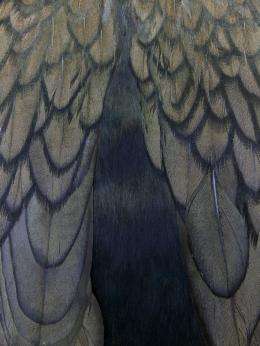
Shiny black feathers have a distinctive nanostructural basis than other fully iridescent feathers like one sees in starling or pigeon neck feathers,” Maia says.

Maia explains that the colors in iridescent result from the interference of light as it moves between extremely thin layers of material on the feather surface. “Think of the rainbow-like hues created by oil and water,” Maia describes.

New manufacturing possibilities

The glossy black feather, however, incorporates a thin film that is not formed fully enough to create color, but enough to create a distinct shiny, or glossy, appearance. This “half-baked film,” as Shawkey describes it, also is significant because it may provide inspiration for new ways to produces glossy materials. Gloss is typically achieved by increasing the smoothness of a surface, for example by polishing it.

However, Shawkey notes, “These structures appear to generate gloss whether the surface is smooth or rough, showing that production of smooth, but matte, or rough, but glossy, materials is possible.”

Explore further: Bittersweet: Bait-averse cockroaches shudder at sugar

More information: Paper online: rspb.royalsocietypublishing.org/content/early/2010/11/30/rspb.2010.1637.abstract

Provided by University of Akron

5 /5 (1 vote)
add to favorites email to friend print save as pdf

Related Stories

The color of dinosaur feathers identified

Jan 27, 2010

(PhysOrg.com) -- The colour of some feathers on dinosaurs and early birds has been identified for the first time, reports a paper published in Nature this week.

Recommended for you

Bittersweet: Bait-averse cockroaches shudder at sugar

4 hours ago

Sugar isn't always sweet to German cockroaches, especially to the ones that avoid roach baits. In a study published May 24 in the journal Science, North Carolina State University entomologists show the ne ...

White tiger mystery solved

6 hours ago

White tigers today are only seen in zoos, but they belong in nature, say researchers reporting new evidence about what makes those tigers white. Their spectacular white coats are produced by a single change ...

Scientists announce Top 10 New Species from 2012

14 hours ago

An amazing glow-in-the-dark cockroach, a harp-shaped carnivorous sponge and the smallest vertebrate on Earth are just three of the newly discovered top 10 species selected by the International Institute for ...

User comments : 0

More news stories

Scientists discover how rapamycin slows cell growth

University of Montreal researchers have discovered a novel molecular mechanism that can potentially slow the progression of some cancers and other diseases of abnormal growth. In the May 23 edition of the prestigious journal ...

Controlling mood through the motions of mitochondria

(Medical Xpress)—Regulating the distribution of power in neurons is done by a system that makes the national electric grid look simple by comparison. Each neuron has several thousand mitochondria confined ...

Google Drive sports new view and scan enhancements

(Phys.org) —Google Drive has a new look and functions. The makeover in Google Drive features scanning and interface enhancements that put the user into "card" mode. The enhancements make it easy for the ...

Future doctors unaware of their obesity bias

Two out of five medical students have an unconscious bias against obese people, according to a new study by researchers at Wake Forest Baptist Medical Center. The study is published online ahead of print in the Journal of ...

WHO: Scientific red tape mars efforts vs. virus

International efforts to combat a new pneumonia-like virus that has now killed 22 people are being slowed by unclear rules and competition for the potentially profitable rights to disease samples, the head ...