Elephant bird probably wiped out by nest raiders and habitat loss
December 21, 2010 by Lin Edwards report

Elephant bird probably wiped out by nest raiders and habitat loss

Enlarge

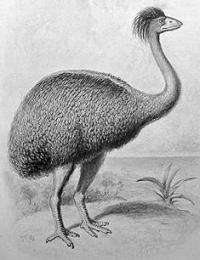
Restoration of Aepyornis maximus. Image credit: Wikipedia.

(PhysOrg.com) -- Sir David Attenborough has returned to the island of Madagascar to discover the fate of the elephant bird, the largest bird ever to live on Earth, and to make a BBC documentary about it: "Attenborough and the Giant Egg."

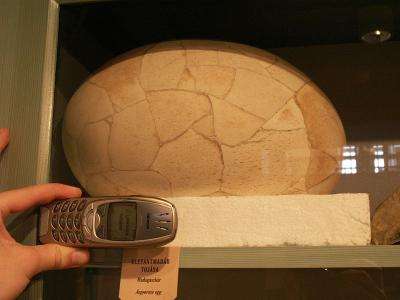
Fifty years ago Sir David collected a giant fossilized egg over 25 cm long and has kept it in his cellar ever since. The bird that laid the egg was around three meters tall, weighed over 450 kg and roamed the island until perhaps as late as a few centuries ago. It is not known what caused the of the , but theories include the effects of climate change, human hunting, and the diseases that came with the domesticated fowls that accompanied the humans.

Madagascar is an island of the east coast of Africa, which Sir David first visited in 1960 to film an episode of Zoo Quest, a popular TV series. After finding fragments of a fossilized shell, he offered the locals a reward if they could find him more pieces, and a little boy presented him with a complete set of fragments Attenborough later had professionally stuck together.

Humans are believed to have arrived in Madagascar about 2,000 years ago, but the elephant bird and humans coexisted for many centuries. Sailors visiting in the 17th century returned to Europe with reports of seeing the giant birds, and with samples of the eggs. It is thought that the birds were fully extinct by the early 18th century.
Elephant bird probably wiped out by nest raiders and habitat loss
Enlarge

Elephant Bird Egg, Hungarian Natural History Museum.

Researchers now believe that most of elephant bird populations had disappeared by about 1,000 years ago and only those in remote parts of the island survived. Dr. Tom Higham of the research laboratory for archaeology at Oxford University said they had dated “quite a few” elephant bird eggs and the youngest they had found was dated at about 900 AD, a time at which the human population was expanding. Sir David had his own fossil egg dated and found it was about 1,300 years old, much older than he had thought.

Sir David says there is now compelling evidence the human inhabitants of the island stole the eggs for food, even though they revered the birds themselves, and the nest raiding plus destruction of the native forest habitats led gradually to their extinction.

Evidence for the theory comes from recent archaeological findings of shells of elephant bird eggs among the remains of ancient camp fires, which suggest the eggs were used for food. At around 150 times the volume of a hen’s egg, one egg would easily feed a number of families.

It is unlikely that the giant bird, which was much bigger than today’s ostrich, was hunted to extinction, according to Sir David, who thinks stealing the eggs and loss of habitat were much more likely cause of their demise.

In the new documentary Sir David examines the latest evidence and returns to some of the sites he visited 50 years ago, the first time he has deliberately returned to a place he had previously visited. He said 50 years ago the forest in the area was extensive, and now all that is left is an abandoned saw mill. The human on the island has tripled, and all the previously wild places are being replaced with villages and rice fields. The changes leave many other species, including the rare Lemur, now critically endangered.

© 2010 PhysOrg.com

4.2 /5 (9 votes)  

Filter


Move the slider to adjust rank threshold, so that you can hide some of the comments.


Display comments: newest first

braindead
Dec 22, 2010

Rank: 5 / 5 (1)
It's a sad reflection that those pristine places that Sir David introduced me to on "Zoo Quest" as a young lad in the '50s are now so damaged. It will make a chilling series if visits more of those places allowing us to see the effect of man in just 50 years or less. Where are those 1970's gorillas and their forest now? Could Sir David return to sit, ever so quietly, with them again? I might be wrong but the update will not be easy watching I suspect.
Rank 4.2 /5 (9 votes)
Relevant PhysicsForums posts

More news stories

It's in the genes: Research pinpoints how plants know when to flower

Scientists believe they've pinpointed the last crucial piece of the 80-year-old puzzle of how plants "know" when to flower.

Biology / Biotechnology

created 10 hours ago | popularity 4 / 5 (5) | comments 1 | with audio podcast

Researchers solve structure of human protein critical for silencing genes

In a study published in the journal Cell on May 24, Cold Spring Harbor Laboratory (CSHL) scientists describe the three-dimensional atomic structure of a human protein bound to a piece of RNA that "guides" the pr ...

Biology / Cell & Microbiology

created 10 hours ago | popularity 5 / 5 (5) | comments 0 | with audio podcast

Study uncovers secret to speedy burrowing by razor clams

(Phys.org) -- If you look at a razor burrowing clam sitting in a bucket, you’d never guess that it could burrow itself down into the soil, much less do it with any speed. Razor clams look like fat straws, ...

Biology / Plants & Animals

created 19 hours ago | popularity not rated yet | comments 3 | with audio podcast report

Copy of the genetic makeup travels in a protein suitcase

Scientists from the Institute for Physical and Theoretical Chemistry at the University of Bonn have succeeded for the first time in the real time filming of the transport of an important information carrier in biological ...

Biology / Cell & Microbiology

created 16 hours ago | popularity not rated yet | comments 0 | with audio podcast

'Transformer' protein makes different sized transport pods

These spheres may look almost identical, but subtle differences between them revealed a molecular version of the robots from Transformers. Each sphere is a vesicle, a pod that cells use to transport materials ...

Biology / Cell & Microbiology

created 16 hours ago | popularity not rated yet | comments 0


Of mice and mental models: Neuroscientific implications of risk-optimized behavior in the mouse

(Medical Xpress) -- Regardless of an organism’s biological complexity, every encephalized animal continuously makes under-informed behavioral choices that can have serious consequences. Despite its ubiquity, ...

Dragon arrives at space station in historic 1st (Update 2)

The privately bankrolled Dragon capsule made a historic arrival at the International Space Station on Friday, triumphantly captured by astronauts wielding a giant robot arm.

Landmark calculation clears the way to answering how matter is formed

(Phys.org) -- An international collaboration of scientists, including Thomas Blum, associate professor of physics, is reporting in landmark detail the decay process of a subatomic particle called a kaon – ...

High-speed method to aid search for solar energy storage catalysts

Eons ago, nature solved the problem of converting solar energy to fuels by inventing the process of photosynthesis.

MIT researchers devise new means to synchronize a group of robots (w/ Video)

(Phys.org) -- For several years, roboticists have been working out ways to get a group of robots to perform synchronized activities as demonstrated most often in dance routines. It’s not just about trying ...

Researchers demonstrate possible primitive mechanism of chemical info self-replication

(Phys.org) -- When scientists think about the replication of information in chemistry, they usually have in mind something akin to what happens in living organisms when DNA gets copied: a double-stranded molecule ...