Light dawns on dark gamma-ray bursts (w/ Video)
December 16, 2010

Light dawns on dark gamma-ray bursts

Enlarge

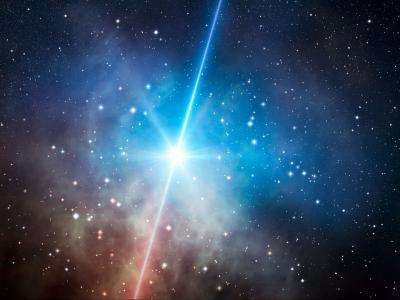
This artist’s impression shows a dark gamma-ray burst in a star forming region. Gamma-ray bursts are among the most energetic events in the Universe, but some appear curiously faint in visible light. The biggest study of these dark gamma-ray bursts to date, using the GROND instrument on the 2.2-metre MPG/ESO telescope at La Silla in Chile, has found that these gigantic explosions, while puzzling, don't require exotic explanations. Their faintness is now fully explained by a combination of causes with the most important being the presence of dust between the Earth and the explosion. Credit: ESO

(PhysOrg.com) -- Gamma-ray bursts are among the most energetic events in the Universe, but some appear curiously faint in visible light. The biggest study to date of these so-called dark gamma-ray bursts, using the GROND instrument on the 2.2-metre MPG/ESO telescope at La Silla in Chile, has found that these gigantic explosions don’t require exotic explanations. Their faintness is now fully explained by a combination of causes, the most important of which is the presence of dust between the Earth and the explosion.

Gamma-ray bursts (GRBs), fleeting events that last from less than a second to several minutes, are detected by orbiting observatories that can pick up their high energy radiation. Thirteen years ago, however, discovered a longer-lasting stream of less energetic radiation coming from these violent outbursts, which can last for weeks or even years after the initial explosion. Astronomers call this the burst's afterglow.

While all gamma-ray bursts have afterglows that give off X-rays, only about half of them were found to give off visible light, with the rest remaining mysteriously dark. Some astronomers suspected that these dark afterglows could be examples of a whole new class of gamma-ray bursts, while others thought that they might all be at very great distances. Previous studies had suggested that obscuring dust between the burst and us might also explain why they were so dim.

This video is not supported by your browser at this time.

This video podcast explains the ESO Very Large Telescope’s Rapid Response Mode, which makes it possible to observe gamma-ray bursts only a few minutes after they are first spotted. Credit: ESO

"Studying afterglows is vital to further our understanding of the objects that become gamma-ray bursts and what they tell us about star formation in the early ," says the study's lead author Jochen Greiner from the Max-Planck Institute for Extraterrestrial Physics in Garching bei München, Germany.

NASA launched the Swift satellite at the end of 2004. From its orbit above the Earth's atmosphere it can detect gamma-ray bursts and immediately relay their positions to other observatories so that the afterglows could be studied. In the new study, astronomers combined Swift data with new observations made using GROND — a dedicated follow-up observation instrument, which is attached to the 2.2-metre MPG/ESO telescope at La Silla in Chile. In doing so, astronomers have conclusively solved the puzzle of the missing optical afterglow.

What makes GROND exciting for the study of afterglows is its very fast response time — it can observe a burst within minutes of an alert coming from Swift using a special system called the Rapid Response Mode — and its ability to observe simultaneously through seven filters covering both the visible and near-infrared parts of the spectrum.

By combining GROND data taken through these seven filters with Swift observations, astronomers were able to accurately determine the amount of light emitted by the afterglow at widely differing wavelengths, all the way from high energy X-rays to the near-infrared. The astronomers used this information to directly measure the amount of obscuring dust that the light passed through en route to Earth. Previously, astronomers had to rely on rough estimates of the dust content.

The team used a range of data, including their own measurements from GROND, in addition to observations made by other large telescopes including the ESO Very Large Telescope, to estimate the distances to nearly all of the bursts in their sample. While they found that a significant proportion of bursts are dimmed to about 60󈞼 percent of the original intensity by obscuring dust, this effect is exaggerated for the very distant bursts, letting the observer see only 30󈞞 percent of the light. The astronomers conclude that most dark gamma-ray bursts are therefore simply those that have had their small amount of completely stripped away before it reaches us.

"Compared to many instruments on large telescopes, GROND is a low cost and relatively simple instrument, yet it has been able to conclusively resolve the mystery surrounding dark gamma-ray bursts," says Greiner.

Provided by ESO search and more info website

4.4 /5 (10 votes)  

Filter


Move the slider to adjust rank threshold, so that you can hide some of the comments.


Display comments: newest first

Francisco_Alvarado
Dec 16, 2010

Rank: not rated yet
Very intersting, the using of satellites and automated telescopes ;D
Rank 4.4 /5 (10 votes)
Relevant PhysicsForums posts
  • revamping general concept and cosmological principle
    created14 hours ago
  • Transiting Exoplanet Light Curve
    created23 hours ago
  • Math behind Theoretical Physics
    createdMay 24, 2012
  • Do we know whats at the center of galaxies yet?
    createdMay 23, 2012
  • Structure of the Milky Way?
    createdMay 20, 2012
  • What would it take to terraform Pluto and Charon?
    createdMay 19, 2012
  • More from Physics Forums - General Astronomy

More news stories

Dragon arrives at space station in historic 1st (Update 2)

The privately bankrolled Dragon capsule made a historic arrival at the International Space Station on Friday, triumphantly captured by astronauts wielding a giant robot arm.

Space & Earth / Space Exploration

created 16 hours ago | popularity 5 / 5 (8) | comments 11

Dragon makes history with space station docking

The private company SpaceX made history Friday with the docking of its Dragon capsule to the International Space Station, the most impressive feat yet in turning routine spaceflight over to the commercial ...

Space & Earth / Space Exploration

created 9 hours ago | popularity 4.8 / 5 (6) | comments 0

Aliens don't want to eat us, says former SETI director

Alien life probably isn’t interested in having us for dinner, enslaving us or laying eggs in our bellies, according to a recent statement by former SETI director Jill Tarter.

Space & Earth / Space Exploration

created 18 hours ago | popularity 4.8 / 5 (10) | comments 24

SKA super telescope to be built in Australia, South Africa (Update 2)

A long-running joust to host a radio telescope that would give mankind its farthest peek into the Universe ended on Friday with a Solomon-like judgement to split the site between Australia and South Africa.

Space & Earth / Astronomy

created 18 hours ago | popularity 5 / 5 (5) | comments 2

NASA sees Hurricane Bud threaten western Mexico's coast

NASA satellites are providing rainfall, temperature, pressure, visible and infrared data to forecasters as Hurricane Bud is expected to make a quick landfall in western Mexico this weekend before turning back ...

Space & Earth / Earth Sciences

created 12 hours ago | popularity not rated yet | comments 0


Of mice and mental models: Neuroscientific implications of risk-optimized behavior in the mouse

(Medical Xpress) -- Regardless of an organism’s biological complexity, every encephalized animal continuously makes under-informed behavioral choices that can have serious consequences. Despite its ubiquity, ...

Landmark calculation clears the way to answering how matter is formed

(Phys.org) -- An international collaboration of scientists, including Thomas Blum, associate professor of physics, is reporting in landmark detail the decay process of a subatomic particle called a kaon – ...

High-speed method to aid search for solar energy storage catalysts

Eons ago, nature solved the problem of converting solar energy to fuels by inventing the process of photosynthesis.

It's in the genes: Research pinpoints how plants know when to flower

Scientists believe they've pinpointed the last crucial piece of the 80-year-old puzzle of how plants "know" when to flower.

Researchers solve structure of human protein critical for silencing genes

In a study published in the journal Cell on May 24, Cold Spring Harbor Laboratory (CSHL) scientists describe the three-dimensional atomic structure of a human protein bound to a piece of RNA that "guides" the pr ...

MIT researchers devise new means to synchronize a group of robots (w/ Video)

(Phys.org) -- For several years, roboticists have been working out ways to get a group of robots to perform synchronized activities as demonstrated most often in dance routines. It’s not just about trying ...