Searching for the perfect Christmas tree
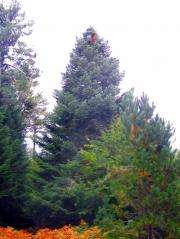
At the Allen Hill Farm 50 miles east of Hartford, Conn., co-owner Charles Langevin sells hundreds of trees during the holiday season. The Fraser fir is one of the most popular species on the market and is widely considered to be the perfect Christmas tree.
But a mold hidden in the soil that is wreaking havoc on Frasers has Langevin looking for other options. Working with scientists at the Connecticut Agricultural Experiment Station in Windsor, he has set aside a small plot of land to test out other species that he hopes will be both pretty enough to please consumers and tough enough to survive difficult growing conditions.
"This isn't a short-term project," said Langevin, also president of the Connecticut Christmas Tree Growers Association. "It might take a lifetime."
The Connecticut project one of many collaborations across the nation between tree growers and university research departments in some of the nation's top Christmas tree-producing states.
One such project, The Collaborative Fir Germplasm Evaluation Project, has brought together researchers from Connecticut, Oregon, Michigan, North Carolina and Denmark -- many of whom are traveling the world in search of the perfect Christmas tree of the future.
It's a search that recently took Chal Landgren of Oregon State University to the mountains of Northwest Turkey, where he and his colleagues hired a tree climber to scramble up the branches of Turkish and Trojan firs more than 60 feet tall. They collected cones and samples -- tagged with the GPS coordinates of the 100 trees they came from -- which will be used to plant 30,000 test trees across the United States and Denmark.
"The trees we were interested in were hard to climb because they had lots and lot of branches," said Landgren. "Lots of branches means good density for a Christmas tree grower."
What makes a perfect Christmas tree? It starts with consumer demand.
"The market has changed," said Langevin. "Consumers have grown more sophisticated in their tastes."
Species like the white spruce, common in the 1960s, have fallen out of fashion. The now-popular Fraser fir owes a lot of its success to its rich fragrance, thick branches and soft needles that hold on tight long after the tree has been chopped down.
"People are buying trees shortly after Thanksgiving now, and they expect them to last until Christmas," said Langevin.
Preliminary experiments with Turkish firs suggested that they also posses these aesthetic qualities. Earlier this year, Landgren tested five experimental plots containing Turkish trees grown from seeds shipped overseas. They showed nice color, height and shape, as well as plenty of branches for hanging ornaments, and inspired his trip to Turkey.
But being a perfect Christmas tree isn't just about looks; toughness is important, too. That's because growers across the country are struggling with a variety of pests and problems that will prevent many of the 41 million seedlings planted this year from ever reaching the market.
In Connecticut and other regions with wet soil, one of the biggest issues is phytophthora. This soil-borne water mold spreads outwards from forests and thrives in wet earth. It can damage and kill the roots of Fraser firs, which can take 6-10 years to reach maturity.
"It's heartbreaking because you know how much effort it takes to grow a Christmas tree," said Richard Cowles, a researcher at the Connecticut Agricultural Experiment Station who is working with Langevin.
The fungus-like pathogen also builds up in the ground, increasing with each new generation of tree.
"If phytophthora is there when you plant the first generation of trees, you'll start to get some tree mortality by the time the second crop is grown up," said Sharon Douglas, a phytophthora expert at the Connecticut Agricultural Experiment Station. "Even if a suitable host isn't available, it can sit in the soil for many years."
High enough levels of the mold can make it virtually impossible to replant Fraser firs.
That's why geneticist John Frampton of North Carolina State University in Raleigh traveled to Turkey along with Landgren. He is interested in the genetic make-up of Turkish firs, which are popular in Europe. Frampton's developing a rootstock from these trees that could potentially be grafted onto cuttings from Fraser firs. In the long-term, he's also working with scientists in the Czech Republic to interbreed different species to produce new lines of trees with the characteristics growers are looking for.
In the meanwhile, at the Allen Hill Farm and the Jones Family Farm, where Connecticut scientists have planted some new species -- including Turkish firs -- the first year of growth looks promising.
At one site with wet soil, about 32 percent of Frasier firs died within the first year. But across both farms and in the laboratories of the Connecticut Agricultural Research Experiment, the 180 Turkish firs planted fared better.
"We didn't lose a single one," said Cowles.
Provided by Inside Science News Service


